
Dragons of Asia
Beneath the Visible World
Dragons across ancient Asia were never imagined as simple creatures exaggerated into myth but as primordial forces moving beneath the skin of the world itself. They drifted through rivers swollen with monsoon water, beneath oceans blackened by storm clouds, through volcanic mountains breathing smoke into the sky and within cave systems descending into depths untouched by sunlight. Their forms changed across centuries of folklore, appearing sometimes as antlered serpents armoured in scales and trailing whiskers like drowned spirits, sometimes as immense water beings coiled beneath submerged kingdoms hidden far below the earth. Yet beneath every variation remained the same unsettling presence, ancient entities suspended between divinity and catastrophe, feared not because they were evil but because they belonged to powers far older than humanity itself. Across China and South East Asia, dragons were woven into temples, royal bloodlines, sacred mountains and funeral rites as though they existed not outside reality but just beneath it, waiting within the dark spaces where the visible world gave way to something deeper and unknowable.

The Politics of Rain
Chinese dragons carried the scale of empires within them, not as decorative myth but as living forces believed to move through the architecture of weather itself, rising through thunderclouds, slipping beneath river systems and coiling invisibly across the heavens where rain was formed and released. Classical poetry and folklore describe them as beings whose movement shaped the turning of seasons, where the stirring of a dragon’s presence meant the arrival of storms or the return of water to parched land. During droughts, entire communities gathered inside Dragon King temples, filling the air with incense and written petitions that treated rainfall as something governed rather than random, as though it could be negotiated through ritual with powers believed to rule water from hidden courts beneath sea and sky. Imperial authority did not stand outside this system but operated within it, sanctioning state ceremonies that appealed to Heaven and its dragon intermediaries in moments of agricultural crisis, when the failure of monsoons threatened famine, displacement, and collapse. Over time, the dragon became inseparable from political survival itself, a conceptual force through which order, legitimacy, and environmental balance were imagined as one continuous structure, capable of sustaining entire dynasties or allowing them to unravel when the fragile rhythm between earth and sky broke.

Serpents of the Mekong
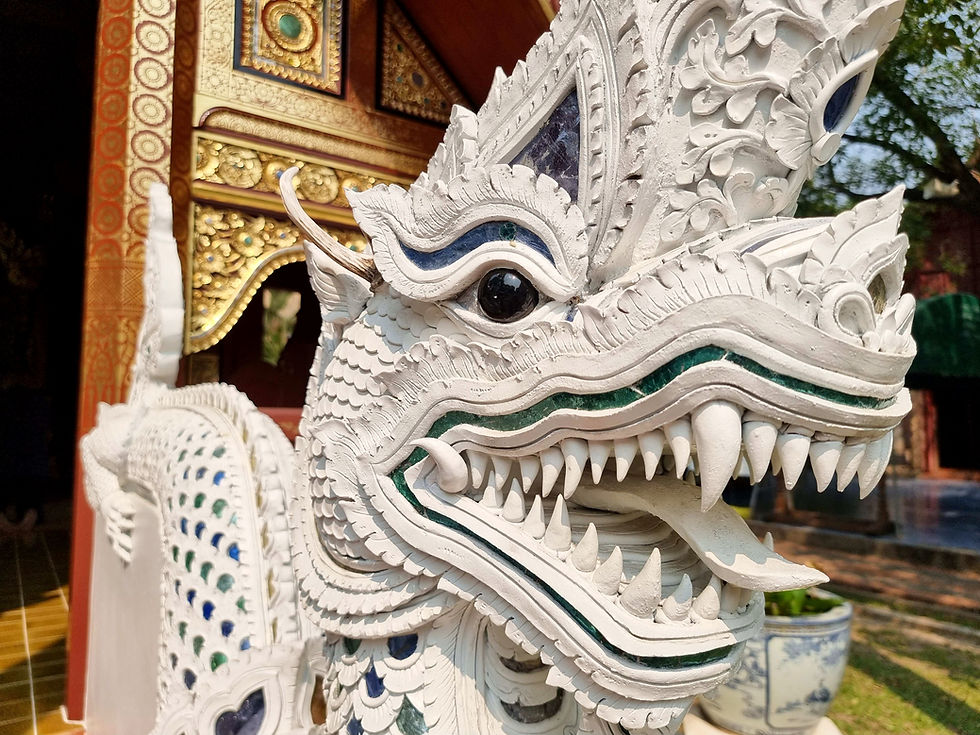
Farther south, the great serpent deepens into something older and more elemental through the Nagas of Thailand and Vietnam, where myth feels less like storytelling and more like a memory embedded in the landscape itself. Across temple staircases, immense serpent bodies coil upward in carved stone, their fanged mouths poised at thresholds where jungle air thick with incense and rain seems to gather and linger, as though the boundary between stone and life is never entirely settled. These beings are not treated as distant mythic figures but as presences tied to the unseen geography beneath the surface, dwelling in rivers that move like living corridors, in flooded caves that open into darkness, and in subterranean spaces where the earth is believed to hollow into hidden domains. Along the Mekong, the river itself becomes the axis of this belief, where accounts of silent, glowing orbs rising from the water during certain lunar nights are spoken of as the Naga Fireballs, phenomena that sit between observation and reverence. Within this world, the river is never only water but a moving threshold inhabited by vast serpentine forces that surface briefly before dissolving again into depth, leaving only ripples and uncertainty behind.
The Dragon Origins of Vietnam
Vietnam carries the dragon not as a distant myth but as a national emblem of origin, authority, and continuity, where the creature is bound to the idea of Lạc Long Quân, the dragon lord said to have emerged from water and coiled himself into the foundations of the Vietnamese people. In this tradition, dragons are not external beings but ancestral presence made visible, tied to rivers, deltas and the shaping force of the land itself as it is formed between flood and fertility. The Red River system becomes the implicit stage for this mythology, where water is never neutral but the carrier of lineage, survival and state formation. Even the name of the Vietnamese people is often traced through this symbolic descent from dragon and fairy, a pairing that frames identity as something born from both terrestrial and aquatic worlds. A distant Khmer parallel appears in the broader regional serpent traditions of the Neak in CAmbodia, yet in Vietnam the emphasis shifts away from temple guardianship toward origin, ancestry and political legitimacy rooted in the image of the dragon as founding force rather than threshold sentinel.
Volcanic Balance in Bali
Balinese serpent traditions carry a distinctly volcanic intensity, shaped by an island where earth, fire and spirit are never fully separate. At the centre of many of these beliefs stands Basuki, a great naga associated with cosmic balance and the unseen foundations that hold the world in place. Within Balinese cosmology, reality is understood as a fragile equilibrium between opposing forces, constantly shifting yet never allowed to collapse and serpent beings occupy the deepest layers of that structure, where stability is negotiated beneath the visible world. Across temples and village shrines, carved Nagas coil around stairways, arch across gateways and emerge from stone with mouths open in silent vigilance, marking the passage between ordinary space and sacred threshold. These forms are not ornamental decoration added for beauty but inherited fragments of a spiritual system in which the landscape itself is alive with layered presence, where mountains are sacred centres of power, forests are inhabited by unseen forces and the ground beneath human movement is never truly still.

Rivers of Fear and Survival
Water binds these traditions together with an almost elemental consistency, as though the serpent itself emerges wherever life depends upon uncertainty. Across rivers, springs, oceans, monsoon skies, and flooded caverns, serpent beings appear again and again as embodiments of water’s dual nature, capable of giving life while also erasing it without warning. In agrarian worlds shaped by seasonal extremes, entire harvests could vanish beneath rising floodwaters, while long droughts could hollow out villages slowly, leaving behind landscapes that felt abandoned by anything human or divine. Within such conditions, it became almost inevitable to imagine presence beneath the surface, something moving through currents that refused to behave with predictability or restraint. Even in the present day, traces of these older cosmologies remain woven into ritual life across parts of Southeast Asia, where Buddhist practice, Hindu symbolism, and earlier animist traditions overlap, allowing fragments of serpent mythology to persist not as isolated belief, but as atmosphere embedded within ceremony, place and memory.

Why Dragons Were Never Just Myth
What makes these dragons so enduring is that they rarely resemble the adversarial monsters of European legend, shaped for confrontation and defeat. Instead, they are woven directly into the structure of the world itself, present within the unseen mechanisms of nature rather than positioned against humanity. They are imagined moving through storm systems, flowing beneath rivers, inhabiting the hollow interiors of mountains and lingering beneath temple foundations darkened by centuries of incense and ritual smoke. In Chinese tradition, this presence becomes especially vivid in accounts of dragons rising through layered thunderclouds or coiling across the sky before the arrival of rain, where weather itself appears as the trace of something living just beyond sight. Across Asia, these beings offered a way to understand a natural world that did not feel inert or mechanical, but charged with intention, volatility and depth. Even now, standing before a serpent staircase at Angkor or before the carved dragon reliefs of the Forbidden City, where imperial power once aligned itself with celestial order, it is easy to see how the boundary between nature and presence could blur into something ancient, active and still quietly moving beneath perception.

Thanks for reading about the Dragons of Asia. Check out more awesome legends here!


