
Kinnari Mythology
The Architecture of Cosmic Order
Across Southeast Asia’s layered Hindu-Buddhist cosmology, the Kinnara are not decorative mythology but a structured class of celestial beings. Originating in ancient Indian traditions and later absorbed into regional belief systems that spread into Java, Bali, mainland Thailand, Cambodia and Laos, they are consistently placed within the Himavanta forest, a mythic, liminal domain said to exist at the threshold of Mount Meru, the cosmic axis. In this framework, the Kinnara are not gods, nor mere spirits but functional intermediaries within a carefully tiered universe. Their purpose is maintenance rather than intervention. They uphold balance through presence, movement and sound, ensuring that the distance between human realms and divine order does not collapse.

Winged Cosmology
Within this class, the Kinnari, the female form, becomes the most visually and ritually prominent expression. She is consistently depicted as half woman, half bird, though the exact morphology varies across regions and eras. In Javanese and Balinese temple reliefs, she appears with a human upper body and avian lower body, often framed within vegetal or celestial motifs that place her firmly in non human space. Her function is not ornamental. She is associated with music, dance and atmospheric refinement, acting as a vessel through which cosmic harmony is made perceptible. In these traditions, music is not entertainment but ontological alignment, an audible structure that stabilises the relationship between realms. The Kinnari’s presence signals that this alignment is intact.

Beings That Exist at the Edge of Worlds
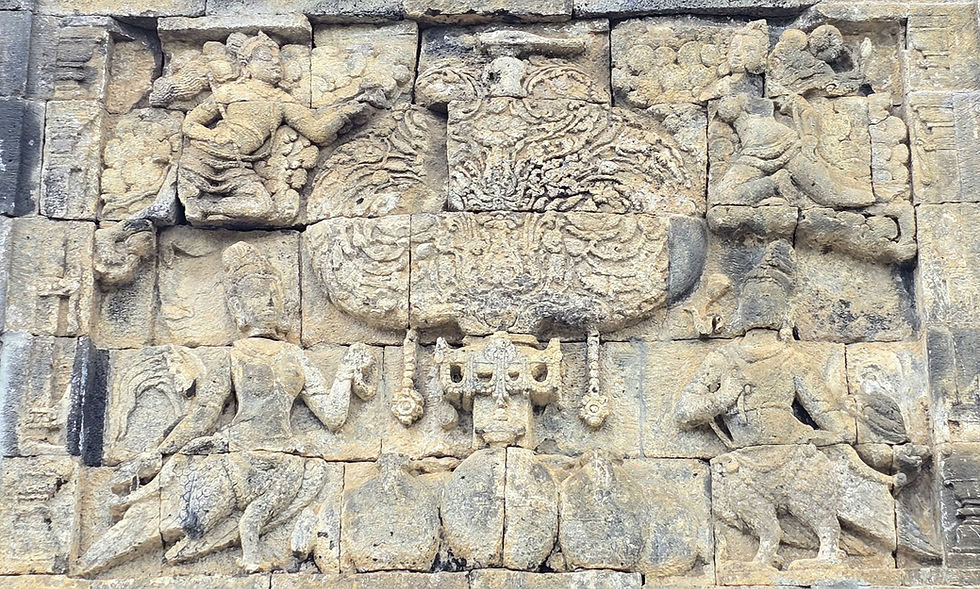
What makes the Kinnari unsettling is not her beauty but her jurisdiction. She does not belong to the human world, yet she is frequently embedded within its sacred architecture. In Indonesian temple complexes, particularly those influenced by Central Javanese Hindu Buddhist court culture, Kinnari figures are carved into narrative panels and transitional zones of stone structures. Their placement is deliberate, at thresholds, friezes and upper registers where the human gaze meets the symbolic sky. They occupy these edges because they themselves are threshold beings. Unlike deities who descend with authority, the Kinnari moves laterally between domains, bound to passage rather than permanence. Her existence is defined by controlled mobility. Never arrival, only transition.
Devotion as Impermanence
Textual traditions reinforce this structural role. In Buddhist Jataka narratives transmitted across Southeast Asia, Kinnara and Kinnari figures appear as embodiments of devotion, loyalty and disciplined emotion under separation. These stories are not romantic in tone but instructive in function. The Kinnari is often portrayed as bound to cycles of longing, displacement or temporary union with human or divine counterparts. Crucially, resolution is never achieved through permanence. The narrative logic always returns her to her original state of separation. This reflects a broader doctrinal principle. Attachment is unstable and even idealised beings must embody impermanence to maintain cosmic balance.

Movement, Discipline and Invocation
In ritual performance traditions across the region, including court derived dances in Java and Bali, the Kinnari is reactivated rather than represented. Dancers adopt stylised gestures that imitate avian-human hybridity, elongated arm movements, controlled footwork and precise, symmetrical postures that suggest wings without fully imitating flight. Historically, these performances were embedded in ceremonial contexts tied to courts and temple festivals, where they functioned as more than art. They were acts of atmospheric regulation, intended to refine collective attention and align human presence with sacred order. In this sense, the dancer does not “become” the Kinnari, they temporarily approximate her function as a mediator of balance.

The Necessity of the Unreachable
What endures across all these forms, in stone, text and movement, is the defining paradox at the heart of Kinnari mythology. She exists to sustain harmony, yet she cannot inhabit it in the way humans understand stability or belonging. Her role depends on separation, between realms, between states of being, between desire and resolution. Even her beauty is structured around distance, rendered in art as poised stillness rather than expressive abundance. The more closely she is observed, the more she recedes into function rather than personality. In the cosmological logic that produced her, this is not tragedy but necessity. The Kinnari is not meant to be possessed, understood fully or brought into permanence. She is a reminder encoded in form, that balance in this world is maintained not by union but by the precise, enduring tension between what can touch the human world and what must remain forever just beyond it.
Thanks for reading about Kinnari Mythology. Check out more awesome legends here!


