
Meiji Shrine - A Monument to Modern Japan
Relatively young compared to many of Japan’s ancient temples and shrines, Meiji Shrine (Meiji Jingū) holds deep symbolic and national significance. Completed in 1920, it was constructed to honour the deified spirits of Emperor Meiji and his beloved consort, Empress Shōken. Emperor Meiji (1852–1912) presided over one of the most turbulent and transformative periods in Japanese history, overseeing the end of the Tokugawa shogunate and the rapid modernisation of the nation. This era, known as the Meiji Restoration, marked Japan's transition from an isolated feudal society to a formidable modern power integrated into the global order. During his reign, Japan introduced Western technologies, legal systems, military practices and education while still attempting to retain elements of its cultural identity.

Emperor Meiji was seen as a sacred figure who bridged Japan’s spiritual traditions with the new world order. The idea to deify the Emperor and Empress and enshrine them at Meiji Jingū was not merely religious, it was deeply political. Their enshrinement reinforced the divine status of the Emperor and helped cement Shintō’s role as a national ideology, particularly in the lead-up to Japan’s militarist era. Interestingly, Empress Shōken was a progressive figure in her own right, supporting women's education, public health and welfare. Their union symbolised not just modernity, but a harmonious balance between change and continuity.
The shrine’s location in Tokyo, adjacent to Harajuku and the bustling Shibuya district, adds a layer of contrast that feels almost surreal. Covering 70 hectares of forest, Meiji Shrine and Yoyogi Park offer an escape from the overwhelming neon sprawl of Tokyo’s urban jungle. The "Forest of Sincerity", which feels primeval, was actually man made. After the original shrine was destroyed by American firebombing in World War II, more than 100000 volunteers and over 100000 trees, donated from across Japan, helped to rebuild the sacred space. The act of reconstructing the shrine wasn’t just physical, it was also a spiritual restoration of national pride during the early years of Japan's postwar recovery.
Visitors enter the shrine grounds through towering torii gates, massive structures that symbolise the transition from the secular to the sacred. The largest of these gates stands nearly 40 feet tall and is made from 1700 year old cypress from Taiwan, then part of the Japanese Empire. This gate, built in the Myōjin style, is the largest wooden torii in Japan and exudes an almost mythic presence. The immense age of the wood and its foreign origin speaks to the imperial reach of Japan during Meiji's reign and underscores the shrine’s role as a symbol of power, unity and spiritual continuity.

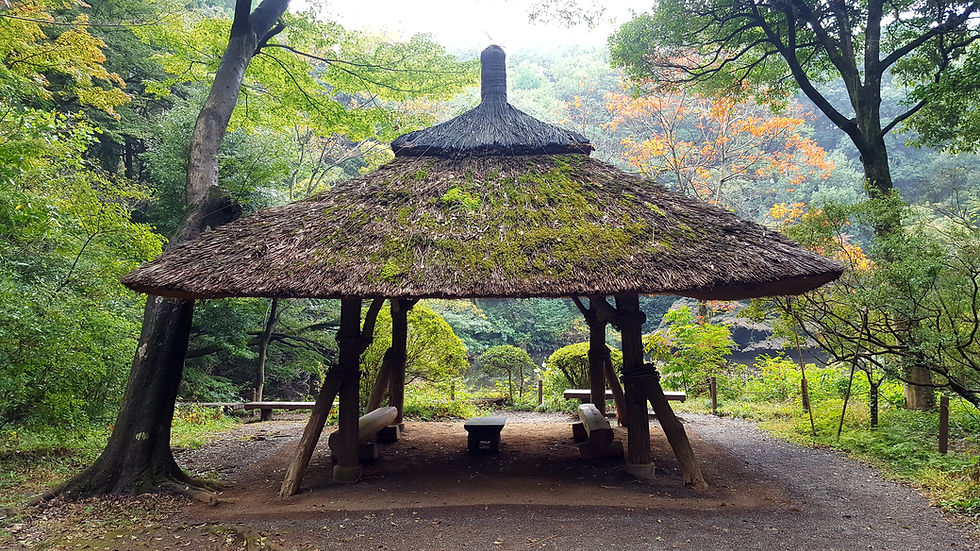
Within the inner precinct of Meiji Shrine lies the Nai-en or inner imperial garden, a serene space that predates the shrine and was lovingly designed by Emperor Meiji personally, as a romantic tribute to his beloved Empress. The Emperor, known for his appreciation of nature and aesthetics, personally tended to the garden, choosing the iris flower, of which over 150 varieties bloom every June, as a living symbol of his love and devotion. At its heart lies a peaceful pond and the legendary Kiyomasa’s Well, believed to have been dug in the early 1600's by the samurai warlord Katō Kiyomasa. This well is revered today as a spiritual “power spot,” said to radiate mystical energy. The garden as a whole embodies the Shintō principle of kami, the belief that spirit resides in all elements of nature, blending imperial love, ancient warrior lore and sacred energy into one tranquil, otherworldly retreat.
Despite its peaceful atmosphere, whispers of darker lore surround the site. Some local stories suggest that spirits of those who died during Japan's imperial expansion or who were tied to the militarisation of Shintō during the early 20th century, linger in the forest. The juxtaposition of peace and latent memory gives Meiji Shrine an eerie undercurrent for those attuned to Japan’s more shadowed history. The shrine, while a place of beauty and reverence, stands atop a complex legacy. It's a living monument to the divine rulers of Japan’s imperial past, the triumphs of modernisation and the ghosts of war that modern Tokyo quietly carries.

Sake barrels at Meiji Jingu symbolise offerings from brewers, honouring Emperor Meiji and Empress Shoken, reflecting sake’s deep ties to Shinto tradition
Location : Meiji Jingū, 1-1 Yoyogi Kamizono-cho, Shibuya-ku, Tokyo
How to get there : Meiji Jingū is easily accessible on the JR Yamanote Line from either Yoyogi Station’s West Exit (8 minutes walk) or Harajuku Station Main Exit (1 minute walk). It is also accessible via the Tokyo Metro on the Oedo, Odakyu and Fukutoshin Lines. The shrine is located almost in the centre of the grounds and it takes about 10 minutes from the 3 entrances.
Attraction Info : The shrine and its grounds are open everyday however open hours fluctuate thought the year to coincide with sunrise and sunset times. Average open hours fluctuate between 5am and 6:30pm and access to buildings within the park is generally between 9am to 4pm, however it is advisable to check their website before planning your visit. Entry to the park is free but there is a ¥500 maintenance fee required for admission to the inner Imperial garden and ¥1000 entry to the Meiji Jingū Museum.
Etiquette : Dress respectfully. At the gates, bow once when entering and once when leaving. When you reach the font (temizuya), rinse your hands and mouth with water and at the end allow the water to run down the stick and place it back. Don’t let any used water go back into the font, and do not touch the dipper with your mouth. If you wish to pray, place some coins on the offering box, bow twice, clap twice, make a wish and bow again.
明治神宮
Official Website : www.meijijingu.or.jp/english
Thanks for reading about the Meiji Shrine - A Monument to Modern Japan. Check out more destinations here!


