Neka Art Museum
The Neka Art Museum sits on a quiet rise just outside central Ubud, where the density of galleries and workshops gives way to slower air and more open land. It was founded around 1975 by Balinese collector Pande Wayan Suteja Neka, at a moment when Balinese painting was undergoing intense pressure from two directions at once, with increasing international demand and rapid internal transformation. His motivation was not simply preservation in the nostalgic sense but consolidation, an attempt to hold together a visual record of Balinese life, belief and artistic development before key works and traditions were dispersed into private hands abroad or dissolved into newer hybrid forms without documentation of their earlier states.

The earliest galleries inside the museum are dominated by Kamasan painting, one of the oldest continuous pictorial traditions in Bali, rooted in court and temple storytelling rather than individual artistic expression. These works are visually dense and highly structured, with flattened spatial composition and tightly controlled narrative sequencing. Episodes from the Ramayana and Mahabharata unfold across layered fields of figures, where scale and positioning are determined by narrative importance and symbolic hierarchy rather than natural perspective. The effect is less like looking at a painting in the modern sense and more like reading a fixed visual manuscript, where myth, cosmology and moral instruction are embedded into every arrangement of form.
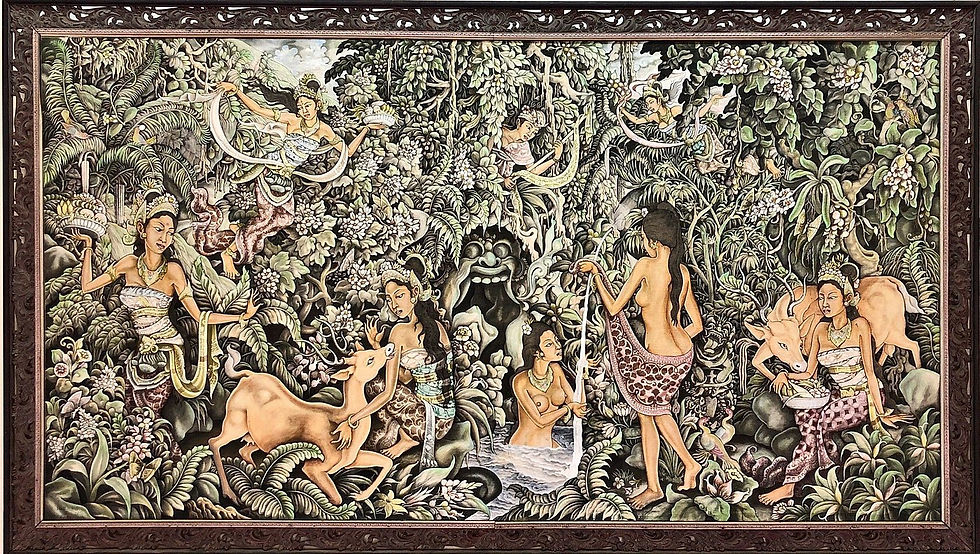
As the visitor moves deeper into the museum, the visual language begins to shift in ways that are subtle at first and increasingly pronounced. The arrival of European painters in Bali during the early twentieth century introduced concepts such as linear perspective, shading, anatomical proportion and observational realism. Rather than replacing existing traditions, these techniques were absorbed unevenly into local practice. The museum shows this transition as a layered evolution: Balinese artists begin to experiment with depth, volume and naturalistic environments, yet continue to anchor their subject matter in mythological narratives, ritual life and cosmological symbolism. The result is not a clean division between “traditional” and “modern” art, but a long period of overlap where multiple visual systems coexist within the same cultural space.

This sense of layered continuity is reinforced by the physical design of the museum itself, which is organised not as a single enclosed institution but as a series of Balinese style pavilions arranged across gardens, courtyards and open pathways. Each gallery space is partially exposed to the surrounding environment, with tropical vegetation, shifting light and ambient sound constantly entering the viewing experience. Movement between buildings is slow and fragmented, shaped by heat, shade and distance rather than linear exhibition flow. In this sense, the architecture mirrors the logic of Balinese cultural space more broadly, where artistic, spiritual and everyday environments are not separated into rigid categories but overlap through ritual practice, communal activity and landscape continuity.

One of the most distinctive sections of the museum is the Lempad Pavilion, dedicated to I Gusti Nyoman Lempad, a pivotal figure in Balinese art and architecture. His works stand in sharp contrast to the more densely populated narrative paintings elsewhere in the collection. Lempad’s drawings are characterised by extreme economy of line, often reducing complex mythological scenes into elongated figures and minimal spatial cues. Despite their apparent simplicity, they carry strong narrative and emotional weight, compressing entire episodes of Balinese mythology into gestures and spatial tensions rather than detailed depiction. This reduction creates an unusual effect: the work feels both ancient in subject matter and unexpectedly modern in execution, as though myth has been stripped down to its essential psychological structure.

Alongside painting, the museum also holds a significant collection of keris (or kris), traditional Indonesian ceremonial blades that occupy a complex position between object, heirloom and spiritual entity. In Balinese cultural understanding, a keris is not merely a weapon but a vessel of inherited meaning, often associated with lineage, ritual authority and unseen forces believed to reside within its form. The blades vary in age, origin and function, with some linked to royal courts and others to familial or ceremonial use. Their display within the museum extends the institution beyond visual art into material culture shaped by metallurgy, belief systems and the continuity of inherited spiritual frameworks.

What ultimately gives the Neka Art Museum its depth is the way it presents Balinese art not as a static heritage but as a continuously adaptive system. Across its galleries, one can see older ritual forms existing alongside works influenced by foreign artistic techniques, as well as more modern interpretations reflecting social and cultural change within Bali itself. Rather than separating these phases into rigid categories, the museum allows them to coexist in tension, revealing how Balinese visual culture has been shaped by ongoing negotiation between internal tradition and external influence. The result is not a linear history of art but a layered record of transformation in which continuity is maintained not through sameness, but through repeated reinvention.

🗺️ Location
Jalan Raya Campuhan, Kedewatan Village, Ubud, Gianyar Regency, Bali, Indonesia
🚆 How to get there
The Neka Art Museum is located roughly 3.5km's west of central Ubud, in the Sanggingan area, along the main road that continues toward Kedewatan and the Ayung River valley. From Ubud Palace, it is only around 5-10 minutes by car or scooter, depending on traffic. If you are comfortable on a gojek scooter, it will cost about 25,000 IDR. Getting a return ride is easy if you have wifi or internet. It took me about an hour to walk there from Ubud Palace.
⭐ Attraction Info
The Neka Art Museum is open daily from between 9am - 5pm. Entry is charged at (a pretty steep) 150,000 IDR for adults and 75,000 IDR for children, with proceeds contributing to the maintenance of the collection and grounds. The museum complex is divided into multiple pavilions arranged in traditional Balinese architectural style, surrounded by gardens and open-air walkways, which means exploration is naturally slow and spatially spread out. 1 - 2 hours is ample time to explore. The museum operates as a formal exhibition space rather than an active religious site, so standard visitor dress is acceptable, though respectful clothing is still recommended given its cultural significance. Personally, I wouldn't go out of your way to see this, only if you are an art enthusiast and have some time to kill. For the price, I was disappointed.

Thanks for reading about the Neka Art Museum. Check out more awesome destinations here!