
Pura Tirta Sudamala
Updated: Jul 27
The Sacred Springs Beneath the Jungle
Hidden within a steep river gorge in Bangli Regency, far from Bali's better known temple circuit, Tirta Sudamala Temple is one of the island's most enigmatic sacred water sanctuaries. Although no surviving inscription records its founding, the temple is universally regarded as an ancient place of worship that has served generations of Balinese seeking purification and spiritual healing. In Balinese tradition, a sanctuary without a recorded foundation is often understood as existing within both the sekala (seen) and niskala (unseen) worlds, its origins preserved not through dates but through ancestral memory. The name itself reflects the temple's sacred purpose. Tirta, derived from Sanskrit, means holy water, while Sudamala refers to the removal of impurity, misfortune and spiritual pollution. Here, it is not the stone shrines that define the sanctuary but the crystal clear spring that has flowed from the earth for centuries, transforming a secluded forest canyon into one of Bali's most enduring places of ritual purification, where the quiet movement of water has long been revered as a bridge between humanity and the divine.

The spring emerges beside the Banyuasri River, a minor tributary within the sacred Pakerisan River catchment, one of Bali's most historically significant ritual landscapes and today part of a UNESCO recognised cultural heritage area. Local belief holds that the water rises from beneath an immense centuries old Bunut tree clinging to the cliffside above the sanctuary. The tree is revered not simply for its age but as a living guardian of the spring itself, its sprawling roots binding together the visible and invisible worlds. According to village tradition, when prolonged drought devastated the surrounding countryside, this secluded gorge continued to produce cold, pristine water without interruption. What others may have regarded as an unusual geological spring was interpreted by local communities as an unmistakable blessing from the gods, establishing the site as a permanent sanctuary whose life giving waters have never ceased to flow.

Pura Tirta Sudamala is inseparable from the ancient Sudamala epic, one of Bali's most profound narratives of purification, exorcism and cosmic restoration. The legend tells of the goddess Uma, who, after being cursed by Shiva, was transformed into the terrifying Batari Durga, queen of destructive forces and the cemetery realm. Only Sadewa, the youngest of the Pandawa brothers, possessed the spiritual purity needed to perform the sacred Sudamala rite, freeing Durga from her monstrous form and restoring her divine nature. Rather than portraying good triumphing over evil through violence, the story reveals a deeper Balinese philosophy in which darkness is not destroyed but purified and returned to harmony. For this reason, many Balinese believe the waters of Tirta Sudamala embody the same sacred principle of transformation celebrated in the epic, making the temple a place where spiritual burdens, curses and unseen disturbances may be ritually cleansed rather than merely suppressed.
That philosophy is preserved within the Lontar Sudamala, ancient palm leaf manuscripts that explore the nature of mala, the spiritual impurities believed to arise through suffering, imbalance, inherited misfortune or harmful influences and prescribe tirta as the divine medium through which harmony may be restored. Traditionally, only Brahmin high priests, known as Ida Pedanda, are entrusted with interpreting these sacred texts. During major purification or healing ceremonies, the priest may consult the manuscripts to determine the precise sequence of prayers, offerings and ritual timing required for each individual, reflecting the belief that no two forms of spiritual imbalance are identical. Healing at Tirta Sudamala therefore follows an ancient ritual framework shaped by scripture, priestly wisdom and centuries of inherited religious practice rather than a single universal ceremony, preserving knowledge that has been passed from one generation to the next with extraordinary care.


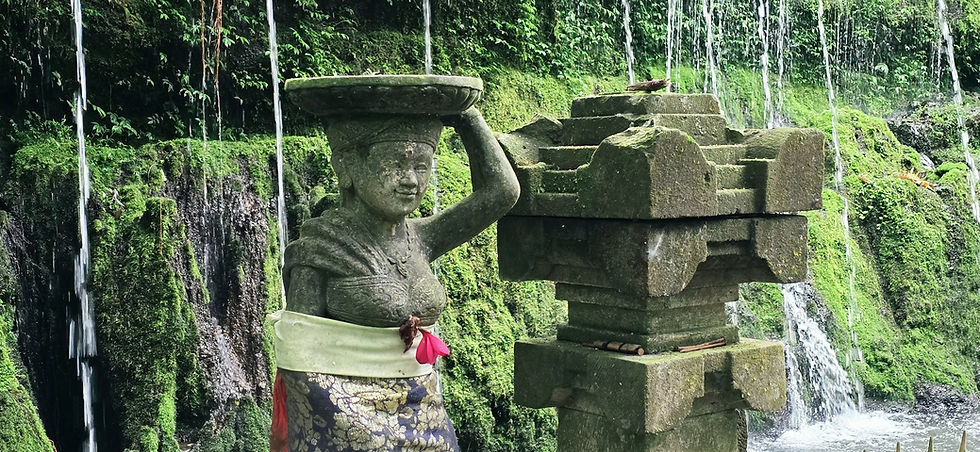
The temple's purification pools reveal yet another layer of living belief. Fed continuously by the sacred spring, each water spout is traditionally understood to possess its own spiritual guardian and distinct purpose. Worshippers begin at the shortest fountain, where permission is symbolically sought from the realm of Bhur, the unseen world beneath the earth, before progressing through the remaining spouts in ritual sequence. The tallest fountains are associated with the celestial realm, where flowing water is believed to dissolve emotional grief, illness and the lingering effects of negative spiritual influences. Local tradition even holds that the sacred qualities of the water change from one spout to the next, each serving a unique role within the purification journey. Whether understood as theology, symbolism or living folklore, these rituals continue to shape how Balinese pilgrims experience the sanctuary, transforming an act as simple as passing beneath flowing water into a deeply personal encounter with the sacred.

Many of the temple's most compelling stories belong not to written history but to oral tradition. Older villagers once described the deep river gorge as a place to be avoided after dark, believing it was inhabited by leak, practitioners of feared black magic and prajapati, restless spirits unable to complete their passage into the afterlife. One enduring legend tells of a villager overwhelmed by a powerful spiritual affliction who fled into the forest in a state of madness before collapsing beneath the great Bunut tree. As the icy spring water touched their head, witnesses claimed violent cries erupted from the afflicted body before the unseen presence was expelled, leaving the individual completely restored. Whether interpreted as miracle, metaphor or folklore, the story transformed the spring into something far greater than a source of drinking water. It became a place where invisible forces could be confronted, where unseen darkness yielded to sacred purity and where healing was believed to reach far beyond the physical world.

Today, Pura Tirta Sudamala remains one of Bali's most authentic sacred water temples precisely because it has never relied upon grandeur or royal spectacle. Hidden within its narrow river canyon, the sanctuary continues to draw pilgrims seeking blessings, purification and renewal through rituals that have changed remarkably little over the centuries. Beneath the sheltering branches of the ancient Bunut tree, the spring continues its quiet journey into the Banyuasri River, carrying with it a legacy shaped by scripture, mythology, ancestral memory and living faith. In a culture where water is understood not merely as a resource but as the visible expression of divine balance, few places embody that belief more completely than Pura Tirta Sudamala, where every shimmering current seems to carry echoes of forgotten prayers, ancient legends and an enduring conviction that the purest water possesses the power to restore harmony between the seen and the unseen worlds.

🗺️ Location
Sedit Hamlet, Bebalang Village, Bangli Regency, Bali, Indonesia
🚆 How to get there
Pura Tirta Sudamala is roughly 23 km from Ubud Palace, taking about 50 minutes to reach. The drive moves through rural Gianyar and into Bangli’s quieter highland villages, where roads become narrower and more winding as they approach the river gorge setting. There is no major public transport directly to the site, so most visitors arrive by scooter, private driver or taxi. The final stretch can include uneven or tight village roads, so extra care is needed, particularly in wet conditions. A full day tour with a rider typically costs around 500,000 IDR, while a full-day car and driver is usually around 1,000,000 IDR.
⭐ Attraction Info
Tirta Sudamala Temple is open to visitors daily between 8am - 6pm although access may adjust during ceremonies and local religious events. Entry is by compulsory donation (around 20,000 IDR), with contributions supporting the upkeep of the temple and its sacred spring. Sarongs and sashes are required and are provided on arrival, if you don't travel with your own. The site is equipped with basic change rooms and lockers for visitors who participate in the Melukat purification ritual. Melukat ceremonies may be conducted by local priests depending on availability. One of the most significant nearby sites is Penglipuran Village, a highly preserved Balinese settlement known for its traditional architecture and bamboo forest. The area is also home to the Pura Kehen Temple, one of Bangli’s most important royal temples.

Thanks for reading about Pura Tirta Sudamala. Check out more awesome destinations here!


