
Shadow Puppetry
Updated: Apr 17
Origins Before Time
Across Southeast Asia, shadow puppetry is not simply an ancient performance tradition but something that feels older than recorded time itself. Its visible forms are generally more than 1000 years old, emerging into recognisable structure during the early medieval period. Its deeper ancestry however, may stretch back two millennia into earlier Indian ritual and epic storytelling systems that moved slowly through maritime Asia long before cultural borders were defined. What makes it unusual is that it isn’t a static invention from one moment in time, but a slow crystallisation of ritual storytelling practices that evolved differently across the region while keeping the same core idea. Meaning emerging from shadow rather than light. It has no clear beginning, only continuation, as though it has always been unfolding rather than created.
The World in Light and Shadow
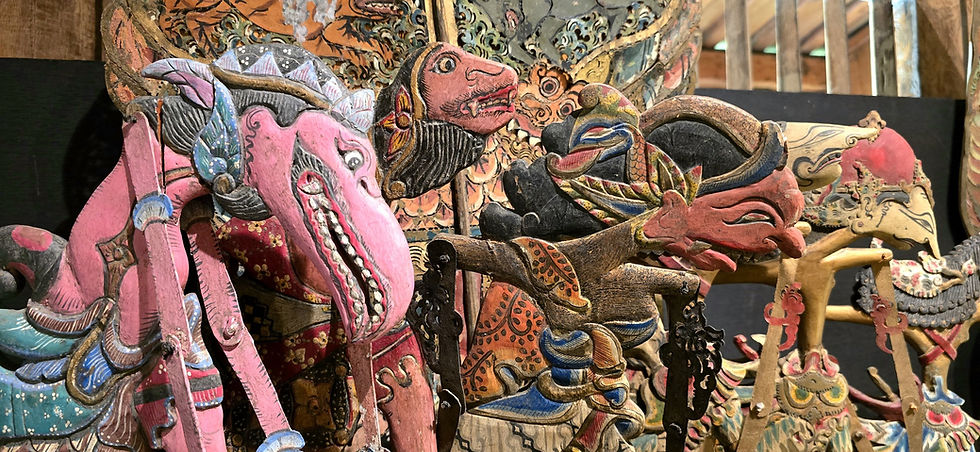
Also known as shadow play, the performance begins with a deliberate reduction of the world into light and absence. A single flame is introduced into a darkened space and the effect is immediate as everything outside its reach disappears. A screen is stretched tightly in front of it, forming a boundary that feels both fragile and absolute. Shadows begin to appear on its surface but they do not behave like images being projected. They feel more like presences arriving gradually, testing the limits of visibility. The longer one watches, the more uncertain it becomes whether the shadows are being controlled or whether they are exerting their own kind of pressure on what is seen.

Stories of Gods and Demons
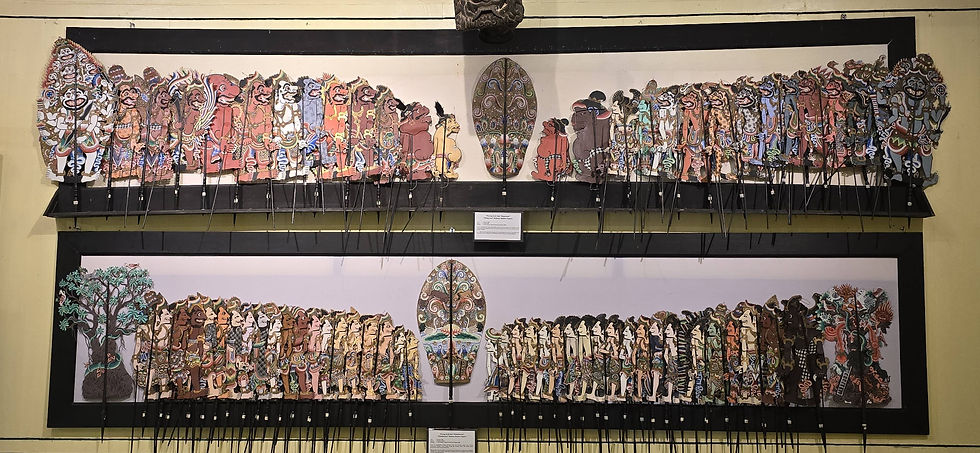
The stories they carry are drawn from vast mythic cycles that travel through Java, Bali, Cambodia, Thailand, Vietnam and Malaysia but they are never fixed to a single telling. In Javanese shadow theatre, the Ramayana is not simply a tale of virtue but a fractured war between duty and possession, where Rama’s certainty is constantly undermined by forces that do not recognise moral order. In Vietnamese and Khmer traditions, spirit courts and wandering dead appear with less separation from the living, as if the boundary between human and other has worn thin rather than been crossed. Demons are not purely evil and gods are not entirely stable, both shift depending on which voice is speaking them into being. These narratives rarely function as simple moral instruction. Instead, they operate like recurring disturbances in order itself. A kingdom is restored only for the conditions of collapse to quietly return. A demon is defeated only to re emerge in a different shape, sometimes closer to human than before. Even moments of clarity feel unstable, as if the story is aware that resolution is temporary and must be undone to continue existing. Across performances, repetition is not redundancy but necessity, because meaning is not carried by endings but by the constant return to conflict that refuses to settle.

Anatomy of Impermanence
The puppets themselves are made from leather or thin hide and are carefully perforated with intricate patterns that allow light to pass through them. This turns what should be solid figures into unstable constructions of brightness and absence. From a distance they appear complete, even defined, but closer observation reveals that they are composed largely of voids held together by illumination. Their forms are highly sensitive to small shifts in the lamp or the hand that holds them and because of this they never fully settle into fixed identity. Instead, they remain in a constant state of transformation, where meaning is dependent on conditions that can change without warning.

The Role of Light
The performance space does not feel like a stage in the usual sense. It feels contained, as if darkness has been arranged rather than simply entered. A thin screen separates the audience from what happens behind it but the separation is not stable. Light presses against it from one side, while sound and movement gather on the other. The result is not a clear division but a controlled tension between visibility and concealment. What appears on the screen is never whole. Figures arrive already broken into parts, an arm, a profile, a shifting outline that holds for a moment before dissolving. The puppetry depends on this instability. Meaning is not delivered through clarity but through interruption. Each image is allowed to exist only briefly before it changes shape or disappears entirely, leaving the imaginations of the audience to reconstruct what was never fully shown.
The Puppet Master
At the centre of this system stands the dalang, the puppet master who carries the performance through breath, timing and a voice that fractures into multiple identities without ever losing command. Nothing on the screen moves independently of them. Every shift in character, every change in tone, every moment of hesitation is pulled through a single point of control behind the cloth. The story does not unfold freely. It is held, steered and corrected in real time as if it could slip out of shape at any moment. Behind them, percussion and chant do not accompany the action so much as keep it in line. The rhythm is constant and unyielding, setting the limits of what movement is allowed to do. When it tightens, the performance sharpens and when it loosens, the shadows begin to drift and blur. Without that pressure of sound, the figures would lose coordination entirely, no longer reading as narrative but as motion without purpose.

When the Curtain Falls
Even in contemporary settings where shadow puppetry is staged for preservation or public display, it exists outside the conditions that once gave it force. Many puppets are no longer used in performance and are instead placed in museums and galleries across the world, where they are suspended or stored behind glass as objects of record rather than function. Removed from light, movement, and voice, they no longer participate in the system that once gave them meaning. When the lamp is extinguished for the final time, there is no continuation beyond it, only separation between what was performed and what remains. What is left is not disappearance but stillness, and the quiet recognition that something once made to move has been fixed permanently into silence.

Thanks for reading about the history of Shadow Puppetry. Check out more awesome legends here!


