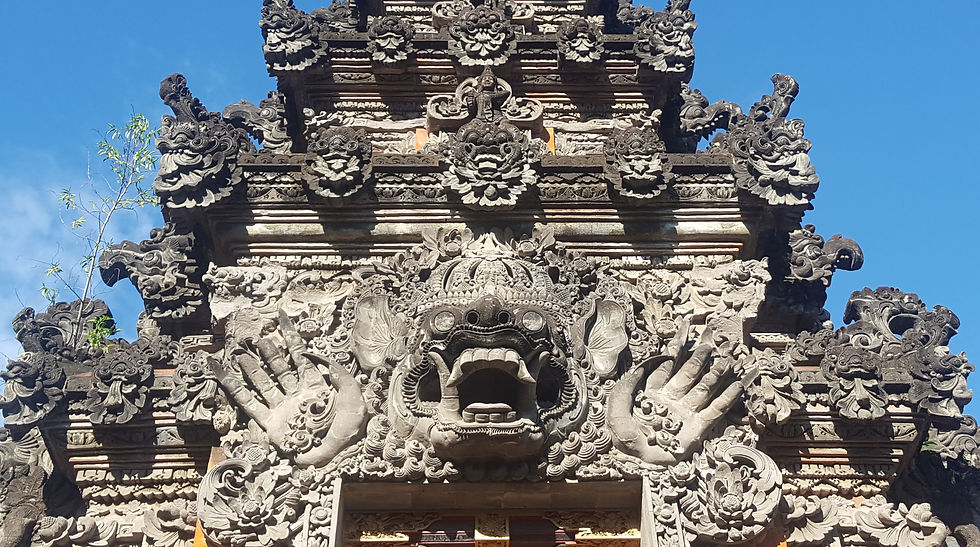
The Dark Legend of Calon Arang - Bali’s Most Feared Witch
The Dark Enigma - Bali’s Witch of Doom
In the black veins of Balinese and Javanese mythos, no figure evokes more dread than Calon Arang. Her story isn’t just about sorcery, it’s about what happens when society pushes a woman too far and she decides to burn the world down rather than be erased by it. She was no mere witch, she became the storm of death incarnate, the widow of Girah and the devourer of life. A woman wronged so brutally by the world of men that her soul rotted from the inside out and what emerged was not human but Rangda, the undisputed Queen of the Leyaks, eater of flesh, corrupter of bloodlines and the eternal enemy of light. Centuries after her time, her name is still invoked with caution, her story retold as a warning of what happens when grief turns monstrous and vengeance takes root in the spirit world.
The Tragic Origins Behind a Sorceress’s Curse
Based on a 13th century Javanese lontar-leaf manuscript, the tale of Calon Arang unfolds in the village of Girah during the early 11th century, under the rule of King Airlangga of the Kahuripan Kingdom. In a society that viewed widows with suspicion and whom feared female autonomy, Calon Arang stood at the very edge of acceptability. She was unmarried, defiant and in possession of arcane knowledge. She was already feared for her sorcery, shunned for her widowhood and hated for refusing to submit. Her only solace was her daughter, Ratna Manggali, whose beauty and kindness were eclipsed by the darkness of her mother’s reputation. When no suitor dared come forward, not out of judgement of the daughter but out of fear of the mother, the humiliation cut deeper than any grief she had known. Enraged by the rejection, mocked by her community and stripped of dignity, Calon Arang turned her agony into a weapon. In a culture that tethered a woman’s worth to marriage and obedience, she did the unthinkable, she embraced her power. She made offerings of blood to Durga, the goddess of destruction and opened herself to the vilest forces of black magic. Something ancient stirred in answer. That night, her heart turned to stone and her flesh became a gate. The skies over Girah thickened. Children died in their sleep, the rivers turned foul and the land recoiled in fear. Through her, death found its voice. Her wrath was not madness, it was retribution, born of a world that punished her for surviving on her own terms.

Dark Magic and Deadly Plagues
At the height of her fury, Calon Arang’s sorcery bloomed into total war. No longer merely a practitioner of curses, she became a walking plague, death in human form. Armies sent to silence her returned as bones picked clean. The sky split with lightning despite no clouds. Entire villages ignited without cause and temples, once filled with prayer, fell into eerie silence. When King Airlangga attempted to reason with her, his emissaries were returned dismembered, with their hearts missing and flesh etched with blood-soaked sigils. She ruled not alone but surrounded by Leyaks, ghastly cannibal spirits that crept through graveyards and fed on the entrails of the living. They were more than followers, they were her children, bound by ritual and rot. Some whispered they had once been human. Others claimed she birthed them from shadows and bone.
The Cannibal Spirits That Serve the Witch Queen
She called her campaign justice but it was pure annihilation. Wells soured. Infants came into the world stillborn or eyeless. Fields shriveled to dust under a sky that wept with black rain. Her wrath was not strategic, it was apocalyptic. Priests, soldiers and sorcerers alike were sent to stop her. All died screaming. Calon Arang stood at the centre of this horror, a figure of decay, her hair like dead roots, her breath thick with the stench of burnt offerings, her tongue muttering spells that blackened the air. The Leyaks swirled around her, never fully seen, only felt, as silent watchers with blood-soaked jaws. Whether summoned or spawned, they moved as her will made flesh, whispering the end of kingdoms. The Leyaks were not simply her servants, they were her mirror. They were extensions of her will, warped into existence through the same crucible of pain that had transformed Calon Arang herself. Once human, they had been hollowed by isolation, grief or the lust for forbidden power, until nothing remained but bone, smoke and obedience. Through necromantic rites and profane oaths, she taught them to shed their flesh, detach their heads and soar through the night sky as flaming skulls trailing rot and entrails. They fed on carrion, slithered into homes to drink the breath of the dying and whispered poison into the ears of the broken.

The Rise of Rangda
As her dominion deepened, Calon Arang crossed the final threshold. No longer woman and not merely a witch but as Rangda, the demon queen of Balinese lore made flesh. Rangda was not a title, it was her metamorphosis, the embodiment of Calon Arang's unholy ascent, locked in her hatred for the living. The legend ossified around this form, her eyes swollen and wild, tongue lashing like a serpent, her face a contortion of hatred and decay. Her teeth cracked bone with ease, her touch was pestilence. The sick and the cast-out came to her not for healing but for power, to serve, destroy and curse. In Rangda, all vestiges of humanity were shed. She was Calon Arang’s final truth, her spirit unchained from flesh and morality. Not merely feared, she is the final vision of the dying, the one who comes when the gods refuse.
The Battle Between Light and Darkness
As King Airlangga’s kingdom withered under plague and black magic, he turned in desperation to Mpu Bharadah, a reclusive ascetic known for his command of sacred law and incorruptible purity. Refusing to counter darkness with more darkness, Bharadah chose deception over brute force. He sent his disciple to seduce Ratna Manggali, Calon Arang’s daughter, lonely, love-starved and unaware of the trap. Through her, Bharadah uncovered the stolen scriptures and unholy rites that anchored her power. Armed with forbidden knowledge and divine authority, he journeyed to the graveyard of Girah, where he called her forth, not as a diplomat but as an executioner cloaked in holiness. When they met, witch and priest, it was not a battle but an unmaking. The confrontation was nothing short of apocalyptic. Calon Arang rose in fury, summoning storms of skulls and rivers of blood, legions of shrieking spirits at her back. Her chants split the sky and the ground blistered beneath her. Bharadah stood alone, unmoved, invoking names more ancient than her gods. Each word he spoke scorched her flesh and silenced her Leyaks, who turned to ash at his feet. Thunder shook the earth and her invincibility shattered. Her power, once absolute, crumbled under the weight of sacred knowledge. Some say her soul was bound and cast into a void where even demons tremble. Others claim she begged for mercy and was tricked before being destroyed. But one truth remains unshaken. Though her body fell, Calon Arang did not die. Her hatred lives on, in shadow, in legend, in Rangda. The earth may have sighed in relief but it never truly slept.

Beyond the Grave
In Bali, the legacy of Calon Arang lingers like a stain that time cannot cleanse. Her name is still muttered with unease, her story feared more than remembered. Villagers leave offerings in the forest, not out of tradition but out of fear, meant to keep the Leyaks from crossing thresholds uninvited. Old women who live alone, who speak to the dead or stare too long into fire, are eyed with quiet dread. Though her tale has been repackaged in masked dances and temple plays, the rituals are more than performance, they are containment. Beneath the drums and painted eyes, the old power stirs. Calon Arang is not gone. She is the scream buried beneath centuries of silence, the vengeance born from exile, the fury of a woman whose sorrow became plague. Her body may have been buried and her name outlawed but her soul calcified into something immortal. Rangda, the demon queen. Too feared to fade, too potent to pass into myth, she survives in the places no light touches. She is not remembered, she is felt, in madness, in fever and in unnatural deaths. Her followers still gather in secret and her Leyaks still glide through the trees on moonless nights, entrails gleaming like wet ropes. In remote cemeteries, rotting offerings mark the presence of a faith that never died. Rangda is not a relic, she is a presence, a curse etched into the bones of the island. The black mother and widow with no grave.
The Paradox of Bali’s Demon Queen
Her descent into darkness wasn’t born of petty cruelty but of betrayal, by the village that mocked her, the suitors who feared her and a society that treated her power as a threat rather than a gift. Refusing to be diminished, she transformed her fury into a force that could shake kingdoms. Her wrath was not random. It was calculated, cosmic and unapologetic. In modern eyes, she is both villain and victim, a woman driven by grief, vengeance and a refusal to be erased. She became the spirit of every woman devoured by injustice, made monstrous by a world that offered her nothing but fire. And when the air grows thick and the dogs begin to howl at nothing, you will know, she is not a memory. Rangda walks again.

Legacy of the Damned
Calon Arang’s story remains deeply important in Bali not merely as a feared tale of the island’s most infamous witch but as a dark legend and vital spiritual symbol embodying the necessary balance between creation and destruction. Through her incarnation as Rangda, she is both feared and revered, her presence central to sacred rituals like the Barong and Rangda dances that cleanse and protect communities. Statues of Rangda are scattered throughout the island, in temples, village corners and shrines, serving as constant reminders of her powerful, chaotic force. While modern Balinese society has softened some of the harsh social judgements once directed at powerful women, traces of patriarchal suspicion linger, making Calon Arang’s story a living memory of the tensions around female autonomy. Her legacy survives not through open discourse but through ritual, embodying both warning and reverence as a force that is neither simply villain nor victim but essential to the island’s spiritual harmony.
Thanks for reading The Dark Legend of Calon Arang - Bali’s Most Feared Witch. Check out more dark legends and more awesome destinations here!

Feared and revered, The Dark Legend of Calon Arang – Bali’s Most Feared Witch – remains one of the most powerful tales in Balinese mythology