
Ubud Water Palace
Updated: Sep 22, 2025
Ubud’s Iconic Lotus Temple
The Ubud Water Palace, more formally known as Pura Taman Kemuda Saraswati, is one of Bali’s most enchanting water temples. Its name translates to “the temple with sacred water sources,” reflecting the central role of water in both its design and spiritual meaning. Tucked just off Jalan Raya in the heart of Ubud, the temple feels like a hidden sanctuary of lotus ponds, guardian statues and stillness, offering a peaceful counterpoint to the bustling shops and cafés just beyond its gates.

Commissioned by the Sukawati royal family and completed in 1952, the temple was envisioned as a sanctuary that blended devotion with artistry. Its design was entrusted to I Gusti Nyoman Lempad, Bali’s most celebrated sculptor and architect. His mastery is seen in the temple’s symmetry and detailed stonework, which balance spiritual symbolism with refined aesthetics. The result is a sacred space that embodies the Balinese way of uniting religion, art and everyday life.
At the heart of the temple lies its dedication to Saraswati, the Hindu goddess of knowledge, wisdom, music and the arts. Often depicted seated on a white lotus, holding a veena, with a swan beside her, she represents clarity and the pursuit of truth. In Balinese Hinduism, Saraswati is especially venerated by students, artists and educators. Every year, her presence is honoured during Saraswati Day, when books and writing instruments are blessed to mark the sanctity of knowledge itself.

The temple’s founding vision came from Ida Tjokorda Gde Ngoerah, a prince of Ubud and spiritual leader born in 1856. He lived through an era of royal courts, Dutch colonisation and Bali’s eventual independence and sought to create a temple that reflected both resilience and renewal. His goal was to establish a space that honoured tradition while encouraging cultural and artistic growth, making the Ubud Water Palace not only a religious landmark but also a symbol of Ubud’s evolving identity.
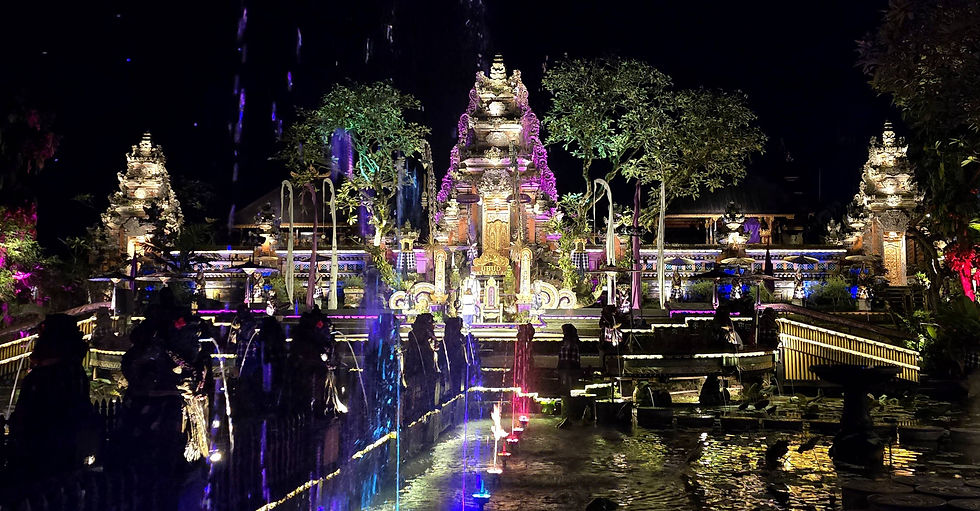
The most striking feature of the site is its lotus ponds, which stretch across the outer courtyard on either side of a raised stone walkway. Blossoms bloom year round in shades of pink and white, rising from dark waters to symbolise purity and enlightenment. In Hindu belief, the lotus mirrors the human spirit, able to rise unsoiled from murky depths toward light and clarity. This symbolism is echoed in every step toward the temple’s gates, a path guarded by stone figures carved from volcanic tuff.

Like many Balinese water temples, the Ubud Water Palace plays a role in the island’s rituals of balance and protection. Water is seen as both life giving and purifying, flowing through temple networks that sustain agriculture, sanctify ceremonies and guard against misfortune. At Saraswati’s temple, the natural spring is revered not only for its cleansing energy but also for its spiritual force, believed to bring harmony between the seen and unseen worlds. These practices reflect the broader Balinese philosophy of Tri Hita Karana, the balance between humans, nature and the divine.

More than a cultural landmark, the Ubud Water Palace remains a living sanctuary. Its water gardens, statues and shrines are not just admired by visitors but continue to anchor daily rituals of prayer and protection. Whether encountered as an architectural masterpiece, a symbol of artistic devotion, or a place of spiritual renewal, the temple endures as a reminder of Ubud’s identity, where tradition, creativity and sacred balance flow together.

🗺️ Location
Jalan Raya Ubud No.14, Ubud, Gianyar Regency, Bali, Indonesia
🚆 How to get there
Getting to Saraswati Temple from Ubud Palace is easy and walkable. The temple is located just a few minutes west along Jalan Raya Ubud, the main street that runs through the centre of town. From the palace gates, head west on Jalan Raya for about 200 meters until you see the entrance to Lotus Café on your right. Walk through the café’s courtyard and you’ll find Pura Taman Saraswati tucked behind it, surrounded by lotus ponds and stone carvings. No transport is needed, it is just a short, scenic stroll from one of Ubud’s busiest intersections.
⭐ Attraction Info
Visitors to the Ubud Water Palace pay an entrance fee of 60,000 IDR for adults or 45,000 IDR for children, which includes hire of a compulsory sarong and sash. Photo packages are also available, such as entry plus one timed photo for 100,000 IDR per person or a three-photo package for the same price, with extra prints costing 40,000 IDR each. The outer courtyard is open from Saturday to Thursday between 8am and 7pm and on Fridays until 9:30pm, closing only on Nyepi and during private ceremonies. While the sacred inner temple is off-limits to tourists, the outer grounds offer intricate carvings and lotus ponds to explore. Each evening at 7:30pm, traditional Balinese dance performances take place, with tickets available at the entrance for 100,000 IDR, or alternatively, visitors can view the show from Café Lotus with a minimum dinner spend of 200,000 IDR.
🔗Official Website
Thanks for reading about the Ubud Water Palace. Check out more awesome destinations here!


