Bale Kambang
The Floating Crown of the Kingdom of Klungkung
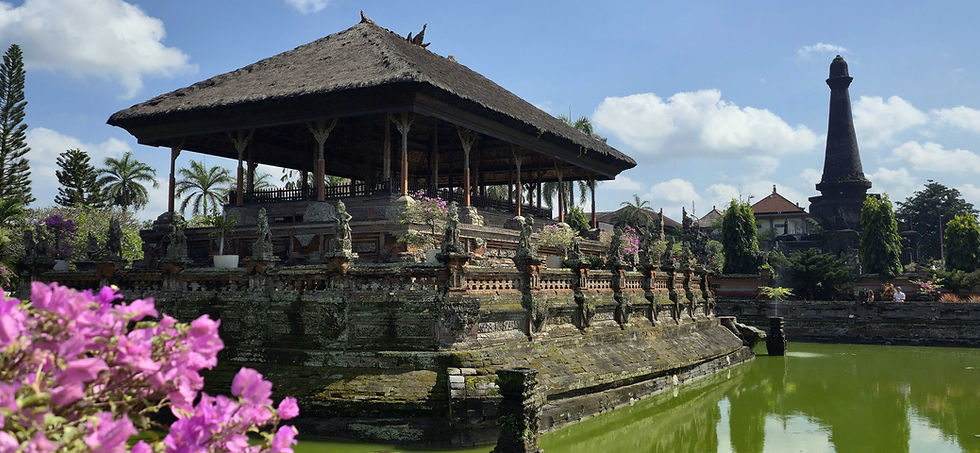
Tucked within the historic royal complex of Klungkung Palace, the Bale Kambang, a name that means "floating pavilion", is a structure that is as symbolically loaded as it is visually striking. Appearing like a rock island rising from the cosmic ocean, this elegant pavilion floats serenely in a lotus filled moat, accessible only by a narrow bridge of aged red brick. While it might appear at first glance to be a place of leisure or ceremony, the Bale Kambang holds within its architecture, artwork and positioning a deep and layered narrative, one that blends Balinese cosmology, royal power and spiritual discipline. To understand it is to peer into the soul of Klungkung itself, a kingdom that, despite centuries of war and fragmentation, has remained the spiritual and philosophical heart of Bali.
The political climate that gave birth to the Bale Kambang was anything but peaceful. The second half of the 17th century was a period of intense upheaval in Bali. The once unified Gelgel kingdom fractured into a patchwork of warring courts as local lords competed for dominance and territory. Power changed hands frequently and bloodshed was often the currency of succession. Amid this political turbulence, Klungkung emerged not necessarily as the most militarily powerful kingdom but as the cultural and spiritual heir of Gelgel's former glory. This reputation as Bali’s spiritual centre would become embedded in every structure the Klungkung court constructed, none more so than the Bale Kambang, which encapsulated their claim to a cosmic mandate.
The pavilion’s architecture is a masterpiece of symbolic intent. Designed to represent Mount Meru, the sacred mountain at the center of the universe in Hindu and Buddhist cosmology, the pavilion rises from the water like a divine peak emerging from the primordial ocean. The surrounding moat, far from a decorative flourish, represents Anavatapta, the mythological lake believed to be the source of the elixir of life. In this way, the Bale Kambang becomes not just a building but a microcosm of the universe, linking the earthly realm of the Klungkung Rajas to the divine structure of the cosmos. To stand on its brick bridge and cross the water is to enact a symbolic journey. It is a passage from the mundane to the sacred.

The pavilion’s function has long been debated by historians and locals alike and that ambiguity adds to its mystique. Some believe it served as the headquarters for royal guards, a vantage point of defense and strategy. Others describe it as an antechamber where emissaries and high-ranking visitors would wait before gaining an audience with the King. Still others insist it was used more intimately by the royal family as a place for leisure, traditional games, philosophical discussions, meditation and receptions for VIP guests. Whatever its day to day use, what is certain is that the space was never just utilitarian. Its design, placement and ornamentation all suggest a deliberate blending of pleasure, power and sanctity.

That spiritual charge is most visible in the pavilion’s richly painted ceiling. Unlike the more famous ceiling in the nearby Kerta Gosa Pavilion, which graphically depicts scenes of karma, punishment and hell, the Bale Kambang’s paintings tell more uplifting and esoteric tales, structured across six concentric levels. The outermost level features the Palalintangan, a Balinese astrological chart that maps out fate and destiny through planetary movements. The second level turns to the Brayut folktale, a beloved story of a humble but devout couple whose faith and diligence lead them to prosperity and spiritual growth, a narrative reflecting ideals of the Balinese family structure and moral virtue.

As one ascends visually through the final four tiers of ceiling paintings, the stories become more sacred and metaphysical. These uppermost levels are devoted to the Sutasoma Kakawin, a late 14th century epic poem and a cornerstone of Balinese literature. It tells the tale of a noble prince who renounces his royal life to seek enlightenment, navigating temptation, moral trials and cosmic battles along the way. This narrative, chosen for the highest and most sacred part of the pavilion, mirrors the ideals of Klungkung kingship, of renunciation, wisdom and divine right. The fact that these stories were painted in such an elevated position suggests they were not meant to be casually consumed but contemplated by those seated below in states of reflection or ritual preparation.

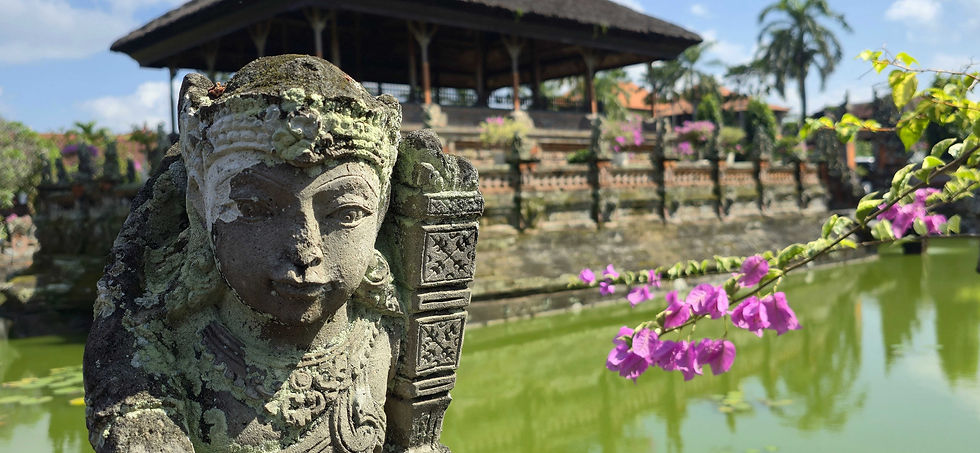
The spiritual gravitas of the pavilion is further amplified by the statues that flank its perimeter. Figures known as parekan, clown like beings who serve as intermediaries between gods and demons in Balinese epics, occupy the lower level, serving as both protectors and trickster figures. Alongside them stand serene dewa and dewi deities, their carved faces exuding calm divinity. Interspersed are the contorted visages of asura demons, signifying the chaotic forces always kept in balance by divine order. These figures, placed around the moat, act as guardians of a spiritual threshold, reinforcing the idea that the Bale Kambang was never just a royal retreat, it was a charged sacred zone.

Today, the Bale Kambang that visitors see is largely the result of careful restoration work carried out in the 1930s and 1940s, part of a broader effort to preserve Bali’s royal architecture during the twilight of its native kingdoms. While much of the greater Klungkung Palace was lost during the Puputan of 1908, a mass ritual suicide marking the Balinese refusal to surrender to Dutch colonial rule, the Bale Kambang endures as a symbol of resistance, not just militarily but spiritually. It represents a refusal to relinquish cosmological order, ancestral lineage and sacred kingship even in the face of foreign domination.

In the end, the Bale Kambang is far more than a picturesque structure on water. It is a vessel for centuries of belief, an island of enlightenment floating above worldly turbulence. Built during one of Bali’s most unstable eras, it managed to convey a cosmic stability through its iconography, its function and its atmosphere. Whether it hosted warriors, philosophers or musicians, its walls absorbed the ambitions of a kingdom that saw itself as the moral compass of an island in flux. Even now, its presence whispers of the sacred architecture of power, of a world where kings were judged not just by their armies but by their proximity to the divine.

🗺️ Location
Jalan Diponegoro, Semarapura Kangin, Bali, Indonesia
🚆 How to get there
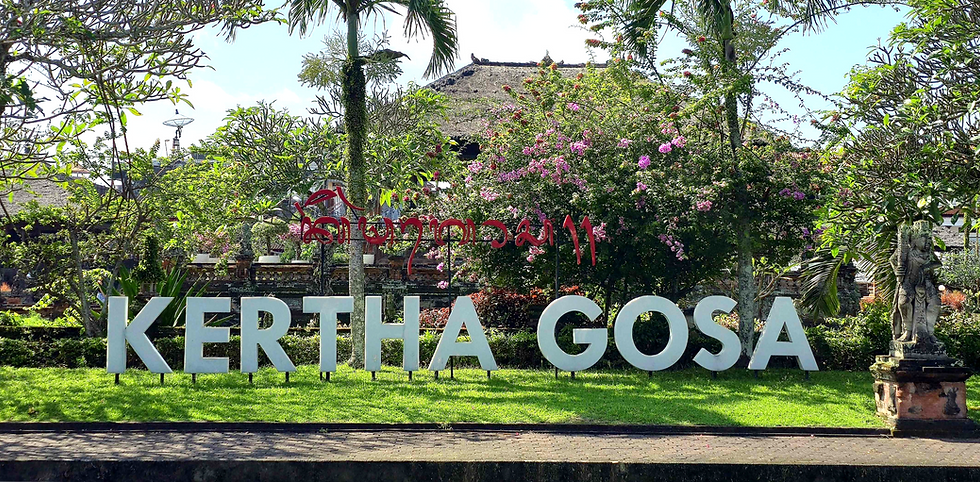
Bale Kambang is located within the Kertha Gosa park complex and is easily accessible from major Balinese hubs. It's roughly 30 minutes from Sanur, 45 minutes to an hour from Ubud, and about 1 1/2 hours from Denpasar. Each route offers a scenic drive through rice fields and traditional villages, making the journey as enriching as the destination itself. You will likely pass this place on your way north or south, so have your driver stop in on the way.
⭐ Attraction Info
The palace is open daily between 8am - 5pm, with tickets sold at the official counter located beside the Puputan Monument on the opposite side of the road. Entry costs 50,000 IDR and includes access to the Kertha Gosa Complex as well as both onsite museums. Be cautious of self proclaimed tour guides who may approach you insisting you need to pay them directly, this is a common scam. The site is small and easy to navigate on your own, so a guide is not necessary. As with most sacred places in Bali, a sarong is required to cover your knees. I strongly recommend carrying your own to avoid dealing with aggressive vendors trying to sell or rent you one at nearly every historical site, including here! Allow yourself 30 to 60 minutes to explore the complex and take in the surroundings at a relaxed pace.

Thanks for reading about Bale Kambang. Check out more awesome destinations here!