
Banryutei Rock Garden - Dragon of Eternity
Tucked behind the imposing facade of Kongōbu-ji Temple, the head temple of Koyasan’s esoteric Shingon Buddhism, lies Japan’s largest Zen rock garden, Banryūtei, or “The Garden of the Reclining Dragon.” Far from your average gravel swirls, Banryūtei is a deliberate masterpiece spanning over 2300 square metres. It was established in 1984, some 1150 years after the death of Grand Master Kobo Daishi, as a place of calm contemplation. It was designed as a symbolic battleground between myth & stone, as a visual echo of cosmic struggles.

Located at the rear of the temple grounds, 140 granite stones have been arranged to form the shape of two dragons who diligently protect the complex, while the white river sand represents the sea of clouds the dragons burst out from. These dry and stylised landscapes were created to imitate the essence of nature as an aid to meditation, to assist in finding the true meaning of life. By stripping a garden to its' bare bones, Zen monks create a miniature image of the universe in its' rawest form. In their peculiar beauty, rock gardens call humanity to be aware, in an open and more sensitive way.
The design is rigidly intentional. Every single stone was placed following esoteric principles rooted in ancient geomancy and Buddhist mandala structure. The male dragon is said to represent the physical world; raw power and manifestation, while the female embodies wisdom, intuition and the spiritual realm. Their positions echo the cosmic duality that runs through Shingon doctrine, where opposites are not enemies but dance partners in the choreography of existence.
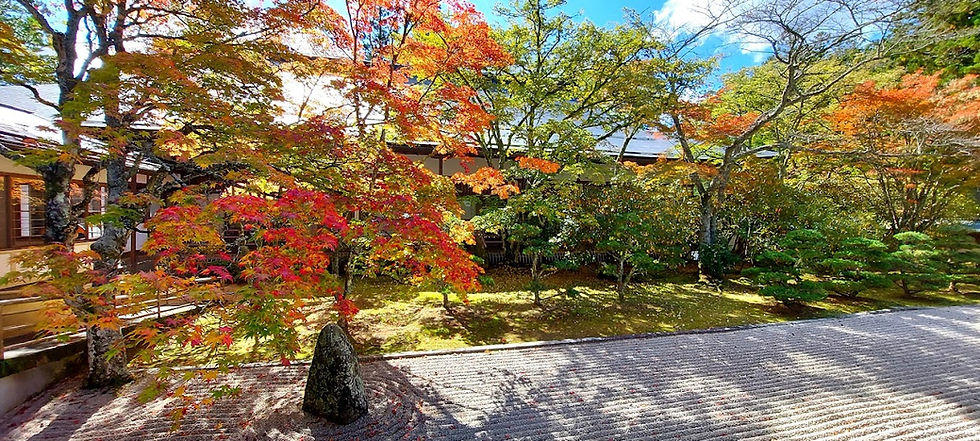
According to local folklore, the Banryutei Garden is more than just an arrangement of stone and gravel, it is the earthly manifestation of an ancient dragon spirit said to slumber beneath Mount Kōya itself. The legend tells that upon returning from his esoteric studies in China during the 9th century, Kōbō Daishi (also widely known as Kūkai) encountered the raging force of this primal beast. Through sacred rites, mudras and the power of dharma, he subdued the dragon, binding its chaotic energy deep into the mountain’s sacred earth. The rocks now seen in the garden are said to represent the dragon’s coiled form, its body stilled, yet its presence forever pulsing beneath the raked gravel.
Location : Kongobu-ji Temple,132 Koyasan, Kōya, Ito District, Wakayama Prefecture 648-0294
How to get there : The Nankai Rinkan Bus from Koyasan Station will take you to the Kongobu-ji temple. Get off at Kongobuji-mae in the town centre, the temple is a five minute walk from the Senjuinbashi intersection and just a few steps from the Garan. The rock garden is located within the temple grounds.
Attraction Info : This temple is open every day between 8:30am to 5:00pm. Admission to Kongobuji is 500 yen, the rock garden is included for free. We visited the area in Autumn when the beautiful leaves were in full colour.
Official Website : www.koyasan.or.jp
蟠龍庭
Thanks for reading Banryutei Rock Garden - Dragon of Eternity. Check out more destinations here!


