
Beneath the Dragon - Imperial Citadel of Thăng Long
Updated: Jun 26, 2025
Constructed on the remains of a 7th century Chinese fortress, the Thăng Long Imperial Citadel was built on strategic reclaimed river lands on the lower Red River Delta and for nearly 13 centuries, remained the regional powerhouse of Northern Vietnamese political and military domination. Shortly after his ascension to the throne, Emperor Lý Thái Tổ declared a royal decree in the year 1010, to move the capital from Hoa Lư and establish a new Imperial City for the Lý Dynasty. This marked a pivotal turning point in Vietnamese statecraft.

According to official historical chronicles, as the Emperor's royal barge approached the Red River plain, he witnessed a golden dragon rising into the sky from the land, which he interpreted as a heavenly omen. Moved by this auspicious premonition, he took it as a sign of divine approval for his decision and renamed the capital Thăng Long, meaning "Rising Dragon," to invoke protection and prosperity from the celestial realm. The Emperor envisioned a capital not only as a seat of administration and military power but also as a cosmic centre aligned with the geomantic principles of Feng Shui.
The fortress was meticulously designed with concentric layers, with an innermost royal compound (Tử Cấm Thành), an administrative and military middle ring (Hoàng Thành) and the outer citadel (La Thành) which housed the general population. Key features included massive earthen ramparts, stone dragon staircases, lotus-filled ponds and wooden palaces with tiled roofs, many adorned with intricate carvings and imperial motifs.

Local folklores speak of a mysterious network of subterranean chambers and archaeological layers beneath the citadel, sealed by imperial decree and believed to contain cursed relics or entomb traitorous Mandarins. These underground spaces were largely forgotten until major excavations began in 2002, unearthing hidden corridors, drainage systems, ancient wells, royal foundations and thousands of artefacts spanning over 1300 years.
One reoccurring legend speaks of a foreign concubine wrongfully accused of espionage, who was entombed beneath the palace floor. Her restless spirit is said to wander the ruins, whispering through the stones and banyan trees on moonless nights. There are also stories of forbidden ritual chambers, where occult ceremonies were performed to protect the dynasty or invoke divine favour. Geomancers, shamans and court priests would conduct rituals involving blood offerings, spirit summoning and talismanic magic. These rites were intended to manipulate fate, ward off disasters or to ensure a dynasty’s continued dominance. Some stories mention the use of human effigies, inscribed with names of rivals, then buried or burned during midnight rites. Others tell of spiritual pacts with guardian deities bound to the citadel’s foundation stones.

The architecture of the citadel is a fascinating palimpsest of dynastic layers. From the Ly to the Nguyen dynasties, each era left its mark, yet time and conflict, especially the French colonial period during the mid 1800's and the devastating Vietnam War, erased much of its grandeur. Today, what remains is a blend of preserved relics and restored fragments. The Đoàn Môn Gate, Flag Tower and the Kinh Thiên Palace foundations are the only original surviving structures.
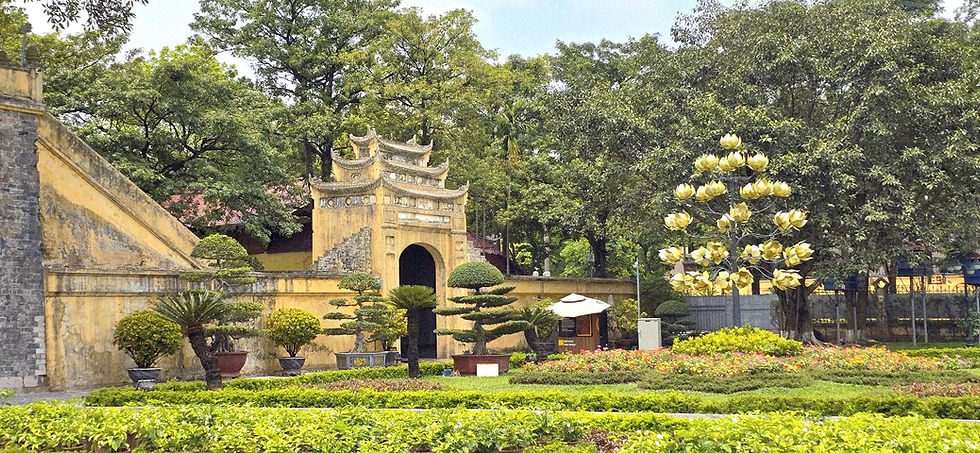
From its founding on the wings of a golden dragon to the silent stones that once bore witness to royal decrees, secret rituals and spectral sorrow, the Citadel is more than a historic site, it is an archaeological treasure and the keeper of Vietnam’s royal legacy. The Imperial Citadel of Thăng Long was officially inscribed as a UNESCO World Heritage Site in 2010, marking the 1000th anniversary of the founding of Thăng Long.

Location : 19c Hoàng Diệu, Điện Biên, Ba Đình, Hà Nội
How to get there : The Thăng Long Citadel is located approximately 2km's from the centre of the Old Quarter in Hanoi and will take around 30 minutes to walk to. If you can't be bothered walking, Grab taxi's or motorbikes are readily available and will only cost a few bucks.
Attraction Info : The Citadel is open between Tuesday & Sunday between 8am - 5pm (closed on Monday's) and on Friday's and Saturdays, special night tours commence at 7pm, for a cost of 300000VND. The standard entrance fee to is 100000VND per person, with discounts available for children and seniors. Allow 1-2 hours to have a wander around. This attraction is VERY quiet, there was nearly no one else there during our visit.
Official Website : https://hoangthanhthanglong.vn/en/

Thanks for reading Beneath the Dragon - Imperial Citadel of Thăng Long. Check more destinations here!


