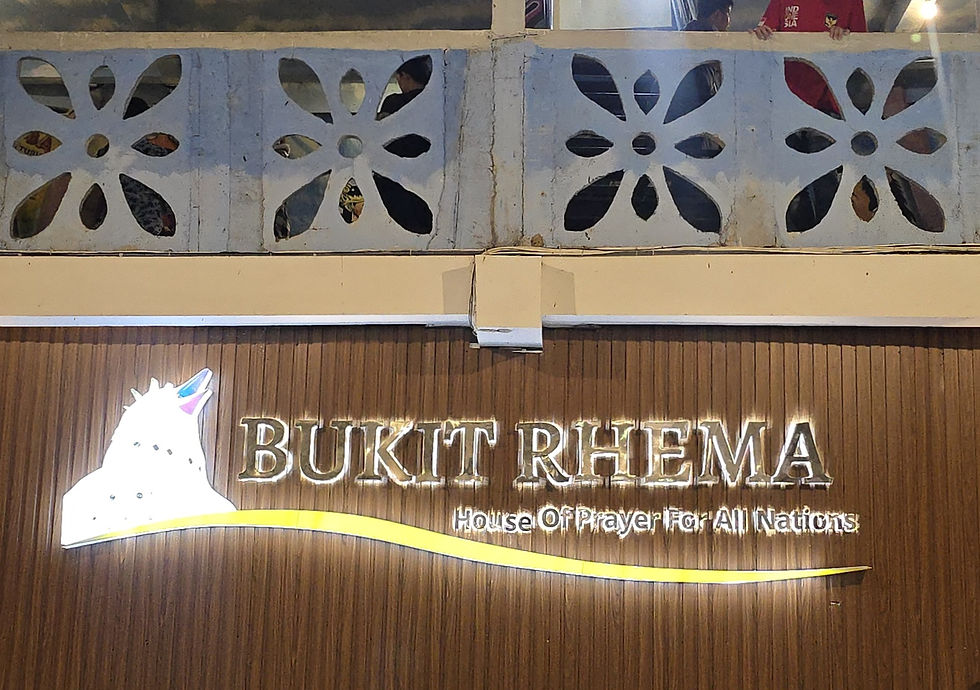
The Chicken Church
The House of Prayer for All Nations
Rising from the jungle covered hills of Magelang in Central Java, overlooking the vast stone mandala of Borobudur Temple, Bukit Rhema sits in a landscape where its unusual silhouette naturally draws attention. It was never intended to resemble a chicken, despite the name that has come to define it. Its creator, a Christian man named Daniel Alamsjah, envisioned a dove as a symbol of peace, spiritual presence and refuge, a form meant to express openness rather than ambiguity. Yet from certain vantage points, the structure’s broad crown and blunt, beak like front have reshaped that intention in public perception, turning a carefully chosen symbol into something more immediately recognisable than it was originally designed to be.

The building originates from a personal vision that Alamsjah claimed to receive in 1989, in which he was instructed by God to construct a house of prayer shaped like a dove on a hill he had never visited. He interpreted this as a spiritual directive and later travelled through Central Java until he identified a site that matched his vision. Construction began around 1992, funded largely through his own means and guided by individual conviction rather than institutional planning. The project was conceived not as a conventional church but as an interfaith sanctuary where religious boundaries dissolved into a shared space for prayer, reflection, and withdrawal from daily pressures, without the constraints of a single doctrine.

By the late 1990s, the project began to encounter practical limitations. Rising construction costs and the complexity of maintaining such an unconventional structure made continued development increasingly difficult for a privately funded effort. By around 2000, construction ceased and the site was abandoned. For nearly a decade, the decaying building became known as a hangout for graffti artists and bored teenagers, its unfinished spaces gradually marked by informal use rather than formal purpose. Its profile shifted significantly after appearing in international media and several Indonesian films and documentaries, which brought widespread attention to the site. Visitor numbers increased and the church gradually developed into a managed cultural and tourism destination. Maintenance and reinforcement work followed, along with improved access routes, focusing on preservation and safety rather than redesign. Today, it functions as both a place of worship and a public viewpoint, with steady movement through its interior spaces.

Inside, the structure opens into a large multi level interior designed with an open, flowing layout. The lower floors are arranged as halls and rooms for prayer, reflection and community use, including areas once used for outreach and rehabilitation programs. Within this layout are around fifteen niche like prayer rooms that resemble carved caves set into the concrete shell, irregular in shape and scale, giving the interior a more sculpted than constructed quality. The 1st floor also contains a small museum space that presents the history and development of the site, alongside more reflective areas. One of the most distinctive features is the Wall of Hope, where visitors leave written prayers and personal wishes, gradually building a layered record of public engagement. The walls throughout the interior are covered in vivid murals that remain strongly coloured, combining religious symbolism, moral themes and local artistic styles.

As visitors move upward, the structure narrows into the hollow head where a staircase leads into an upper chamber filled with natural light from carefully positioned openings. These openings frame the surrounding landscape in wide, structured views, from the agricultural patterns of the Kedu Plain to distant volcanic ridgelines and shifting weather across Central Java. Borobudur is visible from this level, sitting within the broader landscape rather than as a point of comparison. The experience is shaped by elevation and perspective, with the architecture directing attention outward through its own form.

What gives the structure its lasting presence is the way it continues to generate different readings without settling into a single one. It was built from a private vision, yet it exists within a public landscape where it is approached as a place of worship, an architectural curiosity and a lookout in equal measure. Visitors come for different reasons and leave with different interpretations, shaped as much by the setting as by the structure itself. Its significance lies in this ongoing circulation of meaning, where the building is not fixed to one identity but continually defined through how it is used and encountered.

🗺️ Location
Gombong Hamlet, Kembanglimus Village, Borobudur District, Magelang Regency, Central Java, Indonesia
🚆 How to get there
Bukit Rhema (Chicken Church) is located roughly 3km's south of Borobudur Temple, rising on a hillside above the village area of Kembanglimus. From the main street in Borobudur, the journey is short but gradually climbs away from the busy tourist strip into quieter rural roads lined with homes, small shops and rice fields. The most straightforward way to reach it is by scooter taxi or private car, with the drive typically taking around 15 minutes. A return GoJek scooter ride usually costs around 60,000 IDR. The final stretch leads up a narrower access road toward the entrance and parking area, where the structure begins to appear above the treeline. Walking is also possible, taking roughly an hour, though the incline becomes noticeable as the route leaves the village edge and moves into the foothills.
⭐ Attraction Info
Bukit Rhema is open to visitors daily between 7am to 5pm, with hours adjusted on religious holidays or special events. Entrance fees are 25,000 IDR per person, which includes a return shuttle and entry to the main interior spaces and upper viewing areas inside the dove structure. Tickets are purchased on site at the main entrance complex at the base of the hill and at the end of your tour, can be exchanged for a free keyring. Technically, photos are not permitted to be taken in the prayer area. The site is well equipped for visitors, with an onsite café and restaurant offering drinks and simple meals overlooking the surrounding hills, as well as a souvenir area selling locally made crafts and themed memorabilia tied to the site. Facilities also include shaded seating areas, rest points along the ascent and basic visitor amenities such as toilets and designated photo spots throughout the complex. Its close proximity to Borobudur Temple makes it a common addition to the wider Borobudur area itinerary and many travellers visit both in the same day. Despite its popularity, the atmosphere remains relatively relaxed, with the experience shaped as much by the hillside setting and open viewpoints as by the structure itself.