
Sonobudoyo Museum
Ancient Artifacts and Hidden Secrets
In the heart of Yogyakarta’s Kraton district, the Sonobudoyo Museum preserves centuries of Javanese art, ritual objects, and historical artifacts, offering a rare glimpse into the island’s artistic, religious and social life. Established in 1935 to safeguard the region’s cultural heritage during a time of rapid change, its galleries reveal the richness of Indonesia's past. Visitors encounter statues dating back nearly 1300 years, ancient inscriptions in Kawi script, shadow puppets, textiles and ceremonial objects. Each piece carries traces of the hands that made it and the rituals that gave it meaning. History here is not told in words alone, it is encoded in form, material and craftsmanship, preserving centuries of human ingenuity, devotion and daily life, waiting to be discovered by those who look closely.

The museum’s archaeological collection is dominated by bronze and volcanic stone statues dating from the 8th to 10th centuries, many sourced from Candi Prambanan, the Dieng Plateau and other Central Javanese temples. Deities such as Ganesha, Shiva and Vishnu are rendered with astonishing detail, their jewellery, postures and hand gestures conveying both aesthetic mastery and ritual significance. These statues were never mere decoration, they were designed to embody the divine, capturing a moment of eternal devotion in metal and stone. Standing before them, visitors can almost sense the silent prayers and meticulous craftsmanship of artisans who sought to make the sacred tangible, preserving a world of belief that has endured for over a millennium.
Among its other treasures are stone and copper inscriptions in Kawi script, some over a thousand years old. These texts record temple dedications, royal decrees, and ceremonial practices, offering insight into the political, social and religious life of early Javanese kingdoms. Even fragmentary pieces whisper the authority of kings and the intentions of priests, guiding communities and preserving knowledge across generations. For historians and curious visitors alike, these inscriptions are more than records, they are echoes of voices from a vanished world, connecting us directly to the thoughts, rituals and ambitions of those who shaped Java’s past.

The museum’s wayang kulit (shadow puppet) collection spans centuries, with articulated puppets that once danced in the flickering lamplight of royal courts and village ceremonies. Each painted face, jointed limb and delicate detail preserved a story from the Ramayana or Mahabharata, blending entertainment with moral and spiritual instruction. The puppets hold the memory of performance, the rhythm of gamelan, the gestures of the puppet master and the tension of a narrative unfolding against a glowing screen. Observing them, one feels a bridge across centuries, as if the stories themselves linger in the museum air, waiting to be awakened.
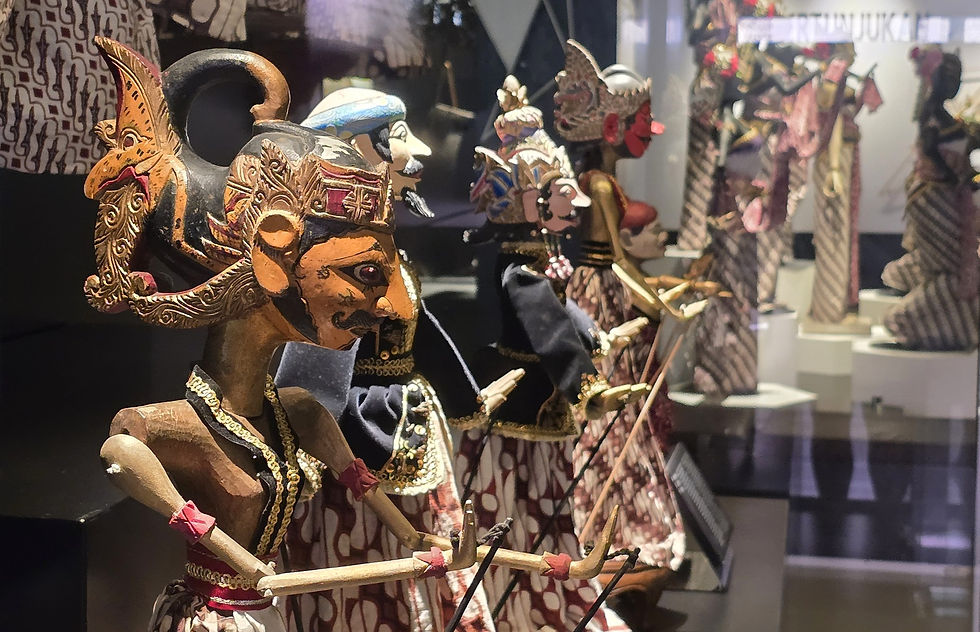
Beyond statues and puppets, the museum houses batik fabrics, kris daggers, ceremonial masks and gamelan instruments, each reflecting the interwoven nature of artistry, ritual and social identity. A kris is never merely a weapon, it is a ceremonial heirloom, often inscribed and believed to carry ancestral power. Batik patterns encode region, status and ceremonial function, while masks reveal the choreography of dances where humans and spirits intersected. Gamelan instruments preserve the soundscape of courts and temples, their layered tones echoing rituals, celebrations and daily life. Every object resonates with centuries of human presence, revealing a culture where art, belief and identity were inseparable.
The museum’s curatorial design emphasises these connections, arranging objects to suggest their original relationships and cultural contexts. Statues stand near inscriptions, puppets beside instruments, and textiles alongside ceremonial items, allowing visitors to perceive the dialogues that would have existed in temples and courts. In this way, the museum becomes more than a display, it transforms into a narrative space, guiding visitors through centuries of Javanese devotion and artistry. Observing the objects in relation to one another, one can trace how material form, ritual function and social meaning converged in classical Java.

Even without legendary tales or supernatural embellishment, the Sonobudoyo Museum radiates a quiet intensity. Bronze statues retain the precision of centuries old hands, inscriptions preserve the words of rulers and priests and puppets, textiles and instruments embody the stories and aesthetics of classical Java. For those willing to pause and observe, the museum offers a profound encounter with a civilization that valued beauty, ritual and historical memory. Here, time is not measured in years but in the enduring presence of objects that have witnessed devotion and human life, a journey through a world rendered in objects of extraordinary skill, meaning and mystery.

🗺️ Location
Jalan Pangurakan No.6, Ngupasan, Kraton, Special Region of Yogyakarta, Indonesia
🚆 How to get there
The Museum is just a short distance from Taman Sari Water Palace in Yogyakarta, rouhgly 2 km's northeast. On foot, it’s a pleasant 25 minute walk. If you prefer to ride, a quick 5 minute drive or Gojek ride will get you there, usually costing around 20,000 IDR. Both sites are located within the old city core near the Sultan’s Palace, making it easy to visit them together. Parking available close to the museum entrance.
⭐ Attraction Info
Sonobudoyo is open Tuesday to Sunday between 8:00am - 4pm, closing on Mondays and national holidays. Entry costs 20,000 IDR for foreign visitors and is cheaper again for locals. Guided tours are available on request, providing deeper insight into the museum’s treasures. Visitors can easily spend 2 - 3 hours exploring the many levels of the museum, including its galleries and exhibition spaces.

Thanks for reading about the Sonobudoyo Museum. Check out more awesome destinations here!


