
Kebo Edan Temple
Once buried in the rice fields of Pejeng, Pura Kebo Edan has brooded for more than seven centuries, its stones blackened by time and ritual smoke. Believed to date from the 13th century and now recognised as an official National Cultural Site, this temple does not invite the faithful, it judges them. Its name, the Temple of the Crazy Buffalo, recalls the bull statue that guards the courtyard: Nandi, once Shiva’s loyal mount, now frozen in fury, his eyes locked on the god he can no longer obey. Here, faith curdles into defiance. The beast glares toward the inner sanctum where Shiva has descended into Bhairawa, the god of blood, madness and ecstatic ruin. The air hangs thick and damp, moss clings like flesh, and silence itself feels watchful, as if the temple remembers every act of worship and every sin.

The temple’s true heart centres on the Giant of Pejeng, a 3.6 metre high statue of Shiva Bhairawa, his body coiled with snakes, his face eroded into something unrecognisable, as if time itself recoiled from remembering. The god’s stance is both a dance and a desecration. He moves upon a corpse, crushing it beneath his feet, symbolising the triumph of divine power over mortal decay. But this is no serene cosmic balance, his form radiates hunger and lust, his anatomy grotesquely exaggerated, his manhood multiplying in impossible excess. Long ago, this phallic terror was made of iron, polished by the hands of devotees who sought tantric potency from the god of destruction. That ritual has long ceased but the air still vibrates with the echo of those forbidden invocations.
Archaeologists estimate the temple to be around seven centuries old, its exact origins swallowed by history. It may date to the late Pejeng kingdom, a time when Bali’s rulers dabbled in esoteric Shaivism, when gods were not gentle and worship meant confronting the raw violence of creation itself. The statue’s identity, however, is still debated. Some say it truly is Shiva Bhairawa, lord of time and terror. Others argue it represents Bima, the mighty hero of the Mahabharata, caught in a moment of divine transgression. In one dark retelling, Bima’s desire for a woman consumes him, his passion grows monstrous, his body uncontainable. When the woman spurns him for another, Bima finds them entwined and kills them both, then dances on their corpses in a frenzy of grief and rage. The temple, they say, remembers this dance.

Every stone in Pura Kebo Edan seems to breathe with that same feverish energy. Serpents are carved into the base of altars, spiraling toward the Bhairawa like veins feeding a heart. Esoteric tantric symbols lie half buried in moss, their meaning half lost but their intent unmistakable, to channel chaos into awakening. The temple may once have been a site of initiation, where Shaivite ascetics practiced dark meditations on death and desire. The boundary between ecstasy and madness was the test. Some say that those who failed the rites left not as men but as beasts, the “crazy buffaloes” from which the temple takes its name.
Even the village folklore holds a peculiar tension between reverence and fear. The people of Pejeng still practice Balinese Hinduism, a faith where gods, demons and ancestors coexist in a fragile balance of offerings and appeasement. They still leave flowers, incense and rice at the temple gates, yet no one lingers after sunset. Strange lights are said to shimmer between the stones at night and the cries of unseen animals echo across the fields. The keepers of the temple warn visitors not to laugh, not to touch the statue, not to enter with impure thoughts. It is not superstition, it is survival. For this temple, they say, remembers desire and desire here has teeth.

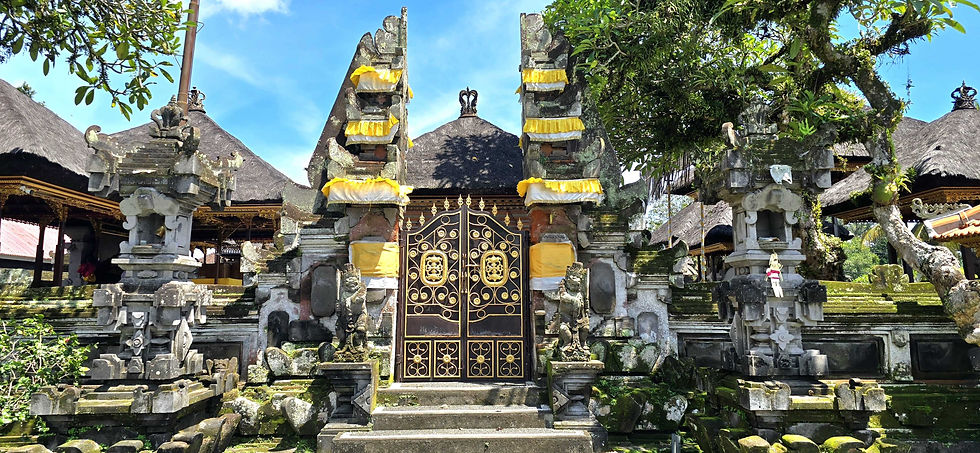
Archaeologists studying Pejeng’s ancient relics note that its iconography diverges sharply from typical Balinese sanctuaries. It is less Majapahit refinement and more raw mythology, as though carved before moral order was imposed upon the island. The temple itself follows a layout unlike later Hindu shrines, its open courtyards enclosed by low laterite walls and stone altars heavy with age. Fragments of ancient lingam-yoni, broken Andesite carvings and remnants of early tantric iconography lie scattered across the compound, whispering of older rites that once blurred the line between worship and invocation. At its heart, the union of Nandi and Bhairawa, faith and fury, forms a tableau of spiritual tension, a divine standoff that feels almost alive. Even now, beneath the slow drip of moss and the hum of cicadas, one can sense the god’s restless movement within the stillness, the faint whisper of a drumbeat no longer heard by human ears.

No one truly knows who carved the Giant of Pejeng at Kebo Edan Temple or for what final purpose. The statue is too powerful to be mere ornament, too disturbing to be pure devotion. It stands as a monument to excess, of faith, lust and death intertwined. When the rains fall and the moss glistens red in the dying light, it is easy to believe the god still dances there, grinding the bones of his own worshippers beneath his feet, while the buffalo watches in silence, eternal witness to the madness of the Gods.

🗺️ Location
Pejeng, Tampaksiring, Gianyar Regency, Bali, Indonesia
🚆 How to get there
Pura Kebo Edan lies about 6 kilometres east of downtown Ubud, in the quiet village of Pejeng, and the drive takes roughly 15 - 25 minutes through narrow suburban lanes. The easiest way to reach it is by private driver, which typically costs between 450,000 - 800,000 IDR for the whole day, if you plan to explore nearby sites. For solo travellers or those comfortable on two wheels, a Gojek motorcycle is the cheapest and often fastest option, costing between 20,000 - 50,000 IDR one way. Make sure you ask your rider to wait for you, as transport can be tricky to organise from this site.
⭐ Attraction Info
Pura Kebo Edan is open daily between 7am - 6pm, with tickets costing 10,000 IDR for adults, payable by cash. The entrance fee includes a sarong rental however it is advisable to travel with your own. You can enter any day and stay as long as you like, with access allowed until 7pm if you arrive before 6pm. Most visitors spend about half an hour exploring the small temple grounds. The best times to visit are early mornings before 10am or after 5pm when there is more shade.
Thanks for reading about Kebo Edan Temple. Check out more awesome destinations here!


