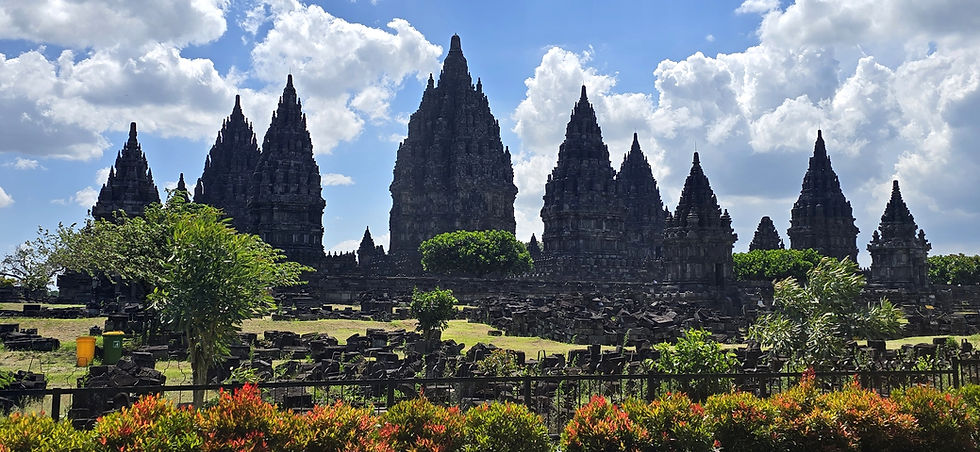
Mendut Buddhist Monastery
The Living Gateway to Borobudur
On the fertile Kedu Plain of Central Java, where morning mist rolls off the Menoreh Hills and the earth is rich with volcanic memory, Mendut Buddhist Monastery rises beside its 9th century companion, Candi Mendut. While the stone temple has stood for over 1200 years, the monastery was established during Indonesia’s 20th century Buddhist revival, restoring life to a centuries old sacred site. Monks move purposefully through halls and cloisters, their chants drifting across shaded courtyards, while gardens and lotus filled ponds mirror the calm of daily practice. The architecture is deliberately simple, yet in its understated order, every corridor and shrine exudes serene beauty. It provides monastics with disciplined spaces for devotion while giving visitors a quiet sanctuary for reflection, serving as a living counterpart to the enduring presence of the ancient temple stones.

Daily life at Mendut follows a disciplined rhythm. Monks rise before dawn for meditation, chanting and study, while lay practitioners participate in guided retreats and Dhamma teachings. Courtyards shaded by frangipani, banyan and teak trees lead to lotus filled ponds and quiet shrines, creating a contemplative environment where nature and practice merge. Every pathway, every courtyard corner, is designed to frame reflection. The movement of monks, the ripple of water and the rustle of leaves all become part of the monastery’s living cadence, reminding visitors that this is a functioning spiritual hub rather than a historical exhibit.

Among the monastery’s most compelling features are its many statues, which guide both meditation and ritual practice. Figures of the Buddha, Avalokiteśvara and Vajrapāṇi are placed throughout halls, gardens and shrines, their varied postures and expressions shaping devotion and focus, while smaller Bodhisattvas and guardian spirits occupy alcoves, offering subtle lessons and layers of meaning to practitioners and visitors alike. Some of these figures recount the Buddha’s past lives, where kings became sages and animals offered themselves for the greater good. One chamber preserves Hārītī, once a child devouring demoness who was transformed into a protector of children and Āṭavaka, a fearsome Yakṣa subdued by the Dharma. These images remain active in the life of the monastery, with locals leaving flowers and incense to seek blessings for fertility, protection and wellbeing, a living testament to the way myth, art and daily devotion continue to converge at Mendut.

Each year during Vesak, the most sacred night in the Buddhist calendar, Mendut becomes the ceremonial heart of observance in Central Java. Thousands of pilgrims gather to begin the procession toward Borobudur, following the sacred axis that passes through Pawon Temple. Notably, Mendut, Pawon and Borobudur lie in a nearly perfect straight line, a design believed to reflect 9th century intentions for ritual alignment and possibly celestial observation. Monks bless the flames, lead chanting and guide devotees along this axis, connecting modern pilgrims to a tradition that stretches back over a millennium. The monastery’s role in Vesak underscores its vitality. It is not a passive site of heritage but an active starting point for one of Southeast Asia’s most important living rituals.

The monastery also maintains deep regional and international connections. Candi Sangharāja, a smaller shrine on the grounds, honours Thai Buddhist patriarchs, emphasising Mendut’s engagement with wider Southeast Asian traditions. Visiting monks, scholars and devotees come to study, teach and participate in rituals, reinforcing the monastery’s identity as both a local spiritual hub and a participant in a broader transnational network. This blend of local and global ties demonstrates that even a relatively young institution can carry forward centuries of Buddhist tradition.
Education and community engagement lie at the heart of Mendut’s purpose. Meditation programs, retreats, and public Dhamma talks invite laypeople to move beyond observation and participate directly in Buddhist practice, while affiliated centres such as Griya Vipassanā Avalokiteśvara provide longer term study and intensive retreats for deeper immersion. These initiatives do more than cultivate devotion they foster understanding, ensuring that the teachings and rituals of Buddhism remain alive, meaningful and relevant. By nurturing both learning and practice, Mendut transforms from a quiet sanctuary into a vibrant centre of spiritual life in Central Java, its ancient axis reinterpreted for the modern age.

As evening falls, the monastery quiets but does not lose its presence. Lamps glow along garden paths, incense curls skyward from shrines and guardian statues take on an almost animate serenity in the soft lamplight. The lotus ponds mirror the dimming sky and the distant hills frame the monastery like a natural cathedral. Mendut Buddhist Monastery is a place where ritual, community, and contemplation converge, where the past informs the present, and where the living spirit of Java’s Buddhist heritage continues to thrive in every chant, every step and every offering.

🗺️ Location
Jalan Borobudur - Ngadiharjo, Mendut, Mungkid, Magelang Regency, Central Java, Indonesia
🚆 How to get there
Mendut Buddhist Monastery is located about 3km's east of Borobudur Temple and roughly 40 km's northwest of Yogyakarta’s city centre, making it an easy stop on the classic Borobudur circuit. The drive from Yogyakarta typically takes around 1 to 1.5 hours, depending on traffic and route. The most convenient way to reach the monastery is by hiring a private car or taxi, which usually costs between 400,000 and 600,000 IDR for a round trip and allows plenty of flexibility to combine Mendut with Borobudur and Pawon on the same day. For a cheaper alternative, visitors can take a TransJogja bus from Yogyakarta to Jombor terminal (20,000 IDR), then transfer to a local bus heading towards Borobudur for around 40,000 IDR. From Borobudur, Mendut is just a short ride away by gojek or becak, costing around 20,000 IDR. The journey is a highlight in itself, winding past rice fields, rivers and traditional Javanese houses before arriving at the monastery’s tranquil compound.
⭐ Attraction Info
The Monastery and temple complex is open daily between 8am - 5pm, allowing visitors to explore both the active vihara and the centuries old sanctuary at a relaxed pace. Entry is free. Facilities include parking areas, small warungs selling drinks and snacks and shaded spots to rest under banyan trees. Its location only a few km's from Borobudur means many travellers combine the two in one visit but Mendut offers a quieter, more spiritual atmosphere where the sounds of chanting monks blend with village life. Late afternoon is particularly atmospheric, as the setting sun casts a golden glow over the temple’s reliefs and the monastery gardens, creating an intimate setting for reflection and photography.

Thanks for reading about the Mendut Buddhist Monastery. Check out more awesome destinations here!