
Prambanan Temple
The Skyward Sanctuary of Java
Prambanan Temple rises from the plains of Central Java like a jagged crown of stone, built in the 9th century during the height of the ancient Mataram Kingdom. As the largest Hindu temple complex in Java, it comprises 240 structures arranged in a precise, sacred layout that reflects a carefully ordered vision of the cosmos. Towering spires dominate the central courtyard, their sharp vertical lines drawing the eye upward and evoking Mount Meru, the mythical axis of existence in Hindu cosmology. The scale is imposing, yet deliberate, forming a landscape where religion, power and cosmic symbolism are inseparable.
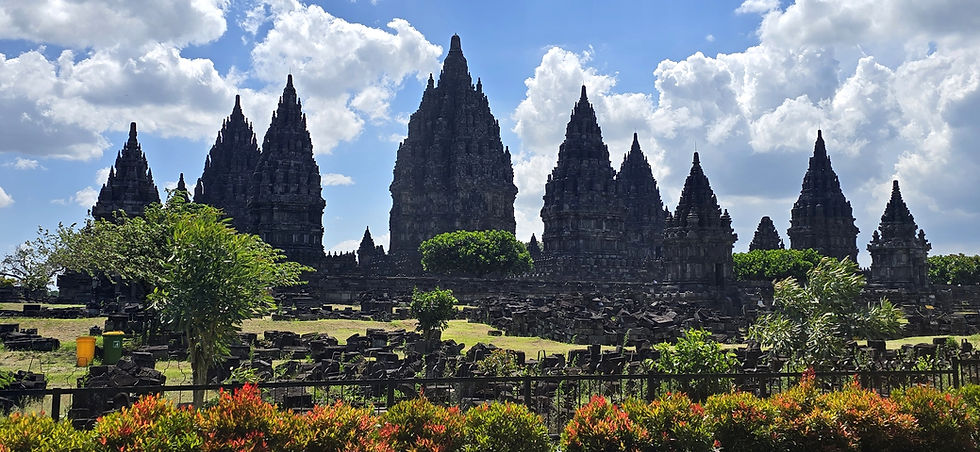
The layout of the complex follows a strict hierarchical design, with the most sacred temples concentrated at the centre and layers of smaller shrines radiating outward in concentric squares. This organisation guides pilgrims inward, from the mortal plane to the divine, reinforcing the idea of spiritual ascent. The symmetry is exacting, suggesting a worldview in which cosmic order governs every stone. Repetition and layering amplify the sense of vastness, while the carefully measured distances between towers and terraces echo a deliberate sacred geometry, where human movement mirrors divine intention.
At the heart of the complex stand the temples dedicated to the Trimurti, the three principal deities of Hinduism representing creation, preservation and destruction. Shiva, the destroyer and transformative force, occupies the tallest temple at the centre, his inner chamber housing the primary statue. Flanking him are Vishnu, the preserver and Brahma, the creator, each in slightly smaller temples to complete the cosmic triad. Opposite these shrines, smaller temples honour their vahanas, Nandi the bull for Shiva, Garuda the eagle for Vishnu and Hamsa the swan for Brahma, reinforcing the gods’ presence through symbolic guardians. The entire ensemble establishes a sacred order in stone, a vertical hierarchy where divinity asserts itself over both space and worshipper.

Encircling the main temples, hundreds of perwara shrines radiate outward in precise, concentric formations, forming a mesmerising labyrinth of stone that stretches across the temple grounds. Many still cradle statues of lesser deities, guardian figures and divine attendants, their presence reinforcing the sanctity and spiritual power of the site. These shrines served as both protective sentinels and symbolic companions to the main sanctuaries, amplifying the presence of the gods and providing space for ritual practice along the path toward the Trimurti.

Narrative reliefs wrap around the bases of the main temples, most famously depicting the Ramayana, one of the great epics of India. The story follows Prince Rama, his wife Sita, his brother Lakshmana and the devoted monkey-general Hanuman as they confront the demon king Ravana. Carved in continuous panels, the reliefs depict battles, loyalty and divine intervention, conveying moral lessons while linking the earthly realm to the cosmic order. These carvings guide visitors’ eyes along the walls as if telling a story in stone, merging devotion, instruction and artistry into a single, unbroken narrative.

The legend of Rara Jonggrang has seeped into every stone of Prambanan. The story tells of a powerful prince, Bandung Bondowoso, who sought her hand in marriage. She refused, setting him an impossible task, to build a thousand temples in a single night. With the aid of spirits, the prince nearly completed the work, raising hundreds of structures with miraculous speed. Desperate to avoid marriage, Rara Jonggrang created the illusion of dawn, tricking the spirits and halting the effort. Enraged by her deception, Bandung Bondowoso cursed her into stone, transforming her into the statue said to reside within the Shiva temple. The surrounding perwara shrines, numerous yet finite, echo this incomplete thousand temple ambition, leaving behind a sense of unfinished power and tension. Her story lingers like a shadow across the complex, blending human cunning, divine punishment and the fragile boundary between mortality and the eternal.

Within the northern chamber of the main Shiva temple stands the single statue of Durga, locally identified with Rara Jonggrang. She is depicted as the slayer of Mahishasura, the terrifying buffalo demon, her multiple arms bristling with weapons. Her expression is a chilling combination of serenity and wrath, calm in her resolve yet unmistakably lethal, embodying the moment before the strike that ends the demon’s life. The figure dominates the chamber, radiating both protective power and the violent energy necessary to maintain cosmic balance. Though the only free standing Durga figure in the complex, her presence resonates throughout the surrounding shrines, a symbol of vigilance and the relentless enforcement of divine order.


This Unesco World Heritage site endures not merely as a temple complex but as a testament to an ancient civilisation that transformed art, ritual and legend into a single, enduring landscape. Each shrine, relief and chamber preserves the tension between cosmic order and human desire, between gods and mortals, turning the stones themselves into vessels of memory and authority. The silent presence of Durga, the story of Rara Jonggrang and the countless mythic figures carved into the walls remind visitors that here, stories govern space and ritual shapes perception. Even 1150 years later, Prambanan commands respect, leaving all who enter with the sense that its creators did more than build, they inscribed the pulse of a universe into the earth.

🗺️ Location
Jalan Raya Solo, Yogyakarta No.16, Kranggan Village, Bokoharjo Subdistrict, Prambanan District, Sleman Regency, Yogyakarta Special Region, Java, Indonesia
🚆 How to get there
Prambanan Temple lies about 17 km's northeast of Yogyakarta’s city centre, roughly a 25 - 30 minute drive depending on traffic, making it an easy addition to a day exploring the eastern plains of Sleman. Visitors can reach the site by taxi or rideshare, with fares from central Yogyakarta generally ranging between 100,000 - 150,000 IDR one way or by renting a scooter for about 70,000 - 100,000 IDR per day if you’re comfortable navigating local roads. Many travellers prefer hiring a private car with driver for the day at roughly 600,000 IDR, which offers the flexibility to combine the visit with nearby temples such as Ratu Boku or Plaosan Lor and other scenic spots in the region.
⭐ Attraction Info
Prambanan Temple is open daily between 6:30am - 5:30pm, with international visitor entrance fees at (a steep!) 400,000 IDR. On Mondays, the main temple courtyards may be restricted for maintenance and preservation, though visitors can still explore the outer grounds and nearby sites. The complex offers a wide range of facilities, including restrooms, cafés and restaurants, shaded seating, souvenir stalls, a dedicated on site museum and options to hire guides. Shuttles and bicycles are also available for rent, making it easier to explore the huge, 40 hectare temple complex. Visitors should allow at least two to three hours to fully experience the main temples and surrounding perwara shrines. On Tuesday, Thursday and Saturday evenings, the Ramayana Ballet is performed against the illuminated temple backdrop, usually starting around 7:30pm, with tickets ranging from 150,000 to 450,000 IDR depending on seating. The temple is particularly striking in the late afternoon, when the sun casts a warm glow over the spires and reliefs, creating ideal conditions for photography.

Thanks for reading about Prambanan Temple. Check out more awesome destinations here!


