
Pura Agung Jagatnatha
Denpasar’s Monument to the Supreme God
At the spiritual centre of Denpasar stands Pura Agung Jagatnatha, a temple unlike any other on the island. Constructed in the mid 20th century, its founding was initiated around 1953 and completed in the 1960's, envisioned by I Gusti Ketut Puja, the first Governor of Bali after the islands' independence. Unlike Bali’s ancient temples devoted to specific deities or local spirits, Jagatnatha was conceived as a "Kahyangan Jagat", a temple for all humanity, dedicated to Ida Sang Hyang Widhi Wasa, the supreme and formless God who encompasses every aspect of the universe. The name itself, Jagatnatha, means “Lord of the Universe,” a phrase that captures both the temple’s cosmic scope and its unifying intent in a post colonial Bali seeking spiritual identity.

The temple was deliberately raised beside Lapangan Puputan Badung, the blood soaked grounds where Denpasar’s royal court met its end in 1906. Here, surrounded by Dutch guns, the Balinese nobles and their families chose ritual suicide (or Puputan) over surrender, marching into gunfire adorned in white ceremonial dress. The field became both grave and altar, a final offering of bodies to dignity and dharma. It is no accident that Pura Agung Jagatnatha now stands within sight. The temple’s placement binds faith to sacrifice, its presence a solemn echo of that collective death and spiritual rebirth. Constructed from white coral stone, it gleams beneath the sun, purity forged from the memory of violence. Its flawless geometry contrasts sharply with the dark volcanic temples elsewhere, as though declaring that from the island’s deepest shadow, Bali’s devotion found light.

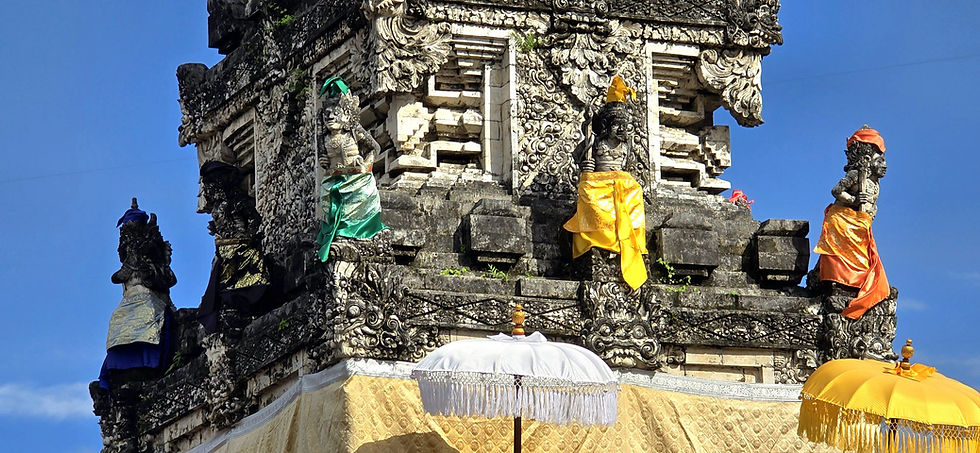
At the heart of the temple rises the Padmasana, the towering lotus throne that commands the courtyard in solemn silence, bearing witness to both mortal ruin and divine endurance. While similar structures appear in temples across the island, the one at Jagatnatha Temple is unique, sculpted entirely from white coral stone rather than the dark volcanic rock typically used, its brilliance a deliberate emblem of spiritual purity. It is the largest of its sort on the whole island. Its base depicts Bedawang Nala, the cosmic turtle supporting the world, entwined by the serpents Anantabhoga and Basuki, guardians of balance and creation. From this foundation, the tower climbs through the underworld, the human plane and the celestial realm, culminating in a golden sun disc that crowns the structure. Facing east toward Mount Agung, Bali’s holiest peak, the Padmasana anchors the temple to the island’s spiritual axis, its gleaming presence a steadfast point of focus, where the tension of earthly life meets the calm of the eternal.

Although a relatively recent construction, the temple quickly became one of the most significant places of worship in southern Bali. On Purnama (full moon) and Tilem (new moon), the courtyard transforms, filled with hundreds of devotees carrying offerings of flowers, fruit and incense, moving with deliberate, measured grace. The air thickens with smoke and the low, rhythmic resonance of gamelan, blending with the ringing of bells and the chants of the Gayatri Mantra, creating a tension between the mortal and the divine that feels timeless. Priests in white robes weave through the shadows, sprinkling holy water and reciting mantras that seem to linger long after the sound fades, while the lamplight flickers across the white coral of the Padmasana, casting shifting silhouettes that hint at unseen presence. Though the temple sits in the heart of modern Denpasar, in these moments it feels ancient, each stone echoing the countless cycles of devotion and loss that have defined the island. It is a living symbol of Bali’s faith, resilient, renewing and quietly luminous amid the bustle of the city.

In its design, Jagatnatha bridges eras and ideologies, a structure where time itself seems to fold. The split gates (candi bentar), guardian statues and tiered courtyards echo centuries of classical Balinese architecture, familiar yet elevated, while the temple’s monumental scale and precise symmetry reflect the ideals of a newly unified Indonesia after 1945. Its white coral stone, luminous against the tropical sky, stands in stark contrast to the dark volcanic rock used in most temples, signaling both purity and transcendence. Every line and curve is deliberate, a statement that Sang Hyang Widhi Wasa exists beyond duality, beyond shadow and light, form and void. Here, opposites meet. The cosmic and the civic, the ancient and the modern, the sacred and the human, all converging in silent, uncompromising harmony.
The temple’s significance extends beyond architecture. Constructed soon after Indonesia’s independence, it embodies Bali’s negotiation with modernity, a conscious effort to adapt without sacrificing spiritual identity. It demonstrates that Hinduism on the island could centralise, unify and still honour its myriad local traditions. Jagatnatha became both a religious and cultural declaration, a monument insisting that devotion need not fracture, that the island’s countless deities were, in essence, manifestations of the one infinite source, Ida Sang Hyang Widhi Wasa. Every ceremony, every step across its white stone courtyards, is a reminder of this delicate balance between continuity and renewal.

Today, Pura Agung Jagatnatha pulses at the centre of Denpasar’s spiritual life. Its rituals mark lunar cycles with silent discipline and resounding presence, while its open gates welcome devotees and travelers alike, all drawn to its commanding serenity. As dusk falls and the city’s bustle softens, the temple glows under lamplight, its white coral surfaces catching the fading sun and reflecting a ghostly, almost spectral radiance. Each shadow and contour seems alive, echoing centuries of devotion, resilience, and belief. There is no need for myth or legend here, the temple’s power lies in its very being, in its living connection to the island’s faith. It stands as a modern sanctum built upon ancient foundations, a place where stone and spirit converge and where the eternal breath of Bali’s gods continues to move through shadow, light and the quiet pulse of human reverence.
Thanks for reading about Pura Agung Jagatnatha. Check out more awesome destinations here!

🗺️ Location
Jalan Surapati No. 7, Dangin Puri, East Denpasar, Bali, Indonesia
🚆 How to get there
Pura Agung Jagatnatha is easily accessible from both Kuta and Sanur, lying approximately 10km's from Kuta (roughly 30 minutes drive) and 8km's from Sanur (about 25 minutes), navigating through Denpasar’s bustling streets, local neighborhoods and cultural landmarks. From Sanur, visitors can follow Jalan Danau Tamblingan west toward Denpasar, continue onto Jalan Raya Puputan and turn onto Jalan Mayor Wisnu to reach the temple. Taxis or private drivers cost around 80,000 - 120,000 IDR one-way, while hiring a motorbike with a driver for around 40,000 IDR, allowing for a more immersive exploration of the city and surrounding temples. Morning departures are recommended to avoid traffic and enjoy the temple in relative calm.
⭐ Attraction Info
Jagatnatha Temple is open daily between 8am - 5pm , with free entrance, though voluntary donations (around 30,000 IDR) are appreciated to help maintain the temple. Visitors are required to dress modestly, covering shoulders and knees. A sarong is mandatory and will cost an additional 20,000 IDR if you don't travel with your own. Most visits take 30 minutes max to explore the monumental Padmasana, courtyards and guardian statues. The best time to visit is in the morning, when the courtyards are calm and the white coral stone structures glow under soft sunlight. Nearby, visitors can explore the Bajra Sandhi Monument, the Bali Museum right next door and the Maospahit Temple. Despite its historical significance, Pura Agung Jagatnatha remains surprisingly overlooked by international visitors, so you're far more likely to share its courtyards with local worshippers than crowds of tourists. It is quiet.


