Pura Ulun Danu Batur
The Temple of Ash and Mercy
Pura Ulun Danu Batur rises along the fractured inner rim of the Kintamani caldera, where the land feels less like a stable foundation and more like a long unfinished rupture in the surface of the earth. At roughly 900 metres above sea level, it overlooks the immense volcanic basin of Mount Batur and the shifting waters of Lake Batur, a body of water understood in Balinese cosmology not as scenery but as a living force that regulates fertility, agriculture and spiritual balance across the island. In this elevated position, the temple does not simply occupy the landscape but appears to govern it, as though the entire caldera sits within a wider ritual responsibility.

Although its formal establishment is generally placed in the 17th century, the temple's spiritual origins draw from far older and less documented traditions of mountain and lake worship that long predate written history. The original complex once stood at the base of Mount Batur in the village of Karang Anyar, where human settlement existed in constant negotiation with an active volcano that was understood not as inert geology but as an expressive presence capable of destroying without warning. When the eruption of 1917 occurred, lava descended through the slopes with an almost deliberate inevitability, reshaping fields and villages, yet local tradition preserves the belief that it stopped just short of the temple gates, an outcome interpreted not as coincidence but as restraint, as though the mountain itself had acknowledged a boundary between sacred space and destruction.

Interwoven with this cosmological structure is the legend of Kang Cing Wie and King Sri Jaya Pangus, one of Bali's most haunting origin myths, where devotion slowly gives way to deception and desire. Sri Jaya Pangus is remembered as a ruler bound to both courtly authority and foreign maritime networks, married to Kang Cing Wie, a Chinese noblewoman whose presence marks both a powerful political alliance and the union of two distant worlds. When he left on pilgrimage to Mount Batur, the journey gradually became something far more dangerous than an act of devotion, as he entered the volcanic highlands and encountered Dewi Danu, the goddess of Lake Batur and guardian of Bali's sacred waters, whose beauty and supernatural presence captivated the king. Concealing the existence of his queen, Sri Jaya Pangus courted Dewi Danu as though no earthly vows had ever bound him, weaving a deception that would ultimately destroy them all. In many versions of the legend, the two married and bore a son, as what began as pilgrimage transformed into an act of adultery and abandonment, with the king convinced his betrayal would remain hidden forever.

While the king built a new life in the shadow of Mount Batur, Kang Cing Wie was left with nothing but silence, until absence hardened into suspicion and suspicion into certainty. Refusing to accept her husband's disappearance, she ascended into the volcanic highlands, only to discover him living another life beside the goddess herself. The confrontation that followed was not simply between a wife and an unfaithful husband but between two women who had both been deceived. Realising the king had concealed his marriage, Dewi Danu's fury turned upon the man who had betrayed them both. Tradition holds that divine vengeance erupted across the mountainside, consuming Sri Jaya Pangus and Kang Cing Wie in fire before transforming them both into stone, their final moments forever absorbed into the volcanic landscape. Their story refused to end there. It lived on through the towering Barong Landung effigies, carried in current day temple processions as haunting reminders that desire, deceit and divine vengeance rarely fade quietly into legend.

That fragile interpretation of protection collapsed in 1926 when Mount Batur erupted again with far greater intensity, overwhelming settlements and burying or destroying the original temple complex beneath ash and volcanic debris. In the aftermath, survival became a ritual act as much as a physical one, with villagers carrying sacred heirlooms, bronze effigies, cloth wrapped relics and ancestral objects upward through unstable terrain still radiating heat, as if preservation required passage through the aftermath of divine violence. The decision was then made to relocate the temple to a higher point along the southwest rim of the caldera, where it was reconstructed stone by stone, not as simple restoration but as a re-articulation of devotion in a landscape that had demonstrated its capacity to erase entire worlds without warning.

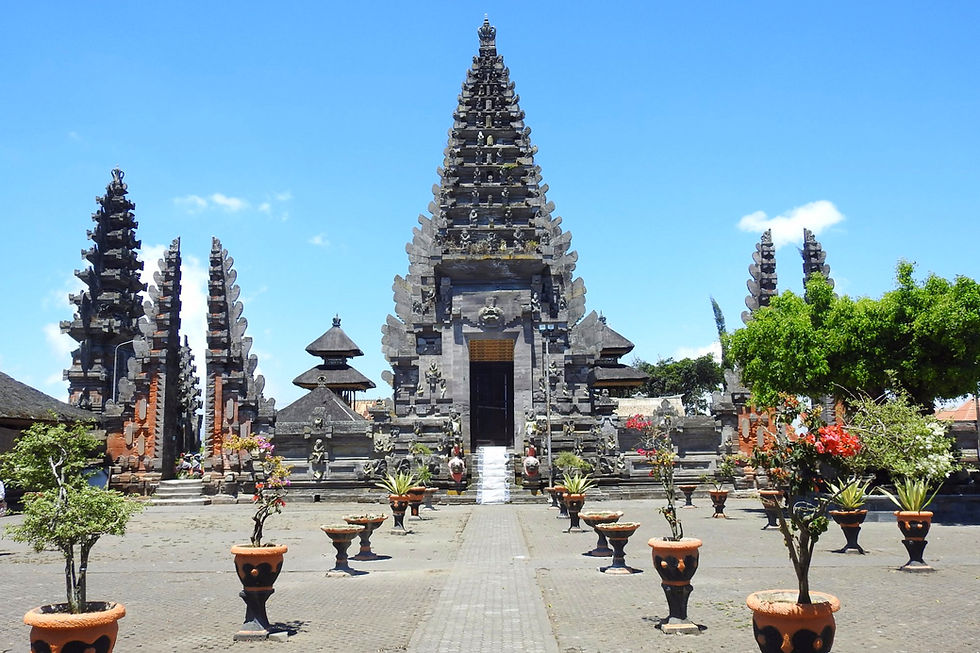
In its reconstructed form, Pura Ulun Danu Batur expanded into a vast ritual ecosystem comprising nine major temple compounds and more than 280 shrines and pavilions, arranged as a structured network of spiritual functions distributed across space. Each shrine is associated with different aspects of life and cosmic order, including agriculture, fertility, artistic expression, protection and the management of sacred waters, creating a system in which devotion is not centralised but dispersed across many specialised points of contact. The architecture is dense with symbolic intention, where carved guardians, black lava stone structures and layered courtyards create a visual language of authority that feels fluid rather than fixed, as if power itself is meant to circulate rather than remain still.
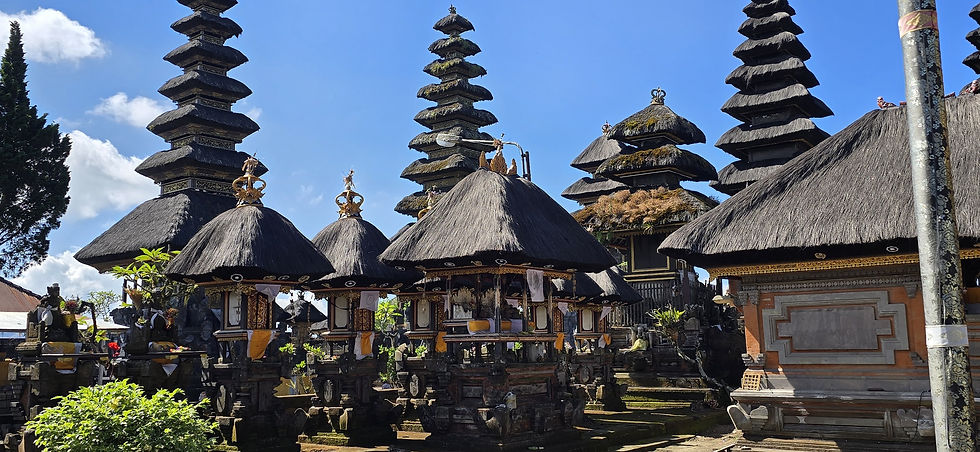
The most visually dominant elements of the temple are its meru towers, particularly the 3, nine tiered structures that rise like vertical condensations of belief above the complex. These are dedicated to Mount Batur, Mount Abang and Ida Batara Dalem Waturenggong, the deified ruler of the Gelgel dynasty whose presence binds political history to sacred geography within a single architectural gesture. Each tier of a meru represents a cosmological ascent, marking increasingly refined levels of existence, where the material world is gradually left behind in favour of more abstract spiritual states, until form itself begins to dissolve into symbolic suggestion.

Even today, Pura Ulun Danu Batur retains a reputation for subtle atmospheric disturbances that resist straightforward explanation, with local accounts describing mist that gathers unusually tightly around the meru towers, sudden drops in temperature near certain shrines and shifts in the lake's surface light that feel almost responsive. Despite its recognition as part of the UNESCO World Heritage listing of Bali's Cultural Landscape in 2012, the temple does not function as a static monument but as a living system in which geology, agriculture, ritual and memory remain inseparably entangled. It endures not as a structure protected from instability but as one embedded within it, maintaining a continuous and uneasy agreement with a landscape that has already proven it can erase, reshape and renew everything it contains.

🗺️ Location
Jalan Raya Kintamani, Batur Sel, Kintamani, Bangli Regency, Bali, Indonesia
🚆 How to get there
Pura Ulun Danu Batur is located in the Kintamani region, perched high on the southwestern edge of Mount Batur’s caldera. The most common approach is from the south, with two main routes leading from Ubud, each taking around an hour. The temple is also accessible from Besakih, about an hour’s drive away and from Bangli, which takes approximately 30 minutes. Travellers coming from the north can reach the site easily via the coastal road that runs east of Singaraja, with a journey time of about one hour. If you're staying in the southern tourist hubs like Kuta or Denpasar, expect a scenic two hour drive one way, into the mountains to reach Kintamani and the temple. Organising a private driver for the day will be your easiest option, there are plenty of sites to see along the way. A driver for the day with cost around 1,000,000 IDR per car.
⭐ Attraction Info
Pura Ulun Danu Batur is open daily between 8am to 5pm and entry currently costs 75,000 IDR per adult for foreign visitors. The ticket counter is located on the other side of the road, opposite to the temple entry gate. As with all Balinese temples, visitors are required to wear a sarong and a sash tied around the waist as a sign of respect. If you don’t bring your own, these can be rented near the ticket counter for around 20,000 IDR. Many travellers have reported persistent vendors and occasional pressure to pay for unnecessary services near the entrance. To avoid hassle, it’s often easier to bring your own sarong, purchase tickets directly at the official counter and continue into the temple grounds without engaging with unsolicited offers. Once inside, the atmosphere is generally far calmer, allowing you to appreciate the temple’s dramatic caldera setting and spiritual significance in relative peace.

Thanks for reading about Pura Ulun Danu Batur - The Temple of Ash and Mercy. Check out more awesome destinations here!