
The Life of Buddha
Updated: Apr 17
The Sealed World of Perception
The story of Siddhartha Gautama begins around 2600 years ago in Lumbini, in southern Nepal near the border of India, in a fragmented world of rival courts and shifting borders where nothing stayed unified for long. He is born into the ruling Shakya clan and his father raises him inside a carefully controlled world built to shield him from suffering, as if it could be erased simply by keeping it out of sight. That sheltered reality holds until Siddhartha steps beyond it and it breaks. He encounters what tradition calls the Four Sights: old age, sickness, death and a wandering ascetic, a monk who had given up worldly life in search of liberation. These are not symbols but direct confrontations with existence itself. Something irreversible opens in him. At twenty nine, he leaves his home, his wife, his child and his inheritance behind, stepping into a world of wandering seekers who had already renounced ordinary existence.

The Renunciation of Siddhartha
What follows is not a search for comfort but a stripping away of every way experience can be controlled or avoided. He studies under teachers who guide him into deep meditative absorption where perception fades and identity seems to dissolve into vast stillness, yet even these states end and return him to the same underlying dissatisfaction. He then turns toward extreme asceticism, reducing his body through starvation and deprivation until it is nearly extinguished. It brings him close to death but not closer to resolution. In that collapse, a clearer understanding forms. Neither pleasure nor pain resolves suffering because both depend on the same assumption that experience can be mastered. From this breaking point emerges the Middle Way, not as moderation but as refusal, a path that rejects both indulgence and self-destruction as distortions born from grasping.

Beneath the Bodhi Tree
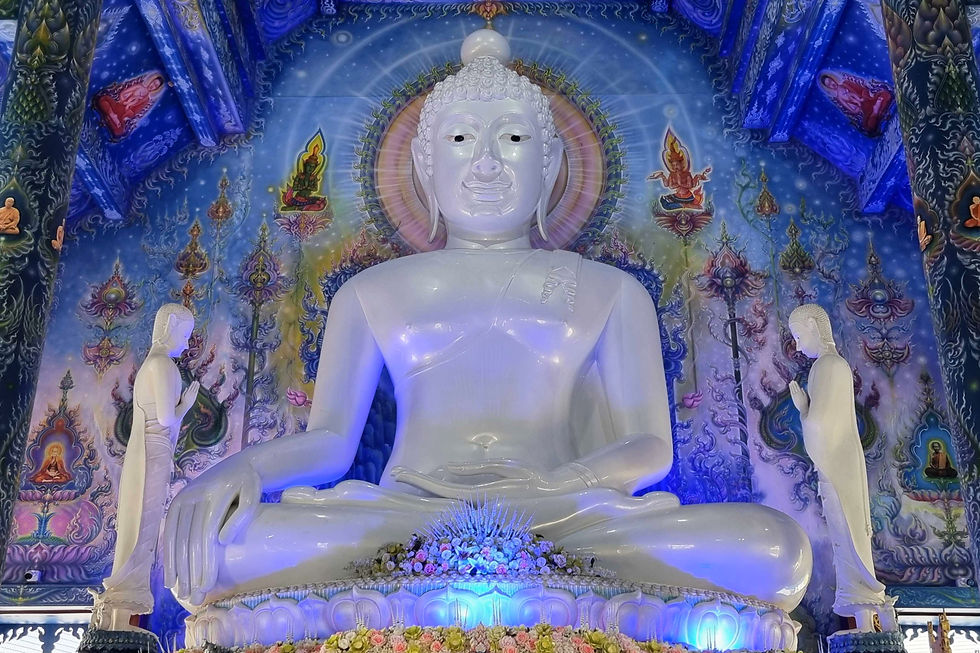
The turning point comes beneath the Bodhi tree in present day Bihar, where he enters deep meditation and turns directly towards experience itself. In that stillness, awakening breaks through and he becomes known as the Buddha, the Awakened One. He sees that existence is marked by Dukkha, a deep sense of suffering and unease running through all things because everything is always changing. Its cause is Tanha, a craving that tries to hold on to what is already slipping away. When this is clearly seen, its release becomes possible. From here he sets out the Noble Eightfold Path as a way forward, a practical discipline of how to see and live: right understanding, intention, speech, action, livelihood, effort, mindfulness and concentration. At the core of this insight is also a shift in understanding. Everything is impermanent, Anicca, nothing staying fixed even for a moment, with thoughts, bodies, emotions and perceptions constantly arising and fading. From this follows Anatta, non-self, where the sense of “I” is not a solid thing but a process made from changing parts. What feels like identity is only a shifting pattern held together by habit, not something permanent or separate.
Teaching the Dharma
For roughly 45 years, he travels across northern India, teaching through direct encounter rather than doctrine. He speaks to rulers, merchants, farmers and wandering ascetics, shaping his language to context while returning to the same insight about suffering, craving and perception. Around him forms the Sangha, a monastic community of monks and later nuns, who preserve his teaching through disciplined practice, oral transmission and daily observance. After his death, this community becomes the vessel through which Buddhism spreads beyond India along trade routes into Sri Lanka, Myanmar, Thailand, Laos, Cambodia, Vietnam and Indonesia, where it adapts to local cultures while retaining its core concern with the nature of suffering and awareness.

Completion of the Buddha’s Path
His death comes at around 80 years of age in Kushinagar, in northern India near the Nepal border, at the close of a life spent entirely in motion, teaching across rivers, kingdoms, forests and cities without ever settling into permanence. It follows a final illness traditionally associated with a meal offered by a supporter named Cunda, yet it is not treated in tradition as misfortune or interruption but as the final unfolding of the truth he had spent decades articulating, that all conditioned things dissolve. As his body weakens, he is said to continue teaching, turning even the approach of death into instruction, showing that impermanence is not theory but direct experience. His passing is called Parinirvana, the complete release beyond rebirth, understood not as disappearance into nothingness but as the end of the conditions that produce existence as it is ordinarily known. In his final moments, he instructs those gathered not to anchor themselves in his physical presence, because it will not remain but to rely entirely on the teaching itself as their refuge once he is gone.

Sacred Fragments
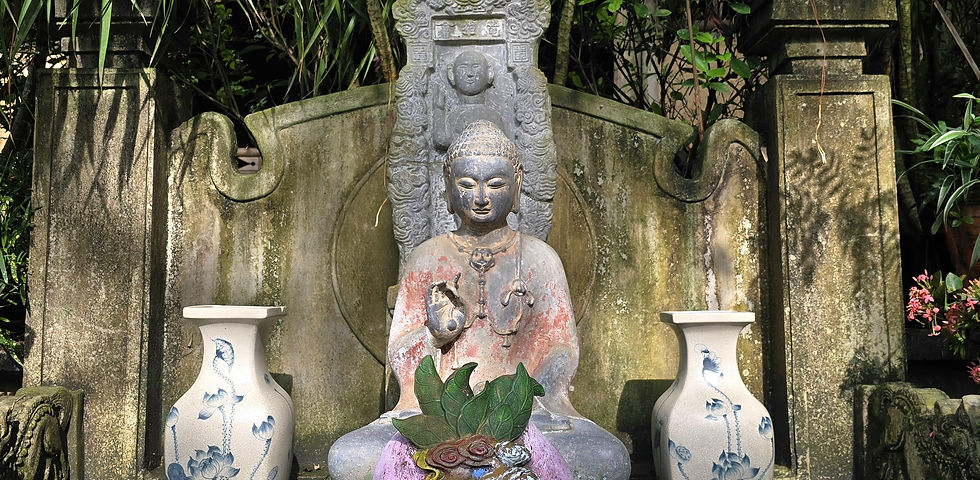
After his cremation, his remains are traditionally said to have been divided among early Indian kingdoms and clans. These relics were distributed as sacred portions to rulers and communities who enshrined them in stupas across the Gangetic plains and beyond, turning physical fragments into focal points of devotion and pilgrimage. Bone relics and ashes were not seen as remnants of absence but as enduring links to presence itself, anchoring memory in stone and ritual across centuries. From this physical dispersal, Buddhism develops a visual language that carries its philosophy into form. Seated Buddhas represent awakening, earth touching gestures mark enlightenment, teaching postures signify the turning of understanding and reclining forms represent final passing, all expressed through symbolic hand gestures known as mudras. In Mahayana traditions, Bodhisattvas are enlightened beings who delay final release from rebirth, choosing instead to remain within the cycle of suffering to help others awaken, embodying compassion as an active force within the world.
The Legacy of Buddhism
What remains is not a doctrine to be accepted but a way of seeing that challenges the idea that anything is fixed. It reveals suffering as the tension between wanting things to stay the same and the reality of constant change. Identity is seen as a process rather than something solid or owned and even certainty begins to weaken when closely examined, leaving a clarity that does not depend on anything remaining still. In that clarity, the Buddha is not a historical figure but a continuing shift in perception itself, where the mind becomes aware of how quickly it grasps at things as if they were permanent. This recognition does not fade like ordinary understanding but lingers, reshaping how attention works and how life is lived, not by offering escape but by removing the need for escape in the first place. What the life of Buddha leaves behind is not a story that resolves but a pressure on perception that reshapes how reality is seen, leaving nothing in experience untouched by the recognition that nothing was ever fixed to begin with.
Thanks for reading about The Life of Buddha. Check out more awesome legends here!


