Borobudur Temple
Threshold Between Worlds
Rising from the misty Kedu Valley like a cosmic citadel, Candi Borobudur stands as both a marvel of human ingenuity and a mystery of the divine, its nine intricately stacked platforms and six square terraces crowned by three circular levels, culminating in a majestic central stupa that dominates the horizon. Spanning over 2500 square metres, each layer is more than architecture, it is a spiritual ascent, a three dimensional map of the cosmos where the earthly and the sacred converge, echoing the Buddhist path from mundane existence to enlightenment. Carved meticulously from volcanic andesite, the terraces and walls bear the silent legacy of ancient Javanese artisans, their artistry enduring centuries of volcanic upheaval, shifting dynasties and the relentless passage of time. As dawn mists curl through the valley, the monument transforms into a labyrinthine bridge between earth and sky, inviting all who approach to embark on a journey toward spiritual awakening that has persisted for over twelve centuries.

Walking along its relief laden terraces, visitors encounter over 2600 panels depicting the Jataka tales, chronicling the Buddha’s previous lives in meticulous detail. The walls come alive through these carvings, as figures of humans, animals and divine beings are frozen mid gesture, caught in moments of struggle, temptation and transcendence. From the shadowed lower terraces, where earthly desires and moral lessons are etched with painstaking care, to the higher levels illustrating the soul’s ascent toward nirvana, the temple unfolds as a guided spiritual journey in three dimensions. Under the shifting sunlight, the carvings almost seem to move, as if the stone itself watches the observer, a subtle reminder that the path to enlightenment is as fraught with darkness as it is illuminated by wisdom. Each panel instructs, inspires and elevates, turning the act of traversing the terraces into an immersive voyage through centuries of devotion and artistry, where human and divine converge in frozen motion.

At the summit, the central stupa rises like a silent guardian, encircled by dozens of smaller perforated stupas, each cradling a seated Buddha statue. This geometric mastery functions as a spiritual conduit, an axis mundi connecting the earthly realm with the infinite, while the square terraces below represent the world of desire and form and the circular terraces above evoke the formless, eternal cosmos. Scholars have long suggested that the monument itself is a multi dimensional mandala, a sacred diagram guiding pilgrims through a ritualistic ascent, transforming each step into a meditation on the journey from worldly attachment to spiritual liberation, fostering reflection, contemplation and appreciation for the harmony of human ingenuity and spiritual insight.


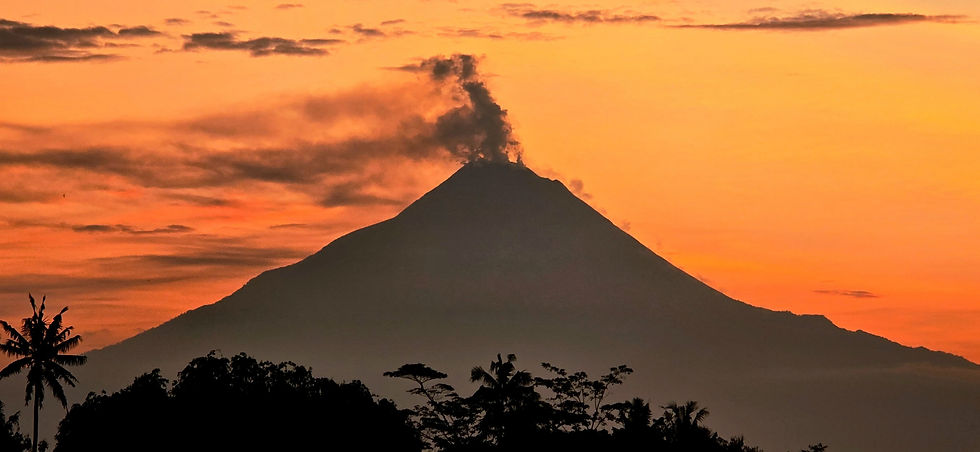
Its power is inseparable from its setting. Aligned with Mount Merapi to the north and the Progo River to the south, the temple occupies a nexus of natural and spiritual forces, where geography itself seems imbued with sacred purpose. Mist rolls through the valley in the early hours, cloaking the terraces in a ghostly veil and transforming the monument into a floating island between earth and sky. The interplay of mountains, volcanic plains and shifting fog creates a liminal space where past, present and the divine converge, evoking a sense of transcendence as if the temple channels the rhythms of nature into a silent, mystical meditation, amplifying the connection between human endeavor and the world around it.


Steeped in both history and legend, the origins of Borobudur entwine human ambition with timeless tales. Local myths cloak the monument in enchantment. Some speak of hidden treasures beneath the central stupa, gifts from the gods protected by mystical forces, while others claim it was raised in a single night by spirits or supernatural architects shaping massive volcanic stones with divine hands before vanishing with the dawn. Over centuries, it was swallowed by volcanic ash and dense jungle, its stupas and terraces hidden as if nature itself conspired to preserve its secrets. Rediscovered in 1814 by Sir Thomas Stamford Raffles, the monument emerged from centuries of volcanic ash and jungle overgrowth, revealing not merely ruins but a meticulously engineered structure. Its interlocking volcanic blocks and harmoniously stacked terraces conveyed a level of precision and architectural knowledge that astonished all who saw it. For the Javanese people, this reclamation was not merely an archaeological triumph but a profound reconnection to spiritual heritage, illuminating the enduring mastery and mystical aura of this ancient sanctuary.

In the 1970's, UNESCO undertook a monumental restoration to safeguard the temple for future generations. Thousands of volcanic blocks were painstakingly dismantled, catalogued, and reassembled, while the delicate reliefs and carvings were treated to endure centuries more of weathering and erosion. The project preserved not only stone but the subtle harmony of art, geometry, and spiritual symbolism that gives the monument its transcendent power. Even today, visitors can sense the meticulous care and reverence embedded in every restored surface, a tangible echo of human devotion across the ages. The sanctuary endures as a bridge between mortal craftsmanship and sacred ambition, its presence commanding awe while hinting at the silent mysteries that have drawn pilgrims and scholars alike for over a millennium.

Even today, Borobudur awakens with devotion and wonder. During Vesak, the most important Buddhist festival commemorating the Buddha’s birth, enlightenment and passing, thousands of pilgrims ascend its terraces in candlelit processions, retracing the sacred path to liberation. The volcanic stones, etched with centuries old tales of morality, karma and transcendence, seem to hum with the memory of generations past, as if the structure channels the devotion of countless pilgrims. More than a monument, Borobudur is a living enigma within a mystical landscape where history, spirituality and artistry converge, leaving every visitor with a sense of awe, reflection and a tangible connection to a tradition that has endured for over 1200 years.

🗺️ Location
Jalan Badrawati, Borobudur, Magelang Regency, Central Java, Indonesia
🚆 How to get there
Borobudur Temple is located approximately 40 km's northwest of Yogyakarta’s city centre. The drive typically takes around 1.5 to 2 hours, depending on traffic and travellers can reach the site in several ways. Hiring a private car or taxi is the most comfortable option, with round trip fares generally ranging from 600,000 to 800,000 IDR and it offers the flexibility to stop at scenic spots along the way. For those on a budget, the DAMRI bus service connects Yogyakarta to Borobudur in about 2.5 hours, with tickets costing between 17,000 and 85,000 IDR. More adventurous visitors may opt to rent a scooter for roughly 70,000 to 100,000 IDR per day, though navigating local roads requires confidence and experience. The journey itself is scenic, passing through lush countryside and small villages, making the approach to the temple an immersive part of the experience.
⭐ Attraction Info
Borobudur Temple is open daily between 6:30am - 5:30pm, except on Mondays, when the temple is closed for maintenance. Access to the upper temple structure and terraces begins at 8:30am, allowing visitors to explore the intricate reliefs and stupas. International visitors can choose between two main ticket types, the Temple Ground Ticket for 375,000 IDR, which grants access to the surrounding grounds and the Temple Structure Ticket for 455,000 IDR which allows full access to the terraces and their carvings. Combination tickets, valid for two days, are also available for those wishing to visit nearby sites, such as Prambanan or Ratu Boko, priced at 630,000 IDR. The modern complex is designed for comfort and convenience, featuring a museum with historical and archaeological exhibits, a cafeteria and restaurant, clean restrooms and small gazebos for rest and reflection. Visitors benefit from free shuttle services around the grounds, free guides allocated to each group and traditional woven pandan leaf sandals called Upanat, which come in a special bag and may be taken home as a keepsake. To fully experience the monument, including terraces, reliefs and museum exhibits, it is recommended to allocate at least three hours.

Thanks for reading about Borobudur Temple. Check out more awesome destinations here!