Mount Merapi
The Silent Court of Fire and Spirits
Mount Merapi rises over Central Java as both a geological engine of destruction and a living presence in Javanese belief. Scientifically, it is one of the most active stratovolcanoes on Earth, repeatedly growing unstable lava domes that collapse into lethal pyroclastic flows. Culturally, this constant activity is not seen as chaos but intention. Merapi is believed to act when balance between the human world and the unseen realm fractures, making each eruption both a physical event and a moral signal.

Merapi sits on a sacred north - south axis linking the Sultan’s palace in Yogyakarta to the Indian Ocean, the domain of Nyai Roro Kidul, the Spirit Queen of the Southern Sea. In Javanese belief, she is a sovereign entity whose court governs tides, storms and the spiritual currents of the island. The axis is treated as literal infrastructure of cosmic balance and Merapi’s activity signals tension in her court or human disorder. Local legends insist that disrespect, greed or ambition can provoke not just eruptions but misfortune or disappearance. Offerings of incense, flowers and ceremonial textiles are made along the axis to appease her, acknowledging that Merapi’s fury is both natural and deliberate, a response to the imbalance between the living and spirit worlds.
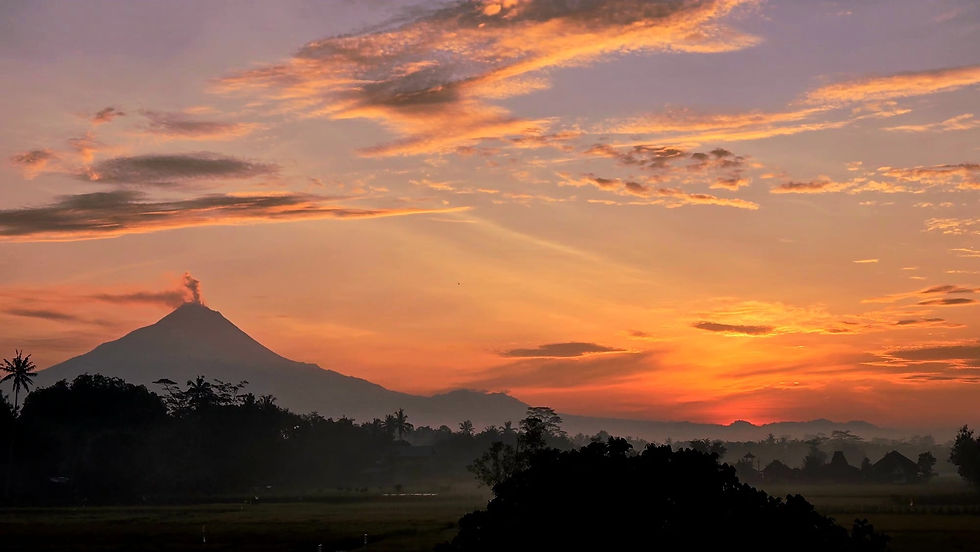
In Javanese belief, Merapi Volcano is inhabited by a structured hierarchy of "makhluk halus" or invisible beings who mirror human society. At the top are royal court entities residing in an unseen kraton, a spiritual palace within the mountain that functions like a Sultan’s palace, complete with rulers, attendants and guards, reflecting cosmic and political order. Below them are guardian figures patrolling ravines and lava paths, ancestral bound spirits absorbed after dying on the slopes and territorial penunggu cave spirits who enforce the mountain’s rules, punishing disrespect and rewarding those who honour them. During eruptions, these beings are believed to relocate within the volcano rather than vanish, “moving house” as Merapi reshapes itself. This metaphor mirrors scientific reality, where eruptions are often driven not by explosive blasts but by internal lava shifting, piling and collapsing under its own weight, turning spiritual migration and gravitational instability into two ways of describing the same violent reordering.

The role of the Juru Kunci, Merapi’s spiritual gatekeeper, embodies this overlap between fact and faith. Appointed by the Sultan, he maintains ritual communication with the mountain, interpreting subtle signs, like changes in wind, animal behaviour and dreams, long before instruments detect danger. In 2010, when Merapi produced its deadliest eruption in over a century, the sitting Juru Kunci refused evacuation, believing his duty was to remain. His death became both a scientific tragedy and a spiritual confirmation for those who believe Merapi cannot be abandoned without consequence.
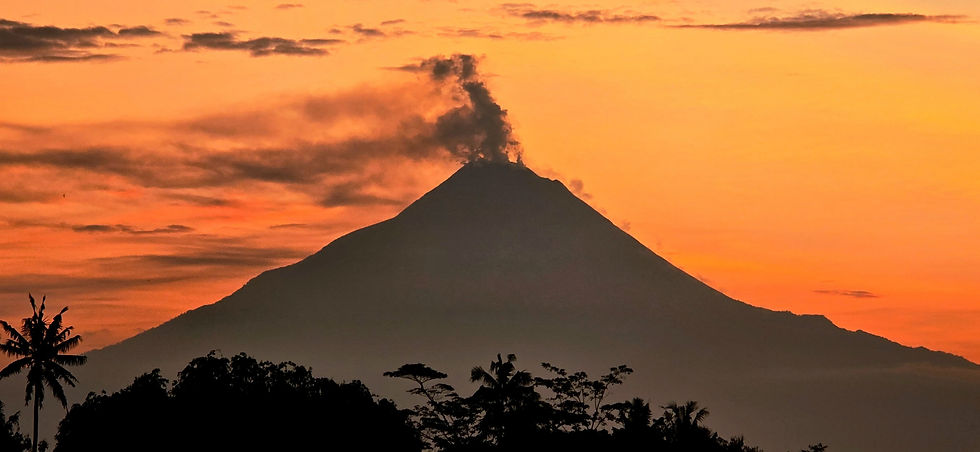
Merapi’s danger does not end when eruptions cease. Volcanologists warn of lahars, cement-like mudflows formed when heavy rain mobilises ash and debris, sometimes years later. In local belief, these delayed disasters are not aftershocks but reminders. The mountain’s work continues even when humans believe it is finished. Entire valleys have been erased long after the summit fell silent, reinforcing the idea that Merapi punishes complacency more than fear.
Despite repeated destruction, communities return again and again to Merapi’s slopes, drawn by soil so fertile it can feed families for generations. This cycle of death and renewal blurs the line between curse and blessing. The same eruptions that burn homes replenish fields, creating a brutal dependency where survival and sacrifice share the same source. Merapi is not escaped because, culturally and practically, it cannot be replaced.

What makes Mount Merapi uniquely unsettling is that its legends do not exist in opposition to science, they coexist with it. Monitoring stations track seismic tremors and gas emissions, while rituals continue at the same time, aimed at maintaining harmony rather than control. To live near Merapi is to accept that not all warnings come from machines and not all causes are measurable. In this landscape, eruptions are disasters but they are also messages, delivered in fire, ash and irreversible silence.
🗺️ Location
Jalan Boyong, Hargobinangun, Pakem, Sleman Regency, Yogyakarta Special Region, Java, Indonesia
🚆 How to get there
From Yogyakarta city, reaching Mount Merapi begins with a drive north along the winding Jalan Kaliurang, a scenic route that threads through villages and lush foothills for about 30km's until you arrive at the Kaliurang area, the main gateway for visitors. From there, roads continue up the volcano’s slopes, often requiring a 4x4 vehicle, especially if you plan to explore lava fields or observation points near the crater. For those without a private vehicle, guided tours from Yogyakarta provide safe access in jeeps, navigating the rugged terrain while offering local insight and a touch of the mountain’s eerie presence. Public transport is possible via minibuses toward Pakem or Kaliurang but venturing higher still demands organised transport, as the slopes are steep, unpredictable and shaped by centuries of lava flows.
⭐ Attraction Info
Visitors to Mount Merapi can explore its dramatic landscapes through jeep tours that navigate lava fields, past remnants of past eruptions and to lookout points or historical sites such as the Kaliadem bunker and the eruption museum. Guided hikes toward the slopes are also available, with guides helping groups safely traverse trails to higher elevations. General tour costs vary depending on duration and inclusions. A basic 3 hour jeep tour typically ranges around 600,000 IDR per vehicle, while half day or full day guided tours, including hotel pickup and multiple stops, can cost anywhere between 500,000 - 1,450,000 IDR per person. Special options like sunrise or night tours may be priced higher and most tours include admission fees and basic provisions, though meals and tips are usually extra.