
Kepeng Coin Figurines
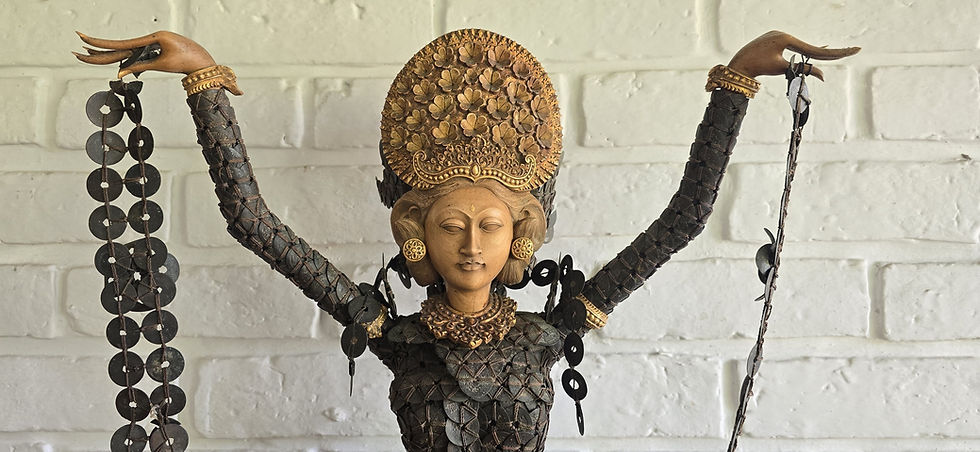
Among the countless carved deities and temple guardians found across Bali, some of the island’s most captivating figures are not carved from stone at all. They are formed from ancient kepeng coins, carefully stitched and wrapped over carved wooden or wire armatures until they become shimmering figures of gods, dancers and celestial beings. Their metallic bodies catch temple light in shifting fragments, their forms built from hundreds of overlapping discs that flicker like scales. Neither purely sculpture nor purely offering, they exist in a liminal space where craftsmanship and devotion blur into a single continuous act of making, as though belief itself has been given physical form.
The coins that form these figures carry a history far older than their life in Bali. Known as kepeng or pis bolong, these Chinese cash coins with their distinctive square centres were already ancient by the time they moved beyond China, their origins tracing back to early imperial dynasties such as the Tang period, around 1400 years ago. By the time they reached Southeast Asian waters, they were no longer fresh currency but objects already shaped by centuries of circulation and use. They arrived in Bali around the 9th century through maritime trade routes, carrying this accumulated age with them and it is perhaps this sense of layered history that allowed them to settle so naturally into Balinese life, where they were absorbed not only into everyday exchange but also into ritual and spiritual practice.

Once introduced, kepeng became deeply embedded in Balinese society and functioned for centuries as everyday currency. They passed through markets, royal courts, village exchanges and ritual transactions, forming part of the island’s material rhythm of life. Even after Dutch colonial systems introduced modern currency in the early 20th century, kepeng did not immediately vanish from circulation. In rural areas and ritual contexts they continued to be used well into the mid century, only gradually fading from everyday economic life by the 1940's. Yet their disappearance from markets did not diminish their importance. Instead, it marked a transition in meaning, as they moved decisively from currency into the realm of ritual, symbolism and sacred craft.
In Balinese spiritual practice, kepeng are now understood as objects capable of maintaining balance between seen and unseen worlds. They are still widely used in offerings and temple ceremonies, often arranged in precise configurations believed to attract prosperity, protection and harmony. In rites associated with death and reincarnation, they take on an even more intimate role, with bound or structured forms believed to assist the soul in its passage through transition and return, reinforcing continuity between life, death and renewal.
From this ritual foundation, one of Bali’s most distinctive folk art traditions slowly took shape. In places such as Gianyar, artisans began building figures not by carving or casting but by layering kepeng coins over carved wood or wire frames, binding them into form with fine thread and hidden structure until the metal itself seemed to become skin. What emerged were beings suspended between devotion and performance. Some take the form of Dewi Sri, the Goddess of rice and fertility, others echo dancers from classical traditions like Legong and Janger, while many draw from the Ramayana, including Rama and Sita. Their identities are never fixed in facial detail but carried instead through posture, gesture and ornament, as if meaning itself has been shifted into movement.

A more intimate variation of this tradition appears in so-called “angel dolls,” paired human-like figures that combine darkened coins with painted wooden hands, feet and faces. These objects carry a quiet theatricality, echoing Bali’s deep performance culture while remaining rooted in household spirituality and ancestral protection. Across all forms, the material logic of the kepeng remains central. Its circular form suggests wholeness and continuity, while the square centre expresses structure within cosmic equilibrium, a visual philosophy closely aligned with Balinese Hindu thought.
These ornate Kepeng coin figurines are encountered not as focal displays but as part of the wider spaces of temples, homes and workshops, where they sit among other sacred objects. They do not announce their significance through scale or placement but through the material itself, shaped by centuries of use and movement before being bound into crafted works. They exist in a quiet continuity with the coins they are made from, where nothing has been reset or erased, only rearranged into new form. What remains visible is not explanation but the persistence of material that has already lived far beyond its original purpose. The result is decorative art that carries its age openly, where the beauty comes directly from how long it has already lived.

Thanks for reading about Kepeng Coin Figurines. Check out more amazing legends here!


