Yogyakarta
A City Forged by Fire and Faith
For over 2500 years, fertile plains in central Java nurtured some of the earliest human settlements and in this volcanic landscape the city of Yogyakarta would eventually emerge as a centre of culture, spirituality and governance. It grew atop communities who farmed rice, traded along waterways and revered mountains and ancestral spirits long before kings formalised their rule. By the 8th and 9th centuries, Hindu and Buddhist kingdoms had already built temples, carved inscriptions and sacred shrines, marking the region as a hub of spiritual and artistic achievement. The land itself was shaped by the restless power of Mount Merapi, whose eruptions buried villages, created fertile soil and inspired awe for generations. When Prince Mangkubumi proclaimed himself Sultan Hamengkubuwono I in 1755, he established the modern Sultanate atop this ancient foundation, inheriting a city forged by centuries of ritual, volcanic forces and devotion to both earthly and spiritual guardians.

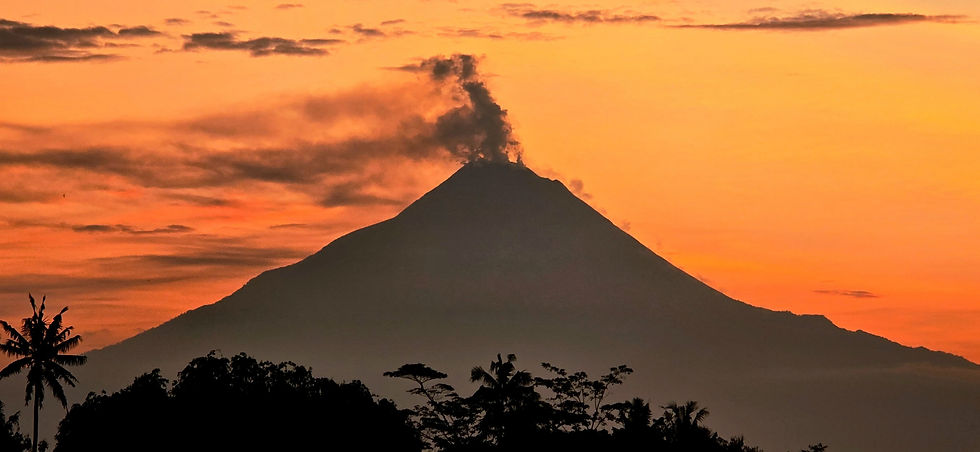
Mount Merapi dominates the skyline and consciousness of Yogyakarta, its eruptions sculpting valleys, redirecting waterways, and replenishing the soil that nourished generations of farmers. Local folklore tells of Ratu Merapi, a powerful spirit queen said to reside in the volcano’s fiery heart, who protects or punishes mortals according to their respect for the mountain and the land. Tremors and ash clouds were long read as omens, while lava flows were seen as messages from ancestors. Communities performed rituals and made offerings at sacred sites around Merapi, blending spiritual belief with survival strategy. Sultans conducted elaborate ceremonies on the mountain’s slopes before campaigns and stories persist of phantom guardians emerging from ash clouds to guide the faithful, warn the unwary or enforce cosmic order, a reminder that Yogyakarta’s identity is inseparable from the fiery giant that towers above it. In every aspect of life, from agriculture to politics, Merapi shaped the rhythms, fears and devotion of Yogyakarta’s people.

A short distance from the city, Prambanan Temple rises with spires that pierce the sky, a 9th-century Hindu sanctuary devoted to the Trimurti gods. Its walls tell the Ramayana epic in vivid stone reliefs, portraying the eternal struggle of heroes and demons. Legend holds that the temple was constructed in a single night by the ambitious prince Bandung Bondowoso, aided by spirits whose work vanished at dawn when the impossible task was completed. Some say the spirits linger still, watching over the temple and ensuring its sanctity. The architecture embodies cosmic order, aligning mortals with celestial patterns and reflects how rulers used sacred spaces to consolidate authority, legitimise their reign and maintain harmony between earthly power and divine will.

About 40 kilometers northwest from Yogyakarta stands Borobudur, the largest Buddhist monument on the planet and a UNESCO World Heritage Site. Built in the 9th century, its terraces rise like a stone mountain toward the sky, each layer guiding devotees along a path of spiritual enlightenment. Thousands of Buddha statues and intricate bas reliefs depict moral lessons, daily life and mythical journeys. Borobudur was buried under centuries of volcanic ash from Merapi and nearby eruptions, preserving its carvings until its rediscovery in 1814. The monument bears silent witness to Java’s long history as a crossroads of religion, philosophy and artistic mastery centuries before Islam reached the island, linking earthly construction with the enduring presence of the mountain that looms above.

Yogyakarta’s history is equally written in conflict and diplomacy. Skirmishes between rival Javanese factions date back to the 16th and 17th centuries as rulers competed for succession after the decline of Majapahit and Mataram authority. In the 18th and 19th centuries, the sultanate resisted Dutch colonial forces while maintaining ritualised military practices that invoked Merapi’s protection and ancestral guidance. During the Java War (1825–1830), the city became a strategic center of resistance, where ceremonial dances, martial formations and battlefield tactics intertwined, reflecting a worldview in which earthly and cosmic forces were inseparable. Local stories from this era often recount that warriors sought the favour of Merapi spirits before battle, believing that their courage and skill were strengthened by unseen guardians watching from the mountain’s shadow.

The reigning Sultan, Sri Sultan Hamengkubuwono X, installed in 1989, embodies a lineage stretching back centuries, a custodian of both ritual and political authority. The palace or Kraton, remains a living centre of Javanese culture, where gamelan music, shadow puppet theatre and sacred dances are performed alongside administrative duties. Islam, introduced centuries earlier, was woven into court life alongside Hindu, Buddhist and indigenous practices, producing a unique spiritual and cultural synthesis. The Sultan continues to guide both ceremonial life and governance, preserving the sacred rhythms of court life while steering the modern city, ensuring that Yogyakarta’s identity remains entwined with history, art and the watchful presence of Merapi, which has shaped every generation of rulers and citizens.

Because of this enduring balance between earthly rule and sacred mandate, Yogyakarta survived when other Javanese states fractured. Even as colonial treaties and modern revolutions redrew Java’s map, the Kraton remained a centre of governance, ceremony and culture. In the mid 20th century, during Indonesia’s struggle for independence, Yogyakarta provided both material and symbolic support and briefly served as a provisional capital of the republic. Throughout this time, the sultan alternated roles as strategist, spiritual intermediary and custodian of culture, honouring traditions that reach back to the earliest settlements under Merapi’s shadow and the enduring myths that shaped the city’s soul.
🗺️ Location
Special Region of Yogyakarta, Java, Indonesia
🚆 How to get there
Yogyakarta is accessible by air, rail and road. The city is served by Yogyakarta International Airport (YIA), which connects to major Indonesian cities such as Jakarta and Bali, as well as limited international routes. From the airport, it takes roughly 1.5 hours to reach the city centre by car. Yogyakarta is also well connected by train, with direct services from Jakarta, Bandung and Surabaya arriving at Tugu Station in the heart of the city. Long distance buses and private drivers are another common option for overland travel across Java.

Thanks for reading about the Yogyakarta. Check out more awesome destinations here!