
Kumbakarna
The Tragedy of the Doomed Giant
In the cultural landscape of Bali, the colossal figure of Kumbakarna, brother to the legendary demon king Ravana, looms remarkably large. Here, the ancient verses of the Ramayana aren't just confined to old books, they have bled directly into temple stone, canvas and firelit performances. The epic itself originated in India more than 2000 years ago but as it travelled across Southeast Asia, it took on entirely new cultural shapes. In Balinese tradition, Kumbakarna isn't remembered as just another monstrous Rakshasa demon, he is a formidable warrior whose story carries a much darker, heavier moral complexity. Born to the sage Vishrava and the demon princess Kaikesi, he was massive from childhood, cursed with terrifying strength and a bottomless appetite. Yet, he never shared the demon king's obsessive hunger for conquest. His world was simpler, built around food, sleep, family and the ancient island of Lanka that had become his home.

Divine Sabotage
His legendary slumber began with a terrifying piece of divine sabotage. Kumbakarna had endured brutal, agonising penance to win a wish from Brahma, the creator god of the Hindu trinity. But the heavens panicked. The gods were terrified of what a giant with that much power might demand. When Brahma finally materialised to grant the boon, the gods desperately had Saraswati, the goddess of speech, hijack the giant's tongue at the exact moment he opened his mouth. Kumbakarna meant to demand Indrasana, the supreme throne of the king of heaven. Instead, the goddess twisted his vocal cords and he accidentally uttered Nidrasana, begging for a state of deep sleep. Brahma bound him to the accidental words. The mistake became an absolute cosmic law, condemning the giant to a profound slumber for six months at a time, only to awaken for a single day. His immense strength was effectively buried alive inside his own body. The gods had feared his power, now that power was trapped inside a living corpse condemned to spend most of its existence unconscious in the dark.
The Sacred Forest Battlefield
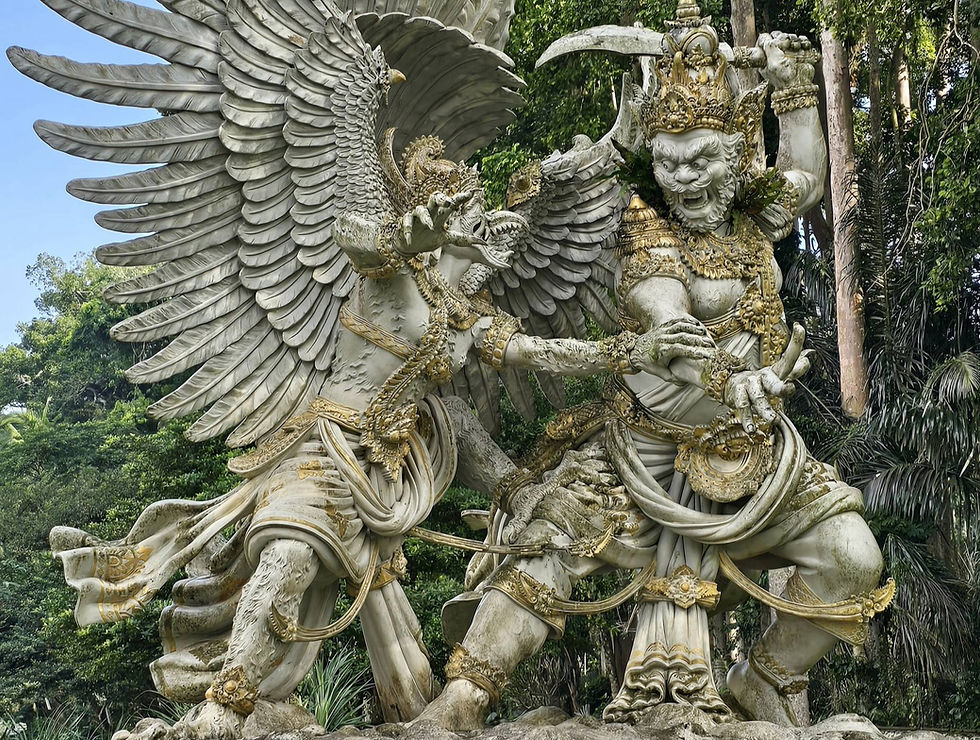
At Sangeh Monkey Forest, this nightmare takes physical form. Monumental stone carvings of Kumbakarna stand locked in combat, his massive body engulfed by a swarming army of Vanara warriors. Local lore says this dense jungle grew from a fallen piece of a holy mountain dropped from the heavens, carrying with it a troupe of mythical simians who took refuge in the branches. Today, that legacy remains anchored to the space itself, beneath a thick canopy of towering nutmeg trees. Long tailed macaques scramble through the branches, creating a collision between present day Bali and ancient myth. Here, the colossal titan isn't trapped in the past, he is frozen in stone, surrounded by a restless army of descendants that once swarmed the ancient battlefield and drove him towards his death.

Tragic Devotion and the Power of Bhakti
The real heart of Kumbakarna’s tragedy happens before he ever steps onto that blood-soaked earth. When Ravana abducts Sita, Kumbhakarna doesn't cheer his brother on. He sees the danger immediately, condemns the theft and warns Ravana that he is bringing ruin down on Lanka. He knows Rama is no ordinary enemy and that Ravana’s pride has put the entire kingdom in mortal peril. Yet, when the war lands on his doorstep, Kumbhakarna refuses to run. His choice can be understood through bhakti, a deep and tragic devotion to the land and community to which he belongs, rather than simple obedience to Ravana. Lanka is his motherland and he cannot sit in safety and watch it burn. This is the most unsettling part of his choice. He doesn't march out because he thinks the cause is right, he marches because the soil that fed him is under attack.

The Final Awakening
When Ravana finally orders his sleeping brother to be dragged awake, the process is a chaotic, violent ordeal because Kumbakarna is simply too massive to rouse easily. As consciousness slowly creeps back into his colossal frame, it brings a ravenous, roaring hunger that forces attendants to wheel in vast quantities of meat and food just to quiet a stomach capable of swallowing an army’s provisions. Only after this monstrous hunger is fed can he prepare for war, ushering in a moment of heavy, funeral-like clarity. Kumbakarna knows Rama holds divine power, that his kingdom is doomed and that he is walking straight towards his own execution. Yet, he reaches for his weapons and leaves the darkness of his chamber anyway. His awakening isn't the grand return of a saviour, it is the start of a final day where every hour of life is spent marching towards his grave.

The Death of Kumbhakarna
On the battlefield, Kumbakarna turns into a brutal force of nature. His gigantic frame smashes into the Vanara lines, scattering warriors and leaving a path of destruction. But Rama’s forces eventually turn their full supernatural strength against him and the slaughter becomes grotesquely methodical. Divine weapons tear into the giant, severing limbs and stripping away the physical power that made him so terrifying. Yet, Kumbakarna keeps pushing forward, a bleeding titan driven by sheer will, refusing to fall even after taking wounds that would have killed an ordinary soldier many times over. The final blow eventually brings the massive body crashing down. In Bali, this bloody climax survives in powerful visual traditions. At Pura Meduwe Karang, Kumbakarna is carved into an elaborate stone sequence, while Kamasan artists have captured his violent final struggle in traditional paintings. His death is never merely a clean, heroic fall, it is the destruction of flesh on a mythic scale.

Dignity in the Wreckage
Perhaps that is why Kumbakarna looks so unnerving when he appears in Bali. His enormous body, hideous features, and monstrous proportions seem designed to inspire fear, yet Balinese artists repeatedly give that terrifying figure an unexpected dignity. He can tower over a temple courtyard like something dragged out of a nightmare, surrounded by weapons, monkeys and the wreckage of battle. Yet, even in stone, his posture is adorned with royal jewellery and the disciplined stance of a high ranking warrior rather than a mindless aberration. The contradiction is deliberate and powerful. Kumbakarna's grotesque appearance does not tell you what to think of him, his choices do. In Bali, the giant remains suspended between those two images. The monster carved in stone and the noble soul of a doomed prince hidden inside it.

Thanks for reading about Kumbakarna. Check out more amazing legends here!


