
Queen Mahendradatta
The Monarch Before the Monster
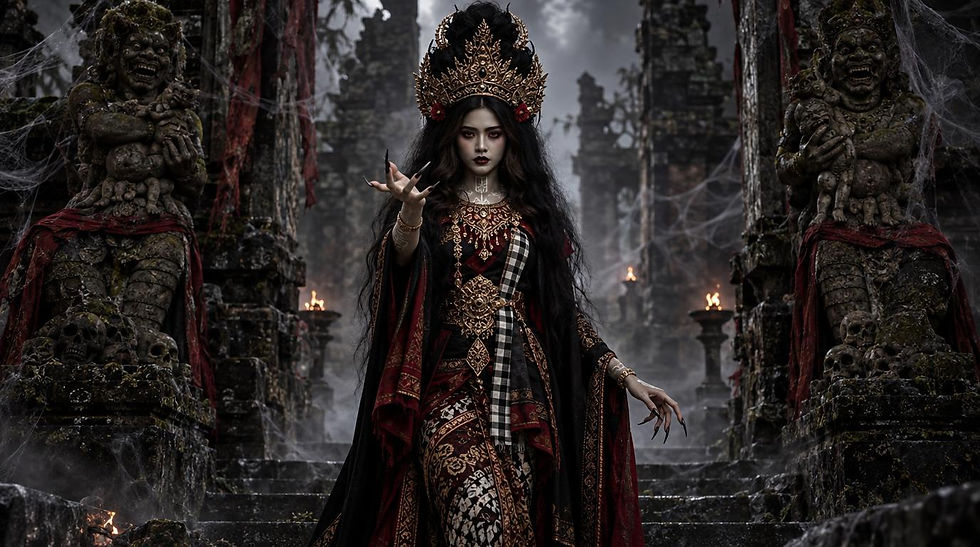
Queen Mahendradatta was one of the most formidable royal women to emerge from ancient Indonesia, yet the story that survived her would eventually bury the queen beneath layers of black magic, plague, cemetery rituals and demons. Born into the imperial heart of Java, she crossed the Bali Strait carrying the prestige of the Isyana dynasty, the religious power of Tantric Shaivism and the authority of a court that regarded Bali as a lesser vassal kingdom. She became queen of Bali, reshaped its religious landscape, secured a bloodline that would rule on both sides of the strait and left behind a son who would become one of Java’s greatest warrior kings. She did not need a sword or a battlefield to exert power. Her weapons were dynastic marriage, political manoeuvring, religious influence and the extraordinary authority carried by her birth. Centuries later, those same forces would be twisted into something far darker. The queen became a sorceress, the sorceress became a witch and the witch became Rangda, the fanged widow who devours children and battles Barong.
Raised in the Shadow of Durga
Born in 961 AD, Mahendradatta was the daughter of King Sri Makutawangsawardhana and sister of Dharmawangsa, the future emperor of the Medang Kingdom. She belonged to the Isyana dynasty, one of the most powerful ruling houses of East Java, and grew up inside a highly literate and sophisticated imperial court where religion, scholarship and statecraft were inseparable from political power. Her upbringing was deeply embedded in the esoteric traditions of Tantric Shaivism and the fierce cult of Durga, where divine power could be volatile, destructive and deliberately terrifying. The left hand path of Tantric practice sought spiritual force through rituals that crossed boundaries surrounding death, blood, sexuality and impurity, confronting the very things ordinary society feared or rejected. Mahendradatta therefore emerged from a religious world very different from the older spiritual traditions of Bali. She understood sacred power not simply as something to be worshipped, but as something that could be channelled, manipulated and wielded through ritual. When she eventually carried that world across the Bali Strait, she was bringing far more than a royal pedigree with her.

Javanese Power Behind the Throne
Around 989 CE, at 28 years of age, Mahendradatta entered a dynastic marriage with King Udayana Warmadewa of Bali. The union was a calculated geopolitical alliance between the powerful Javanese court and a rising Balinese kingdom, strengthening Java’s influence over the island while giving Udayana a royal connection to one of the most prestigious dynasties in the region. There is no reason to imagine Mahendradatta as a passive teenage bride. She was an adult imperial princess entering a marriage designed around dynastic interests, and she arrived carrying the immense status of her Javanese lineage. Her formal name, Gunapriya Dharmapatni, appears before Udayana’s in inscriptions, reflecting the dynastic hierarchy behind the union and the superior prestige of the Isyana house rather than simply a rebellious wife asserting herself over her husband. Java stood above Bali within the political landscape of the period, and Mahendradatta embodied that relationship. Her arrival brought Javanese court culture, political structures and Tantric religious influence directly into the Balinese royal sphere, creating a profound transformation that would continue long after her own reign.

The Bloodline That Claimed Two Thrones
Her children made that political connection even more consequential. Airlangga, her firstborn son, was groomed for a future of absolute rule and eventually sent back to Java while still young, where his maternal connection to the Isyana dynasty placed him close to the Javanese imperial succession. He would become one of the greatest warrior emperors in Java, rebuilding a kingdom fractured by war and political catastrophe. His younger brothers, Marakata and Anak Wungçu, remained in Bali and succeeded to the island’s throne, preserving the Javanese influenced court structures established during their mother’s reign. Airlangga’s sudden removal from Bali has also generated one of the darkest scandals surrounding Mahendradatta. Because he was her firstborn son, his position might appear to make him the natural choice for a powerful Balinese succession, yet he was instead redirected towards Java. Later speculation has imagined that Mahendradatta may have had an earlier marriage or illicit relationship before her union with Udayana, leaving Airlangga’s bloodline politically inconvenient to the Warmadewa dynasty and providing a reason for his exclusion from the Balinese succession. Whether that shadow lay behind the decision or not, Mahendradatta’s manoeuvring produced an extraordinary result. One son was sent towards the Javanese throne while two others inherited Bali, allowing her bloodline to dominate both kingdoms and making her family one of the most consequential dynastic bridges in the history of ancient Indonesia.

Vocabulary of Tantra and Terror
Mahendradatta was not demonised simply because she was an unpopular administrator. Her reign was associated with economic growth, political stability and the introduction of more advanced written traditions, yet her religious transformation of Bali created deep resistance. She became associated with the aggressive expansion of Javanese Tantrayana and the cult of Durga, reshaping older Balinese animist traditions through a fierce and highly esoteric religious system. Mahendradatta was remembered as an aggressive high priestess of Tantric Shaivism, surrounded by an elite inner circle whose rituals belonged far from pristine temple courtyards. To channel the volatile energies of Durga, these traditions placed her in the cremation ground itself, conducting secretive nighttime rites inside cemeteries known as Setra, among human bones and cremation ashes. For an ordinary agrarian Balinese villager, the sight of people gathering at a burial ground in the dead of night, whispering mantras to the goddess of destruction, could look less like religion than black magic and the summoning of demons. Around these rites grew whispers of leyaks, infant sacrifice and dark sorcery. Later stories claimed that Udayana attempted to break her dominance by accusing her of black magic and banishing her into the dense forests of Gianyar, isolating her as a bitter and vengeful royal figure. Udayana, not Mahendradatta, was the widower, although widowhood would later become central to the monstrous identity that grew around her legend.

Plague, Sorcery and a Mother’s Curse
The next stage of Mahendradatta’s afterlife belongs to Calon Arang, the terrifying witch of later Javanese and Balinese tradition. In the tale, the woman of Girah turns to Durga and unleashes deadly supernatural forces upon the kingdom, spreading plague and devastation until Empu Bharadah is sent to confront her. Over generations, the story became inseparable from the dark reputation surrounding Mahendradatta, drawing the historical queen into the orbit of a woman who wielded sorcery, commanded destructive forces and brought an entire kingdom to the edge of ruin. The parallels were irresistible. Both became associated with Durga. Both became figures of death, disease and supernatural power. Both belonged to stories in which a woman carrying terrifying spiritual force could become a threat to the stability of an entire kingdom. The early eleventh century plague that entered this tradition gave the story an even darker historical shadow, as disease, dying livestock, poisoned crops and mass suffering could be transformed in memory into the work of a furious woman unleashing supernatural forces upon the living. Later dance and theatrical traditions pushed the connection further, with Mahendradatta and Calon Arang becoming fused within the same monstrous narrative, Airlangga cast as the son forced to confront his own mother and Empu Bharadah sent against her in a supernatural battle. The real queen who had crossed the Bali Strait carrying the power of Java was now remembered through a witch capable of unleashing plague upon kingdoms. Her political reach became sorcery. Her religious world became black magic. Her exile became vengeance. Her association with Durga became supernatural terror. From that increasingly dark memory emerged Rangda, the monstrous widow who would become one of the most terrifying figures in Balinese ritual theatre.

The Immortal in the Forest
Queen Mahendradatta’s human story ended in 1011 AD. Her remains were interred and deified at Pura Bukit Dharma Durga Kutri, where she was represented as Durga Mahisasuramardini, the terrifying multi armed warrior goddess slaughtering the buffalo demon. By placing her ashes inside the monument, her children weren't just burying her, they were ritually merging her soul with the goddess. The statue became a living vessel containing her lingering sovereign energy. It was an extraordinary final image for a queen whose life had already been so deeply entangled with the cult of Durga, yet her story did not end with the tomb. In the centuries that followed, the memory of disease and devastation became attached to the image of a vengeful royal woman, hijacked by terrified peasants who claimed she could poison the air, destroy crops, kill livestock and unleash supernatural forces upon entire kingdoms. Rangda became the ultimate distortion of her royal identity. The structured Javanese crown became the crown of a demon. Her association with Tantric fire became the flaming tongue that lashes from the mask. Her status as mother of kings was grotesquely inverted through the pendulous breasts of the child eating hag. Her royal beauty became wild hair, claws and tusks, while the forest exile of the old stories became the savage appearance of a creature stripped of civilisation. At Pura Dalem Sidan and Pura Dalem Kahyangan Kediri, imagery associated with Rangda carries that brutal inversion of royal femininity. The woman who had once stood at the intersection of two powerful kingdoms was transformed into a supernatural warning about unchecked power, foreign influence, religious transgression and female ferocity. When the queen died, she was absorbed into the sacred world she had helped shape. Rangda was what remained when history could no longer contain her.

Thanks for reading Queen Mahendradatta. Check out more amazing legends here!


