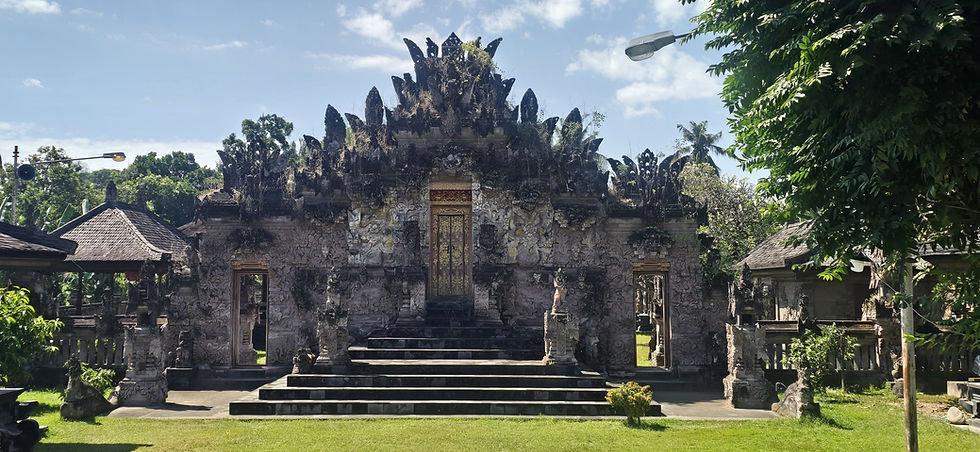
Maduwe Karang Temple
Pura Maduwe Karang is one of Northern Bali’s principal temples, where carving, ritual structure and mythic imagery are bound directly to the fertility and protection of cultivated fields, shaped by the agricultural systems that sustain them. The temple was established in 1890 by Bali Aga communities from the ancient village of Bulian, who relocated in search of more fertile land and reestablished their ritual centre in Kubutambahan as part of a wider movement to secure agricultural stability in a new landscape. Its name, meaning “the one who possesses the land,” refers to Batara Meduwe Karang, the protective presence of cultivated soil, invoked as the force that holds fields in balance, maintains their fertility and safeguards agricultural life through ritual action rather than abstract belief.

The temple’s entrance is dominated by a dense Ramayana sequence carved into stone, consisting of approximately 36 interconnected figures arranged as a continuous procession across the gateway rather than isolated narrative panels. The relief compresses the epic’s cosmic struggle into a single threshold, where demonic, divine and human aligned forces occupy the same visual field in a suspended state of tension. Kumbhakarna, the giant brother of Ravana known for his immense strength and mythic sleep, appears among the central forms, while vanara warriors associated with Sugriwa and the forces aligned with Rama structure the opposing axis of order. Entry into the temple therefore becomes entry into a spatialised myth, where conflict is not depicted as story but embedded as permanent architectural condition.

Within this agrarian framework, the main sanctuary is not an isolated focal point but part of a wider system of reciprocal forces, reinforced by shrines dedicated to Ratu Ayu Sari, a manifestation of Ibu Pertiwi (Mother Earth) and Ratu Ngurah Sari, the guardian of agricultural produce. Together with associated shrines to Surya, the sun and Dewi Sri, the rice goddess, these elements establish a layered cosmology in which fertility is produced through the alignment of earth, growth, protection and solar time. Rather than functioning as separate devotional points, these shrines operate as an integrated system in which land, cycle and sustenance are continuously interdependent.

One of the most discussed carvings in the complex is the bicycle relief, widely associated with Dutch artist W.O.J. Nieuwenkamp, who travelled in Bali in the early 20th century. Rendered with unusual precision, the figure captures a bicycle at a moment when such technology was still unfamiliar on the island, marking an encounter between Balinese visual language and external modernity. Its presence within a sacred relief system reflects how foreign material culture is absorbed directly into temple iconography rather than remaining outside it.

Among the wider mythological carvings is a depiction of Durga in her protective and destructive aspect, situated within a broader Balinese cosmology in which opposing forces are understood as interdependent rather than morally separate. Her presence reflects a system in which creation, destruction and protection are held in continuous balance, reinforcing the temple’s underlying agricultural logic where fertility is sustained through controlled and transformative power rather than stability alone.

A Pura Dalem associated with the temple complex extends this system into the domain of death, transition and spiritual purification. In Balinese cosmology, a Pura Dalem is dedicated to Shiva in his transformative and destructive aspect and is closely associated with death rites, cremation cycles and the release of the spirit from the physical world. It functions as a liminal counterpart to the temple’s life affirming agricultural spaces, often positioned at the outer or “downstream” edge of ritual geography. Within this wider system, it completes the balance between creation, sustenance and dissolution, ensuring that death is not separate from life but structurally integrated into the same sacred landscape.
Severely damaged in the 1917 earthquake that affected large parts of Bali, Pura Maduwe Karang was later restored, though it retained its full ritual function within the surrounding farming communities. Despite physical disruption, its ceremonial role remained anchored in agricultural cycles, with offerings and rituals continuing to mark seasonal rhythms of planting and harvest. More than a century after its establishment, the temple persists not as a static historical site but as a living structure of belief and practice, where mythology, land use and communal memory remain inseparably interwoven into the landscape itself.

🗺️ Location
Jalan Kubutambahan, Kubutambahan Village, Sawan District, Buleleng Regency, Bali, Indonesia
🚆 How to get there
Pura Maduwe Karang is located in North Bali’s coastal-to-rural transition zone near Kubutambahan. From Lovina, it is approximately 35 minutes’ drive east along the main coastal highway. From Ubud, the journey takes around 3 hours one way, via the central mountain route through Bedugul, passing lakes and highland forest before descending into Buleleng. From Canggu or Seminyak, expect roughly 4 hours depending on traffic, typically via Denpasar and Singaraja along the northern highway. Private driver hire is the most practical option, as public transport in North Bali is very limited and infrequent. A full day driver generally ranges from 800,000 - 1,200,000 IDR depending on season and route. Given the isolation of the area and the huge travel times, I would highly recommend spending a night or two in the region.
⭐ Attraction Info
Pura Maduwe Karang is an active agricultural temple deeply embedded in village ritual life, open to respectful visitors throughout the day from approximately 8am to 5pm. Access generally follows daylight hours and may be temporarily adjusted during ceremonies, offerings or periods of heightened ritual activity, when parts of the complex can be restricted. While there is no official entrance fee, entry by compulsory donation of 30,000 IDR goes to support ongoing temple maintenance. As an active place of worship, visitors are expected to follow standard temple etiquette, including sarongs and covered shoulders for inner areas, with coverings often available on site if needed. It is commonly included in broader North Bali itineraries, often combined with nearby sites such as Sekumpul Waterfall, Aling Aling Waterfall and coastal temples around Lovina and Sangsit.


Thanks for reading about Maduwe Karang Temple. Check out more awesome destinations here!