
Pura Dalem Jagaraga
Originally built around 1205AD, its earliest known identity was Pura Dalem Segara Madhu, a funerary temple dedicated to the cycle of death, dissolution and spiritual transition. From its foundation, it belonged to the Dalem sphere of Balinese Hindu cosmology, where Shiva in his destructive aspect and Durga in her fierce manifestation preside over the breaking down of form so that life can be returned to its elemental state. This is not a temple of celebration or prosperity but one of endings, where death is not an interruption of life but part of its managed return to cosmic balance. Over time, that ritual identity became inseparable from real historical catastrophe, as the site was destroyed and rebuilt in the aftermath of colonial violence, leaving its sacred function layered over physical obliteration.

The rupture that defined its modern identity came during the Jagaraga War, one of the most devastating confrontations in northern Bali against Dutch colonial forces. In 1848, the original temple complex was completely destroyed alongside the village itself. The village had already become a centre of total resistance, culminating in a "Puputan", a collective refusal of surrender in which ritual suicide was chosen as the final outcome rather than submission. Around 3000 people are believed to have died in this conflict. After the smoke cleared, the sacred site was rebuilt and took on the name Jagaraga, a word meaning watch yourself, drawn from a warning that once hung in the air of the village before the assault began. It belonged to a time when people were already living inside the expectation of invasion, when vigilance was no longer a momentary reaction but a constant state of awareness. In taking that phrase as its name, the rebuilt temple did not soften the memory of what happened there but fixed it into identity.

The reconstruction that followed did not restore separation between sacred order and trauma but instead folded disruption into the ritual structure itself. Within the temple compound sits both a Padmasana shrine and a Prajapati shrine, the latter associated with Durga in her funerary aspect as the force governing death rites and transitions. Prajapati would traditionally be placed in the village graveyard, outside the main temple space, yet here it was relocated inside during a period of danger. This shift compresses the geography of death into the sacred core, collapsing the boundary between daily worship and funerary passage as though the village had been forced to internalise its own mortality.

This compression extends into the architecture, where movement through the temple is structured as descent rather than ascent. Instead of rising through courtyards toward increasing sanctity, each level drops lower, producing a physical sensation of sinking into the ground. Even the gate system is inverted. The candi bentar, normally the outer threshold between profane and sacred space, leads inward access, while the kori agung, usually reserved for the most protected inner sanctum, functions as an outer defensive barrier. This reversal suggests a sacred structure reorganised under siege conditions, where protection and control of movement override symbolic hierarchy.

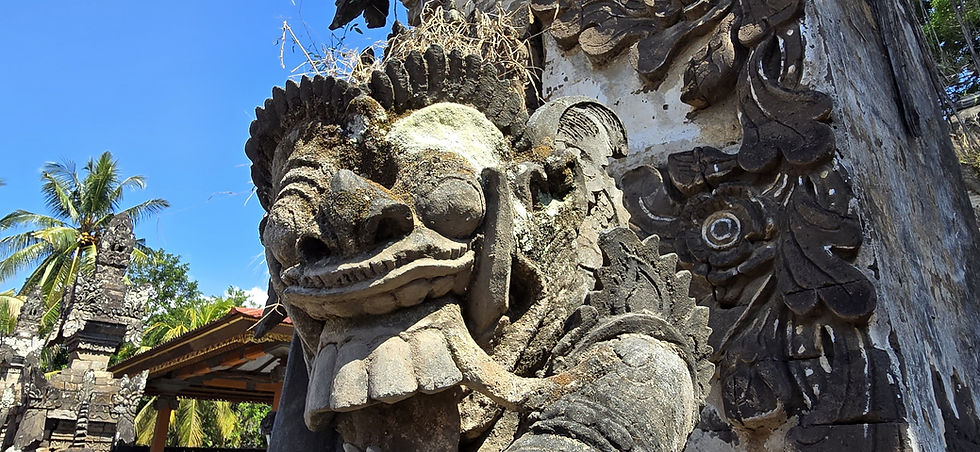
The most unique dimension of Pura Dalem Jagaraga is carved into its stone walls, where reliefs refuse to remain purely mythological and instead record intrusion as lived reality. Dutch arrivals are shown not as abstract colonial presence but as physical entry into the world. Ships move through dangerous waters where crocodiles are carved as part of the surrounding threat. This is followed by bicycles, motorcars and aircraft marking successive waves of arrival. One panel shows a Dutch figure driving a Ford Model T while carrying a flag, accompanied by another figure holding a pistol. These are not symbolic gestures. They are specific moments of occupation and movement preserved in sacred stone, as though history itself was forced into ritual permanence.

Alongside these scenes of intrusion are depictions of Balinese life that feel calm and unburdened, almost like a record of a world before fracture. People climb coconut trees, fish in coastal waters and fly kites across open space, scenes shaped by rhythm, labour and seasonal ease. There is a sense of a community still intact, still moving within its own familiar cycles. Placed directly beside images of arriving ships, machines and armed figures, this calm takes on a different weight. The contrast is immediate and unresolved. The temple does not separate these realities or explain the shift between them. It holds both within the same carved surface, as though peace and intrusion are being remembered together, without one erasing the other.

Within this dense field of imagery appear some of the most revered forces in Balinese death cosmology, inseparable from the identity of a Pura Dalem. Rangda emerges not as a distant myth but as embodied destructive power, bound to Durga’s terrifying aspect and associated with illness, disorder and the breakdown of form itself. She is not treated as evil, but as necessary dissolution, a force that cannot be removed from existence, only held in check through ritual before it returns. Opposing this is the Singa Bersayap, the winged lion guardian, positioned at thresholds and transitional points as a stabilising force that binds the edge between worlds. Its role is not to defeat destruction but to contain it, holding the boundary so that death energy does not spill outward without order or overwhelm the living space. These figures operate within the same system of belief, where destruction and containment are not opposites, but interdependent pressures that keep the structure of the world from breaking open.

Within Pura Dalem Jagaraga, ceremony is marked not by silence but by movement and sound, by incense drifting through carved stone corridors and bells cutting through layered chant. Offerings are placed with careful intent for presences that are understood to remain close even when unseen. These actions are not performed as spectacle, but as necessary balance within a worldview where the dead are not absent, only shifted into another layer of existence that still requires ongoing ritual care to maintain balance between the worlds. The architecture reinforces this, drawing the body inward and downward rather than upward, consistent with its role as a Pura Dalem associated with death, dissolution and the return of life into the earth. Even history does not fully settle into the past but continues to linger in material form, held within stone, ritual, and the ongoing need to keep disorder from breaking through.

🗺️ Location
Jalan Raya Jagaraga / Jalan Kubutambahan area, Jagaraga Village, Sawan District, Buleleng Regency, Bali, Indonesia
🚆 How to get there
The temple is positioned along North Bali’s inland coastal transition zone near the Singaraja–Kubutambahan corridor, making it accessible by road while still significantly distant from the island’s southern tourism hubs. From Lovina, it is roughly a 30 minute drive east, following the coastal highway. From Ubud, the journey typically takes around 3.5 hours one way, either via the central highlands through Bedugul or via the longer coastal route through Singaraja, before reaching the northern plains of Buleleng. From Canggu or Seminyak, travel time is generally around 5 hours one way depending on traffic conditions, with routes typically passing either through Denpasar and the central highlands or along the northern coastal road via Singaraja. Because public transport in this region is extremely limited and infrequent, private driver hire is the most practical option. Full-day driver rates commonly cost around 1,000,000 IDR per day. Given the distance and travel time, many visitors choose to combine the visit with an overnight stay in North Bali rather than attempting a single day return trip.
⭐ Attraction Info
Although still an active village temple, the locals are very proud of the history of Pura Dalem Jagaraga and actively encourage tourists to take a look through. The entrance fee is 50,000 IDR and includes sarong and sash rental, if you forgot to bring your own. The local guides are super enthusiastic and provide a print out of the temples history. Although not expected, another small tip to the caretakers for their valuable knowledge, will be highly appreciated. The temple grounds are open daily between 8am - 6pm, although inner areas may be closed during active ceremonies or ritual cycles, without notice. Visitors are expected to observe standard temple etiquette, by covering your knees and shoulders. It is frequently included in North Bali cultural routes, often visited alongside nearby waterfalls such as Sekumpul and Aling-Aling, as well as other coastal temples including Pura Beji Sangsit and Maduwe Karang Temple.
Thanks for reading about Pura Dalem Jagaraga. Check out more awesome destinations here!


