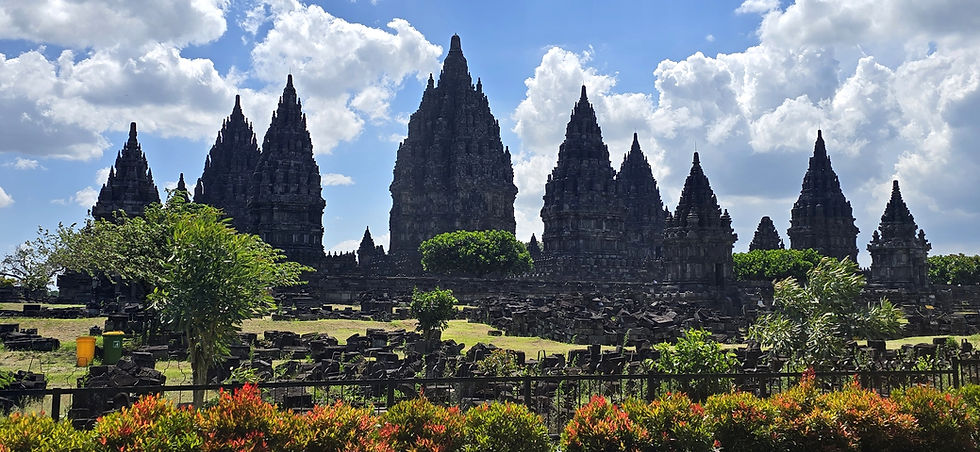
Pawon Temple
The Living Gateway to Borobudur
Candi Pawon rests within the UNESCO World Heritage landscape of the Borobudur Temple Compounds, yet it carries a presence that feels quietly self contained, almost suspended in time. It was built in the late 8th to early 9th century during the height of the Sailendra dynasty, making it one of the older surviving expressions of this sacred landscape, slightly earlier than Borobudur itself. Within its stone restraint lies a sense of deliberate refinement, as though the temple was never intended to announce itself through scale but through precision, balance and symbolic depth. Some traditions also connect it to King Indra of the Sailendra line, remembered in later lore as an enlightened ruler whose association with Pawon adds a faint royal and mythic shadow to its identity.

The name Pawon is commonly traced to the Old Javanese word "awu" meaning dust or ash, yet it is also interpreted as meaning kitchen, a dual reading that deepens its symbolic ambiguity. The idea of kitchen and ash folding into the same linguistic space has led to interpretations that the temple may represent a site of transformation, where what is consumed becomes residue and what is material becomes memory. This connection has also supported theories that it may have functioned in relation to ashes, possibly even those of a king whose passage was ritually reframed into sacred continuity. Its second name Bajranalan carries an entirely different current of meaning, drawn from Sanskrit Vajra Anala which evokes thunder and flame as intertwined forces. Within this layered naming, the temple holds both domestic symbolism and cosmic intensity, as though the ordinary act of burning is elevated into a metaphysical principle.

The placement of Pawon is no accident of geography but part of a deliberate sacred alignment that links Mendut Temple to Borobudur in a continuous ritual corridor. This axis is still actively walked by pilgrims as a living journey of spiritual progression, with each temple marking a distinct stage of inner refinement. Mendut offers narrative grounding, Pawon becomes a point of quiet transition, and Borobudur unfolds into a vast cosmological vision. During Vesak, the most important Buddhist festival marking the birth, enlightenment and death of the Buddha, this movement is fully realised as pilgrims retrace the ancient path in a practice that remains both physically enacted and spiritually continuous.
Across its exterior stonework, Pawon carries finely carved guardians known as Karas figures, placed to protect thresholds and regulate the passage between the human and the sacred. These forms, interpreted as protective beings associated with restraint and spiritual vigilance, contribute to the temple’s sense of guarded stillness. Alongside them are depictions of Bodhisattvas, serene figures embodying awakened compassion, their presence suggesting that the temple once participated in a wider visual language of enlightenment rather than narrative storytelling alone. In one inscriptional tradition linked to Pawon, a Bodhisattva image is described as radiating rays of light, a detail that has led scholars to believe it may have been crafted from bronze rather than stone. Together, these elements suggest a sacred space where protection and illumination exist side by side.

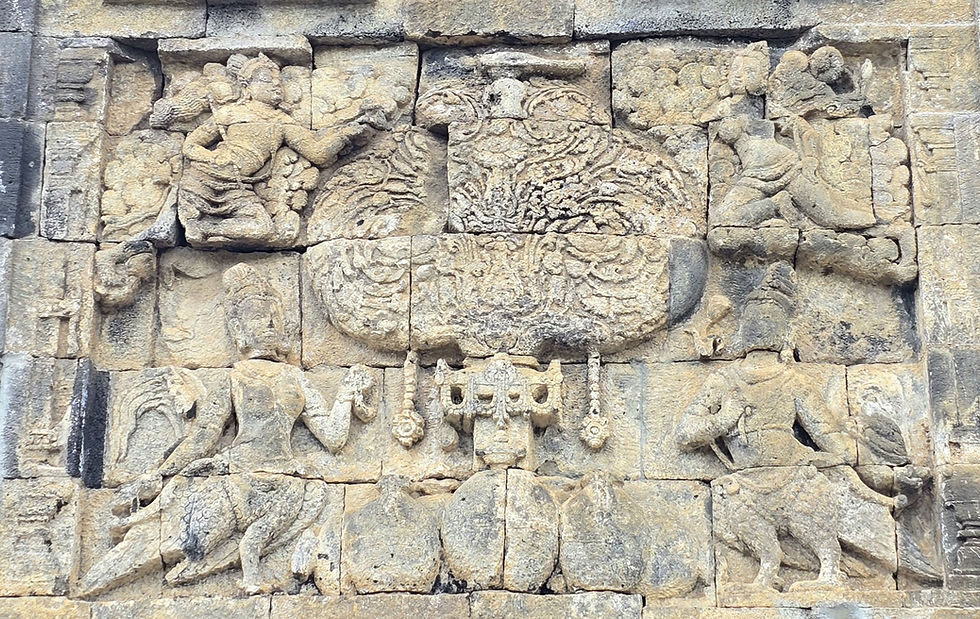
The Kalpataru or Tree of Life, rises across Pawon’s rear wall as a central axis of symbolic order, anchoring the temple in a vision of interconnected realms. It is flanked by kinnara and kinnari, celestial beings suspended between human and avian form, positioned not as decoration but as intermediaries between earthly existence and higher states of being. Their presence reinforces the temple’s role as a threshold space, where transformation is imagined as a gradual crossing rather than a single moment of arrival. The tree and its guardians form a unified cosmological image that binds life, spirit and transcendence into a single carved continuum.
Subtle associations also link the temple to Kuvera, the god of riches, although here, wealth is understood less as material possession and more as spiritual accumulation and protective guardianship of sacred order. His presence is inferred through the temple’s placement within a pilgrimage system that moves not only bodies but also intention and merit across sacred ground. In this sense, Kuvera’s role becomes symbolic rather than literal, suggesting that what is safeguarded is the unseen value generated through passage, reflection and devotion.
Pawon does not rely on scale or spectacle to be remembered. What it ultimately leaves behind is not a settled explanation of what it was built for but a tightly preserved set of clues that refuse to resolve into a single accepted function. Its position on the Mendut Borobudur axis is fixed, its Sailendra context is established and its symbolic language is unmistakable. Its precise alignment, proportion and ritual associations emphasise its integral role along this sacred corridor, reinforcing its enduring significance in Javanese Buddhist cosmology, yet how these elements were intended to work together remains unresolved. That uncertainty is not decorative ambiguity but a genuine historical gap, which is why interpretations ranging from mortuary association to a ritual transition space continue to stand in parallel without one ever fully displacing the others.

🗺️ Location
Brojonalan Hamlet, Wanurejo Village, Borobudur District, Magelang Regency, Central Java, Indonesia
🚆 How to get there
Candi Pawon is located about 2km's east of Borobudur Temple and roughly 40km's northwest of Yogyakarta city centre, making it an easy stop within the classic Borobudur temple circuit. The drive from Yogyakarta typically takes around 90 minutes, passing through rural Magelang landscapes of rice fields, villages and distant volcanic ridgelines. The most convenient option is to hire a private car or taxi, usually around 600,000 IDR for a full day, which allows Pawon to be combined with Borobudur and Candi Mendut in a single itinerary. Budget travellers can take a TransJogja bus to Jombor terminal in Yogyakarta for around 20,000 IDR, then continue by local bus towards Borobudur for roughly 40,000 IDR before completing the short final stretch by gojek. From the main street in Borobudur village, a GoJek scooter ride directly to Pawon typically costs around 40,000 IDR return, making it one of the quickest and most flexible options for independent travellers.
⭐ Attraction Info
Pawon Temple is open daily between 8am to 5pm, forming part of the Borobudur temple circuit. The entry fee is 50,000 IDR per person, with a ticket booth located just before the small entry gate. Facilities are minimal on site, with basic parking nearby and small local stalls in the surrounding village selling drinks and snacks. Pawon itself remains notably quiet compared to its neighbours, allowing its carvings and proportions to be viewed without crowds. Late afternoon is particularly atmospheric, when softer light settles across the stone giving the temple a calm, reflective presence that suits its position on the sacred axis. It is a very small site and typically only requires around 15 minutes to explore.