Plaosan Lor Temple
A Temple of Love Between Two Kingdoms
Situated in a peaceful village near Klaten in Central Java, the Plaosan Lor Temple complex is a remarkable monument to 9th century Javanese Buddhism, royal ambition and dynastic love. Commissioned by Princess Pramodhawardhani, the daughter of Samaratungga, the last known Sailendra King, the twin temples were intended as a symbolic wedding gift to her husband, Rakai Pikatan, a prince from the rival Hindu Sanjaya line, celebrating both devotion and political alliance. Pramodhawardhani was no ordinary princess, she was an influential queen who bridged two great religious dynasties, leaving her mark throughout ancient Java and creating a sanctuary that immortalised her Buddhist faith while highlighting her role as both consort and powerful sovereign.

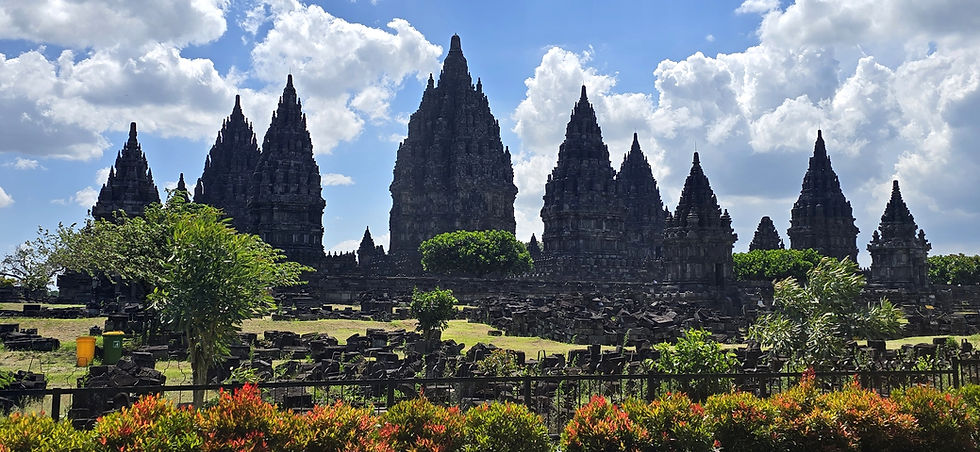
Plaosan Lor is distinguished by its dual main temples, separated by open courtyards and a short walk between them, amid a constellation of smaller shrines and stupas. Each main temple rises across three ascending levels, crowned with intricate pinnacles echoing the cosmic symbolism of Mount Meru, the sacred mountain in Buddhist cosmology. The walls are adorned with finely carved bas reliefs of Bodhisattvas, celestial beings, lotus medallions and protective guardians, while many statues inside the temples remain remarkably intact, allowing visitors to witness the artistry of Javanese sculptors from nearly 1200 years ago. The temples were built using interlocking bricks without mortar, a technique that has helped them endure the centuries. This delicate yet powerful design reflects the Javanese genius for architectural fusion, blending Buddhist iconography with subtle Hindu influences, creating a space both otherworldly and grounded in ritual practice.

Beneath its serene harmony, Plaosan Lor hums with whispered legends that have persisted for centuries. Local folklore claims that the twin temples were constructed under the guidance of mystical architects who invoked protective spirits, and that some of the smaller shrines still conceal hidden chambers where sacred relics of the Sailendra dynasty were secreted, inaccessible to ordinary mortals. The Dwarapala guardians, towering stone sentinels traditionally placed at temple entrances to protect sacred spaces, are said not merely to watch but to actively punish disrespectful visitors, with stories of trespassers falling ill or losing their way in the temple’s corridors. Villagers also speak of the temple’s hybrid carvings, where figures with human bodies and animal heads, some with tiger claws or bird beaks, are believed to house ancient spirits that protect both the sanctity of the temple and the balance between the twin compounds, whose perfect symmetry is said to channel cosmic energy. On certain nights, especially during eclipses or moonless skies, faint chanting or the rhythmic echo of footsteps is reportedly heard within empty corridors, as if unseen monks and guardians continue rites that have persisted for more than a millennium.

The detailed reliefs carved into Plaosan’s walls depict symbolic battles and cosmic struggles, darker and more intricate than the peaceful scenes typical of other Buddhist monuments. Panels show mythical conflicts, celestial beings and figures enduring karmic consequences, each rendered with meticulous detail. Scholars interpret them as parables of karma and rebirth, illustrating the effects of human actions and the path to enlightenment. Folklore regards them as cautionary tales, warning those who stray from moral or spiritual duties. Amid this chaos, serene Bodhisattvas maintain their composure, their calm faces contrasting sharply with demons, warriors and restless spirits, creating a striking interplay of tranquility and turmoil. This duality gives the temple a unique character. It is a sanctuary for meditation, yet a sobering reminder of the delicate balance of life, morality and spiritual practice.

Plaosan Lor was more than a monument, it was a stage for royal life and sacred practice. The courtyards likely echoed with the clang of bronze gongs, the rustle of ceremonial garments and the rhythmic steps of temple attendants as seasonal observances were performed. Offerings of flowers, incense, and rice may have been arranged on stone altars while processions wound through the twin compounds, reinforcing both devotion and prestige. Scholars suggest that some shrines held relics or sacred texts, accessible only to the royal family or ordained monks, emphasising the temple’s exclusivity and its function as a living symbol of dynastic authority. The very layout of the twin temples, separated yet aligned, may have reflected cosmological principles, channeling spiritual energy during rituals and marking the union of two powerful lineages in a subtle yet mystical way.

For nearly twelve centuries, Plaosan Lor has endured the relentless forces of nature and human neglect, the mastery of its construction a testament to its resilience in one of the most seismically active regions on the planet. Peripheral stupas, smaller shrines and sections of the temple compound have collapsed over time, yet the main temples and many interior statues remain largely intact, preserving a remarkable sense of continuity. Fractured walls, scarred statues and fallen monuments hint at centuries of upheaval, while the surviving structures exude a solemn mystery that evokes the ceremonial grandeur of their original purpose.

Today, Plaosan Lor endures as both an architectural marvel and a vessel of living legend. To walk between the twin temples and their surrounding shrines is to step into the world of Pramodhawardhani herself, a queen whose spiritual devotion and political acumen shaped the destiny of dynasties. Visitors encounter not just exquisite Javanese artistry and dynastic history but also the lingering presence of centuries old rituals, the silent vigilance of Dwarapala guardians and the subtle whispers of myth woven into every stone. In this delicate interplay of devotion, power and the supernatural, Plaosan Lor stands as one of Java’s most haunting, enigmatic and profoundly resonant cultural treasures.


🗺️ Location
Jalan Candi Plaosan, Bugisan Village, Prambanan District, Klaten Regency, Java, Indonesia
🚆 How to get there
Plaosan Lor Temple is situated about 17 km's east of Yogyakarta’s city centre and roughly 2 km's northeast of the Prambanan Temple complex, making it an easy side trip when visiting the region’s major monuments. The drive from Yogyakarta typically takes around 45 minutes, depending on traffic conditions. Hiring a private car or taxi is the most convenient option, with full day hire ranging from 500,000 to 700,000 IDR, offering flexibility to combine Plaosan with nearby sites like Prambanan or Ratu Boko. Adventurous travellers often rent scooters in Yogyakarta for about 70,000 to 100,000 IDR per day, giving them the freedom to explore Plaosan and surrounding villages at their own pace. The route itself is scenic, passing through rice fields and rural landscapes before arriving at the quiet temple complex. I would not recommend taking public transport to the area, as the temples are quite far apart on foot.
⭐ Attraction Info
The Plaosan Lor Temple complex is open daily between 8am and 5pm, giving visitors ample time to explore its twin sanctuaries, courtyards and surrounding shrines. Entrance fees for international visitors are 50,000 IDR per person, payable in cash at the small ticket booth. While smaller than Borobudur or Prambanan, the complex provides basic facilities such as parking and open rest areas, though amenities remain relatively minimal. Its close proximity to Prambanan means many travellers combine the two in a single journey, yet Plaosan offers a quieter atmosphere with far fewer crowds. The temple is especially striking in the late afternoon, when softer light enhances the intricate carvings and the twin sanctuaries stand out against the surrounding plains, often with Mount Merapi visible in the distance on clear days. A visit here will take around 20 minutes.

Thanks for reading about Plaosan Lor Temple. Check out more awesome destinations here!