
Pura Puncak Penulisan
Bali’s Ancient Summit Temple
Traces of ritual activity at Puncak PenulisanTemple extend back into the Bronze Age, making it one of Bali’s oldest continuously sacred sites. The temple rises at 1,745 metres above sea level on the summit of Bukit Penulisan, one of the highest and most commanding points in the island’s central highlands. By the 9th century, the temple complex had already begun to take shape, and an inscription dated to 882 AD stands among the earliest written records ever found on the island, carved at a time when writing itself was still emerging as a sacred act. Even its name, Penulisan, meaning “writing,” is tied to this early inscriptional presence, suggesting a place where marking, memory and ritual were already bound into the landscape itself. For more than 2500 years, this summit has functioned as a destination of ascent and reverence, a high point where early communities gathered in the presence of something permanently sacred. Recognised today as a Kahyangan Jagat temple, a universal sanctuary woven into Bali’s wider spiritual geography, it remains one of the island’s most ancient and continuously active ritual sites.
Long before inscriptions were carved or dynasties named, the highlands around Cintamani were already shaped by story. Local tradition speaks of Daa Tua, the “Old Maiden,” a figure who lingers at the edge of history and myth. She is said to have lived alone on the forested slopes, not as a ruler but as the first presence to bring order to the wilderness, clearing land by hand and opening small fields where garlic was planted in deliberate rows, marking one of the earliest remembered shifts from forest to cultivated ground in the highlands. Each morning, her only companion was a white rooster whose call broke the silence of the hills, a sound that came to define the rhythm of life in a place that had not yet been organised by village or temple. Over time, the surrounding forest came to be known as Tanah Daa, the land of the maiden, preserving not just her name but the memory of land first made lived in. In highland tradition, her figure is also understood as a feminine ancestral presence connected to Dewi Danu, the goddess of Lake Batur and principal water deity of the Kintamani region, whose authority is tied to springs, lakes, and the sustaining waters of the highlands. In this reading, Daa Tua is remembered not only as a solitary figure but as part of an older layer of belief in which land cultivation and water origin were inseparable from the feminine sacred force that governs survival in the mountain landscape.

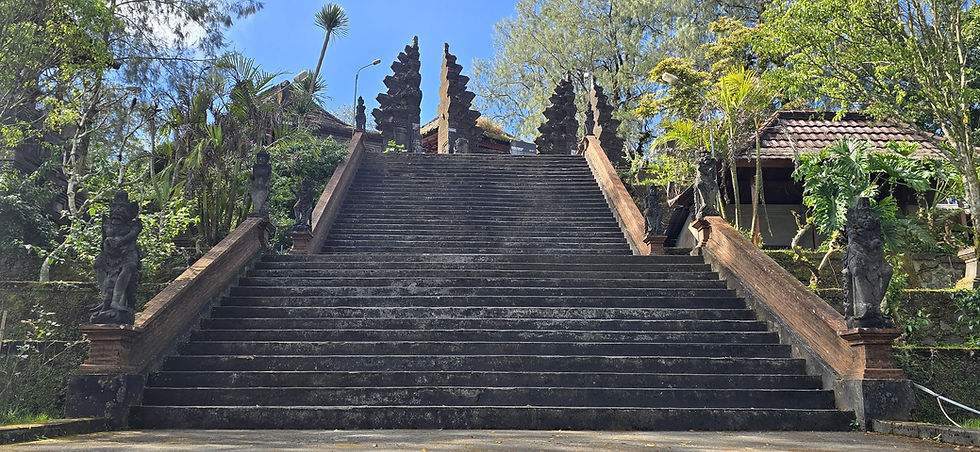
Unlike most Balinese temples, Pura Puncak Penulisan does not impose structure upon the land. It follows the mountain exactly as it is, rising in seven sacred levels that form a single mandala rather than the more familiar Tri Mandala arrangement. More than 300 stone steps wind upward through these terraces, each ascent drawing the body further from the world below and closer to something that feels increasingly unspoken. There are no towering meru shrines and no central padmasana throne. Instead, the mountain itself becomes the architecture of worship, as though the temple was never built but uncovered, revealed through the contours of the earth. The result is a sacred space that feels less constructed than remembered, shaped by an older understanding in which the landscape itself is already complete and divine.

Across these terraces, the mountain unfolds as an open air museum of stone, where centuries remain visible side by side rather than separated into neat historical layers. Volcanic tuff statues, fragmented shrines, lingga and ritual platforms lie across the complex, many carved in forms that retain the roughness of early hands rather than the refinement of later Balinese art. Among them sit figures of Ganesha, weathered by wind and time, their presence marking the continuity of worship as Hindu traditions gradually took root across the island. Some of these objects belong to megalithic phases of ritual life, while others date to the early Hindu Balinese period between the 11th and 13th centuries, creating a landscape where different eras remain physically interwoven . Many of the statues are wrapped in white cloth, a simple sign of purity, sacredness and the presence of divine spirit. Inscriptions found here have helped link Penulisan to other early ritual centres such as Gunung Kawi, pointing to a wider network of sacred mountain sites that once structured the island’s spiritual geography. Even references to the last ruler before the Majapahit expansion are absorbed into this same terrain, not as a story told separately but as another layer within the upper terraces themselves.

Pura Puncak Penulisan remains far more than an archaeological site. It functions as a living centre of obligation where around thirty Bali Aga villages are bound through banua alliances that organise ritual responsibilities across the highlands. People come here to present offerings tied to ancestral lineage, to participate in ceremonies that mark agricultural cycles, and to renew ties between communities whose identities are rooted in the mountain itself. For many Pasek families, this is not a symbolic pilgrimage but a inherited duty, where prayers are made for protection, fertility and continuity of the family line. During major temple festivals, the mountain becomes a coordinated ritual landscape, with different groups carrying out specific roles, from preparing offerings to conducting communal prayers at designated shrines. The focus is not observation but participation and the temple operates as a shared system of ritual labour rather than a single focal ceremony. In recent years, it has also drawn pilgrims from southern Bali who come seeking blessings associated with origin, ancestry and purification, particularly during large ceremonial events when the temple is fully active.

Beyond ritual and stone, the mountain sustains life in ways that are both physical and unseen. Springs emerge from its slopes and descend toward the valleys, feeding waterways that become part of Bali’s ancient subak irrigation system, linking the summit directly to rice fields across the island where generations of farmers have depended on its flow. What begins as water on the mountain becomes agriculture, settlement, and survival below, binding Penulisan into the daily rhythm of Balinese life in ways that are rarely spoken of but constantly relied upon. Local tradition speaks of hidden channels that run beneath the earth, connecting the mountain to lakes, volcanoes, and other sacred sites across the island, forming an invisible network beneath the surface that seems to mirror the visible paths of water above ground. These stories surface most strongly when springs appear or shift after heavy rain, when water is traced back toward its origin and the mountain is spoken of not as a single source, but as part of a wider system that moves through the landscape in multiple directions at once. In this way, Penulisan is understood less as an isolated peak and more as a point of emergence, where water, land and belief continually circulate through one another in ways that shape both the physical and spiritual life of Bali.

From the summit, clear mornings sometimes open a rare window across the island, when cloud lifts just enough to reveal Mount Batur, Mount Abang and Mount Agung standing across the southeastern horizon, the island’s volcanic spine drawn into a continuous line of peaks stretching into distance and haze. On many days it remains completely hidden, folded back into cloud and mist, and only on certain mornings does it appear in full clarity before the atmosphere shifts again and draws it out of sight. This entire region forms part of the UNESCO recognised Mount Batur Global Geopark, where geological formation and cultural tradition exist within the same landscape. In 2024, Pura Puncak Penulisan was officially designated a National Cultural Heritage Site, recognising its extraordinary archaeological depth and its role as one of Bali’s great Kahyangan Jagat temples, a sanctuary acknowledged across the island rather than tied to a single village or lineage. It is a place that feels unlike any other temple in Bali, not because it has never been separated from later layers of history, but because it has never stopped accumulating meaning across thousands of years, where megalithic ritual objects, early inscriptions and continuing worship all occupy the same terrain in visible layers of time.

🗺️ Location
Jalan Sutomo No.6, Pemecutan Kaja District, North Denpasar, Bali, Indonesia
🚆 How to get there
Pura Puncak Penulisan is reached via Bali’s central highlands in Bangli Regency, most commonly accessed through Kintamani. From Ubud, the journey takes around 2 hours, heading northeast through Gianyar before climbing into the Kintamani plateau. From the southern beaches, travel time is typically 3.5 hours depending on traffic, following the route through Gianyar and Bangli before ascending into increasingly mountainous terrain. From Kintamani village, the temple is roughly 25 minutes away by car or scooter along winding ridge roads with limited signage. There is no public transport serving the site, so a private driver or scooter hire is the only practical option. A full day pivate driver in Bali generally ranges from around 800,000 to 1,000,000 IDR depending on season and route. The site is often combined with other highland stops such as Pura Ulun Danu Batur and explorations of the Lake Batur region or extended further to include Trunyan Village on the eastern shore of the caldera, rather than visited as a standalone destination.
⭐ Attraction Info
Puncak Penulisan Temple is typically accessible daily from around 7am to 5pm, with visits discouraged outside daylight hours due to steep terrain and reduced visibility on the mountain paths. There is a 35,000 IDR entry fee per person to support local upkeep and temple maintenance and mandatory sarongs are included with entr.y As an active Kahyangan Jagat temple, access to certain inner areas may be restricted during ceremonies or significant ritual periods, while the broader complex remains open to respectful visitors. Unlike major commercial attractions, the site is managed locally and functions primarily as a living place of worship rather than a formal tourist destination.

Thanks for reading about Pura Puncak Penulisan. Check out more awesome destinations here!


