Pura Tambang Badung
A Royal Temple of Denpasar
Pura Tambang Badung sits in West Denpasar as a surviving fragment of the old Badung royal landscape, traditionally dated to 1660 AD during the rise of the Pemecutan court. It still carries the atmosphere of a place where power was never separated from ritual but instead woven directly into land and ceremony. The temple still holds that older logic in its bones, not as memory but as an underlying structure that continues to dictate how movement and ritual unfold within its layout. Even with the modern city pressing in from every side, it refuses to dissolve into its surroundings, holding a spatial organisation that still follows its original royal order rather than a modern heritage arrangement, because its ritual organisation still follows the older system on which it was built. It is also regarded as a Kahyangan Tiga temple, aligned with Shiva worship, while simultaneously functioning as a royal temple of the Badung lineage.
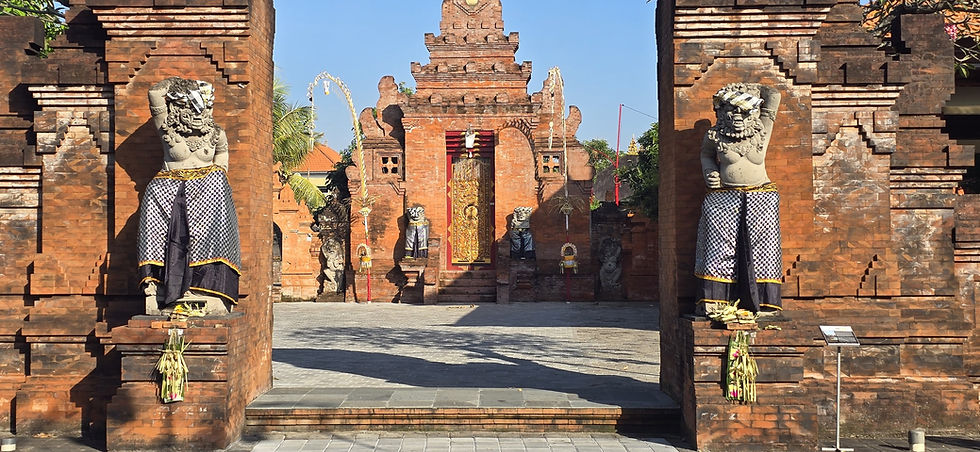
Lions mark the outer boundary as fixed symbols of royal authority, set into the perimeter more as declarations of sovereignty than as decorative guardians. Their role is not mythic spectacle but controlled marking of space, reinforcing that this was once part of a structured royal domain rather than a purely devotional site. The entrance is formed by a Candi Bentar gate, where access is deliberately compressed into a narrow threshold that separates outer public space from the sacred inner compound. At this gateway sit two iron cannons known as Gora and Gori, placed directly into the temple’s architecture rather than displayed as relics. They are not symbolic carvings or ceremonial replicas but genuine artillery, absorbed into the sacred boundary as permanent markers of force. Their presence signals the site’s historical connection to royal power and armed defence, where spiritual authority and military protection were not separate systems but overlapping expressions of the same court structure.

Deep orange red brick defines the material identity of the compound, creating a density that distinguishes it sharply from the volcanic stone more commonly associated with southern Balinese temple architecture and giving the entire site a warmer, heavier visual weight. This material language aligns closely with older Javanese court traditions from the Majapahit Empire, where brick construction was widely used in royal and temple architecture, and that influence remains visible in the structure’s proportions and surface character. Instead of presenting a single resolved architectural moment, the complex reads as an accumulation of phases, where earlier forms remain visible beneath later restoration and expansion. Different periods of construction sit alongside one another without being fully overwritten, giving the site a layered continuity rather than a purified style. The compound itself spans roughly two hectares, reinforcing its scale as a major royal and ritual complex rather than a small neighbourhood shrine.

Along the inner walls carved figures run in a continuous line through the architecture forming an unbroken presence rather than isolated decorative panels. These are armed court guardians known as Arca Jaksa and Jaksi representing the judicial and administrative arm of the royal system rendered in stone. Each figure is shown holding traditional weapons marking them not as symbolic spirits but as embodiments of authority law and enforcement within the court structure they belong to. Their placement inside the compound rather than at the outer gate is significant because they do not function as boundary protectors but as internal overseers extending the reach of royal authority deeper into the space and reinforcing control within the sacred and administrative core rather than only at its edge.

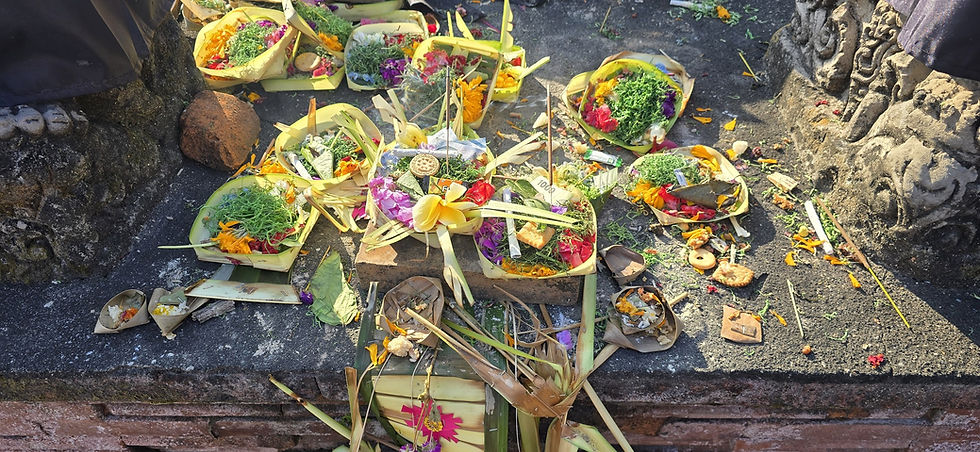
The compound expands into a dense network of 60 paibon shrines tied to the extended Pemecutan lineage, forming a structured system of continuity rather than symbolic ancestral markers, and this network gives the temple its sustained social function beyond its physical form. These shrines operate through use rather than display and are actively involved in ngaben ceremonies, the Balinese cremation ritual where the deceased are purified and released from the physical world through fire and offerings. During these ceremonies the paibon network becomes the route through which ritual activity moves, binding the extended family to the space through repeated participation across generations. This turns the temple into a maintained system rather than a static monument, sustained through continual ritual activation rather than passive observation. Within this broader ritual life the Baris Tangklong tradition is performed, a ceremonial warrior dance in which performers carry traditional weapons and move in formation to symbolically cleanse the environment of negative forces while embodying disciplined martial strength, reinforcing both purification and the spirit of a warrior within the temple’s underlying martial character.

At the centre, the Pelinggih Hyang Ibu Candi holds ancient lingga stones and sits among key shrines such as Gedong Dalam Tambang Badung, the main ancestral shrine of the royal line, and Pelinggih Luhur Kaler, associated with the northern aspect of divine presence. Together they form the ritual core of the temple, where movement and offerings are drawn inward and the spatial order becomes most concentrated. It is also said that important inscriptions recounting the temple’s history and the wider Balinese kingdom lie buried beneath this central area, suggesting the foundations themselves carry a record that is no longer visible. The ritual calendar follows a 210 day pawukon cycle aligned with Wespatik Wuku Sungsang, a fixed week in the Balinese calendar that determines key ceremonial timing. Within this cycle, major rites fall on Purnama Kedasa, a full moon linked to purification and temple renewal, and Purnama Kapat, a full moon associated with ancestral offerings. These are not one off events but returning points in time, where the same ceremonies are reactivated each cycle, keeping the temple anchored to repetition rather than historical sequence.

What defines the temple is not its age or layered construction but its continued role as a royal Shiva temple where ritual is still part of everyday religious life rather than something remembered from the past. Ceremonies continue to bring people into its courtyards, offerings are placed according to established cycles, and the paibon network is used for ongoing family rites that maintain direct links between the lineage and the space. This is not preservation in a modern sense but continued function, where the temple is still actively used for the same kinds of ritual activity that shaped its original form. Its physical elements also remain in use as part of this system. The gate cannons sit at the entrance as permanent features of the boundary rather than display objects, while the carved armed guardians along the interior walls represent court authority that is still embedded in the structure of the space. Even older construction layers are not treated as remnants but remain part of the working environment, visible because the building has developed through continuous use rather than being frozen at a single point in time.

🗺️ Location
Jalan Gunung Batur No 17, Pemecutan Village, West Denpasar District, Bali, Indonesia
🚆 How to get there
Located in West Denpasar, Pura Tambang Badung is approximately 10kms north of Kuta and takes about 25 to reach on bike, following Sunset Road or Jalan Imam Bonjol into central Denpasar. The temple is easily reached by scooter, taxi or ride share, with parking available right outside. A Gojek scooter for a 4 hour loop typically costs around 250,000 IDR, while a one way fare is around 30,000 IDR, although it is generally better to ask the rider to wait given that there is very little immediately surrounding the temple.
⭐ Attraction Info
There are no official opening hours or entrance fees for Pura Tambang Badung and information is quite difficult to source. As an active royal Shiva temple, visitors are generally welcome to explore the outer areas during daylight hours, although access to the inner sanctuaries may be restricted during ceremonies or periods of worship. If you find a local, ask if you have permission to enter. Standard Balinese temple etiquette applies, including wearing a sarong and sash and dressing modestly. Unlike heavily visited landmarks, Pura Tambang Badung receives relatively few international tourists, offering a quieter opportunity to experience a royal temple where ceremonies, ancestral traditions and centuries of ritual practice continue as part of everyday life. It pairs well with nearby visits to Jagatnatha Temple and Maospahit Temple, making it an excellent addition to a self guided heritage loop through historic (and often overlooked!) Denpasar.

Thanks for reading about Pura Tambang Badung. Check out more awesome destinations here!