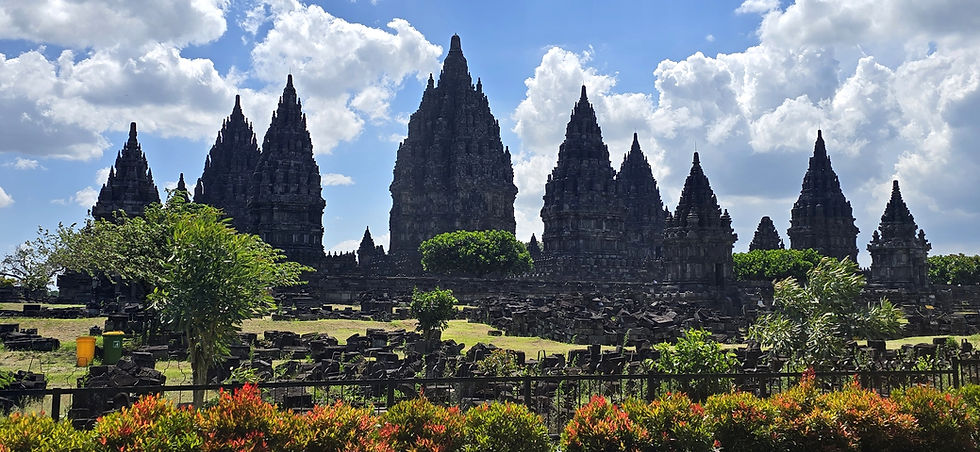
Selogriyo Temple
Echoes of a Lost Era
Hidden high in the misty hills of western Central Java, Selogriyo Temple perches like a forgotten sentinel overlooking the lush valleys below. True to its name, which roughly means “House on the Rock”, the temple clings to steep cliffs, its stones blending seamlessly into the rugged landscape. Unlike the grand Borobudur or Prambanan Temples, Selogriyo’s modest scale belies its enigmatic aura, leaving travellers with the sense that the site is quietly alive with unseen presence.

The temple’s origins are shrouded in uncertainty, though architectural hints suggest it may date back to the 9th century, around the same era as the Dieng Plateau sanctuaries, a cluster of early Hindu hilltop temples dedicated mainly to Shiva. Its unusual design, with its shrine facing the mountains rather than the cardinal points, suggests a spiritual alignment with the natural world, possibly honouring local mountain spirits alongside the Hindu pantheon.

Access to Candi Selogriyo is a journey in itself. Visitors traverse narrow paths carved into cliffs, stepping carefully over volcanic rock and crossing streams. The isolation may have been intentional, some historians believe it served as a hermitage for monks or priests seeking meditation away from the political centres of the Mataram Kingdom. The temple’s remote position adds a sense of reverence and quiet power, as if the hills themselves guard its secrets.

Carved reliefs and statues hint at a complex spiritual life but many are eroded or decapitated, leaving the imagination to fill the gaps. Floral motifs, lingam / yoni symbols and small depictions of deities peek from the stone as if whispering messages long forgotten. In the absence of inscriptions, Selogriyo’s story is conveyed more through atmosphere than text. The morning mist, the shifting light and the wind all seem part of the temple’s language.
The temple’s seclusion and ancient purpose seem to command a quiet respect from those who know of it. Its terraces and stone chambers hint at centuries of ritual and reflection and while there are no widespread tales of spirits or hauntings, visitors often sense an unusual stillness, a weight of history and devotion that lingers in the air, as if the landscape itself remembers the prayers once offered here.

Despite its historical significance, Selogriyo has never been the subject of major archaeological excavation, leaving much of its story untold. Scholars debate its precise role. Was it a ceremonial centre, a meditation retreat or a secretive shrine for elite priests? Each stone seems to resist easy answers, inviting awe and speculation from those who venture here.
The surrounding landscape contributes as much to Selogriyo’s allure as the temple itself. From its terraces, sweeping views of verdant valleys, terraced rice fields and distant volcanoes stretch to the horizon. As the sun rises or sets, shadows shift across the temple walls, transforming familiar shapes into uncanny figures, leaving visitors with the sense that Selogriyo exists at the edge of both the earthly and the divine.

🗺️ Location
Sentonorejo, Jogotirto Village, Berbah District, Sleman Regency, Special Region of Yogyakarta, Indonesia
🚆 How to get there
From Borobudur Village, Selogriyo Temple is located around 18 km's away, taking roughly 40 minutes by car or scooter. Head northwest toward Windusari District, passing through rural villages and terraced farmland until reaching the small parking area near Campurrejo village. From there, continue on foot for about 2 km's along a narrow trail through rice fields, across small streams and along steep hillside paths, a walk that typically takes 30 minutes. Alternatively, you can pay around 50,000 IDR to a local scooter driver, who will take you directly to the temple gate from the carpark. From there, it’s about a 5 minute walk up a few hundred stairs to reach the main temple site. The riders will wait for you and return you back to the car park afterward. We used a private driver for the day for 750,000 IDR, who also took us to Curug Silewe Waterfall, Nepal Van Java and Sukomakmur Village.
⭐ Attraction Info
Candi Selogriyo is open to visitors daily from early morning until late afternoon, typically between 7am - 5pm, though exact times can vary depending on local weather conditions. There is a small entry fee of 10,000 IDR, payable in cash, which helps with maintenance of the site and surrounding paths. Facilities are minimal due to the temple’s remote and rugged location. There are no food stalls or shops at the temple site, so visitors should come prepared with water and snacks, which can be bought in the main village. There are onsite restrooms. The trek to the temple is moderately challenging, with steep trails and rocky paths, so comfortable footwear is recommended. The temple’s seclusion and dramatic hillside setting make it a rewarding destination for those seeking both history and panoramic views of the surrounding mountains and valleys, without the crowds.

Thanks for reading about Selogriyo Temple. Check out more awesome destinations here!