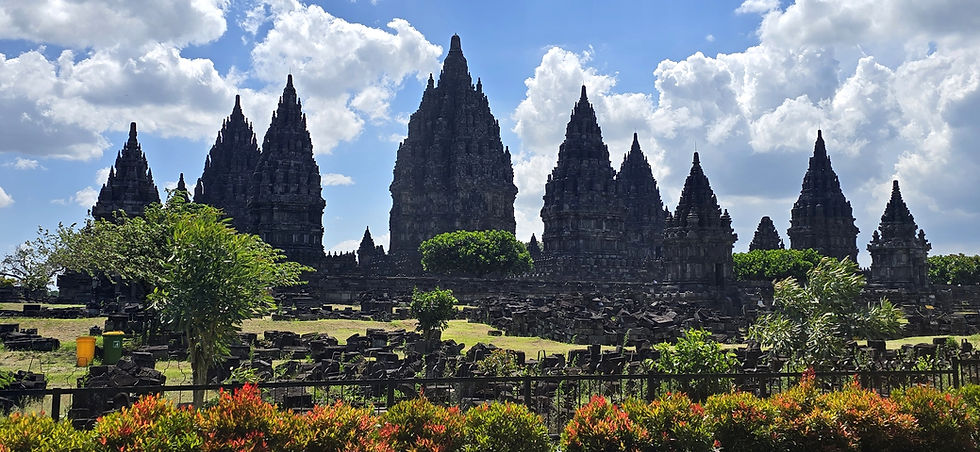
Sewu Temple
The Skeleton of a Lost Empire
Candi Sewu rises in quiet ruin within the Prambanan Temple complex in Central Java. Its name speaks of a thousand shrines, yet only 249 were ever completed, their pattern set in vast symmetry like a stone mandala that once shaped the sacred plain. The complex was raised in the 8th century under the Sailendra dynasty, an age when Mahayana Buddhism reached deep into Java and kings carved their faith into the earth with monuments that were as much declarations of power as acts of devotion. What remains suggests a vision of a sacred city, vast in scale and heavy with meaning, where stone was meant to mirror the order of the cosmos and the presence of the divine. Sewu predates Prambanan and dwarfs it in scale, a reminder that Buddhist power once stood at the very heart of the island before shifting tides of faith and empire buried it in silence.

At the centre of the complex rises the main sanctuary which even in ruin remains imposing. It once towered above the smaller shrines that surround it and its walls were covered in carvings of Bodhisattvas and celestial guardians. The design symbolised the Buddhist cosmos with layers that represented the earthly realm below the path of transition in the middle and the heavens above. Around this sanctuary stood four square rings of perwara shrines. They were aligned with geometric precision so that the entire site mirrored the order of the universe. This was not only a temple but a stone embodiment of spiritual ascent created to be walked in meditation as a reflection of the path to wisdom.

Sewu Temple was dedicated to Manjusri the Bodhisattva of Wisdom. In Buddhist texts he is the one who cuts through illusion and guides the seeker toward true understanding. The temple was meant to be his palace on earth. Pilgrims passing through its gates first encountered massive statues of Dvarapalas who guarded the thresholds. These stone giants hold clubs and stare out with menacing faces. They were not simple decorations but protectors whose very presence dared mortals to step inside only with pure intent. Even now their ancient forms feel alive and those who stand before them feel the echo of ancient warning.

The history of Sewu is not one of peace alone. The Sailendras eventually fell from power and the Hindu Sanjaya dynasty rose to prominence. With Prambanan they created a rival monument close by and the two complexes stood as symbols of competing kingdoms and faiths. In later centuries Sewu suffered destruction as dynasties shifted and new powers sought to erase the old. Looting stripped many of its treasures and natural disasters shattered its stone. Earthquakes across the centuries deepened the ruin including the violent quake in 2006 which shook the foundations and collapsed more of the shrines. What remains today is a wounded skeleton of what was once a city of the gods.

The name Sewu has always been a puzzle and is bound to the legend of Rara Jonggrang. She was the daughter of a king defeated in battle. The conqueror wished to claim her as his bride but she loathed him for killing her father. To escape she demanded the impossible. She asked him to build her a thousand temples in a single night. The king called upon spirits of the underworld who raised stone after stone until the shrines almost reached completion. In fear Rara Jonggrang tricked them by pounding rice and lighting fires so that the spirits believed dawn had come. They fled leaving the task unfinished. When the king discovered her deceit he cursed her in fury. She was turned into stone her beauty frozen forever as the final statue completing the count of one thousand.

The curse of Rara Jonggrang binds Sewu and Prambanan together. The thousand temples she demanded became Sewu and her stone figure stands within Prambanan as if mocking both her trickery and her punishment. The tale gives the temples a dark heart. They are not only sacred structures but the remains of a story of hatred deceit and vengeance. The stones themselves seem heavy with the spirit of the cursed maiden and some say her sorrow still lingers in the air. At night the temples are said to echo with whispers and restless steps as if the spirits of the workers who built them continue their endless toil.
The design of Sewu itself deepens this haunting quality. The four rows of shrines surrounding the central sanctuary form a labyrinth that both protects and imprisons. Some scholars have suggested that this reflects the cycle of rebirth known as samsara a reminder of the endless suffering of life and death. Unlike Borobudur which guides the pilgrim upward toward liberation Sewu feels enclosing and heavy. Local tales claim that the shrines became houses for abandoned spirits when the Sailendra dynasty fell. People still say that headless forms wander there at night searching for the bodies they lost in forgotten battles.

To walk among the ruins of Sewu today is to step into a place where history and myth are inseparable. The cracked faces of the Bodhisattvas look out from the stone as if erased by sorrow. The wind whistles through broken chambers and the guardian giants stand watch with eyes that seem alive. Moss and vines crawl where once incense and offerings burned. Many visitors say the complex feels colder than Prambanan and more oppressive. It is as if Sewu still waits for the final temple to rise and for Rara Jonggrang’s curse to be fulfilled.

🗺️ Location
Jalan Raya Solo, Yogyakarta No.16, Kranggan Village, Bokoharjo Subdistrict, Prambanan District, Sleman Regency, Yogyakarta Special Region, Indonesia
🚆 How to get there
Candi Sewa, within the Prambanan Temple Complex, lies about 17 km's northeast of Yogyakarta’s city centre, roughly 30 minutes drive depending on traffic, making it an easy addition to a day exploring the eastern plains of Sleman. Visitors can reach the site by taxi or rideshare, with fares from central Yogyakarta generally ranging between 100,000 - 150,000 IDR one way or by renting a scooter for about 70,000 - 100,000 IDR per day if you’re comfortable navigating local roads. Many travellers prefer hiring a private car with driver for the day at roughly 600,000 IDR, which offers the flexibility to combine the visit with nearby temples or other scenic spots in the region.
⭐ Attraction Info
Access to Sewa Temple is available daily between 6:30am - 5pm, with tickets available throughout the day. On Mondays, access to the inner sanctuaries of Prambanan is restricted however visitors can still explore the outer areas, including the very quiet Sewa. Entrance fees to the park for international visitors are a hefty 400,000 IDR. The complex provides many facilities, including a restaurant, museum, restrooms and a small gazebo for resting. On select evenings, visitors can enjoy cultural performances of the Ramayana Ballet. The temple is particularly striking in the late afternoon, when the sun casts a warm glow over the spires and reliefs, creating an atmosphere of reflection and ideal conditions for photography. As of late March 2026, access Sewa is closed for renovations.