
Ubud
Walking Through Time in Bali’s Living Heart
Long before Ubud became the bustling artistic and cultural heart of Bali, its lush valleys were first shaped by the hands of early settlers. Archaeological evidence points to human habitation over 1300 years ago, when small communities cultivated rice terraces, tended sacred groves and relied on the land for both sustenance and healing, a connection so deep that the area originally came to be known as Ubad, a word rooted in the Balinese term for medicine. In this era, the Indian Hindu priest Rsi Markandeya arrived, drawn by thMindfulTrave tranquil meeting of the two Wos rivers in Campuhan. He meditated by the flowing waters, sensing the valley’s latent spiritual energy and established the Gunung Lebah Temple, an imposing sanctuary that would anchor the area as a centre of ritual, healing and creative inspiration for centuries to come.
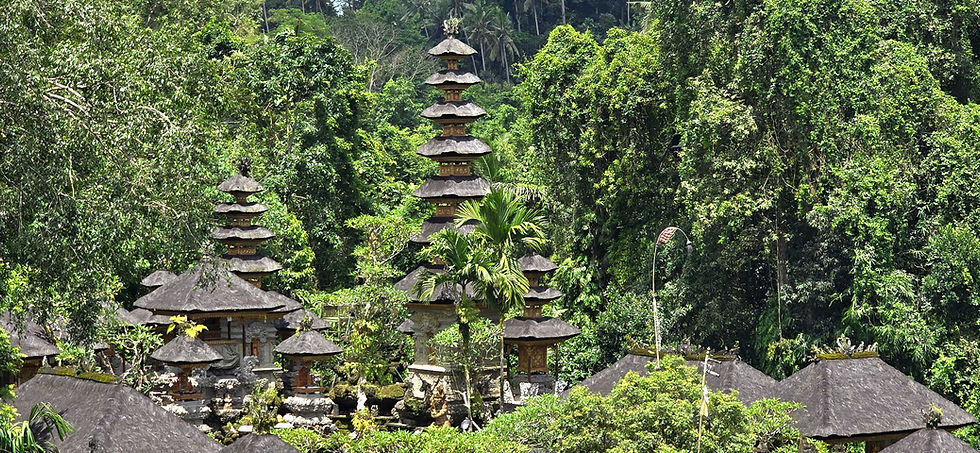
At Gunung Lebah, life revolved around the temple in ways that defined Ubud’s early identity. Villagers came not only to worship but to learn healing arts passed down from Rsi Markanedya, combining herbal medicine with ritual chants and offerings. Stone altars and carved reliefs depicted gods, ancestral spirits and legendary serpents said to guard the valley’s energy, serving as both devotional art and spiritual instruction. Seasonal festivals transformed the temple grounds into a stage for music, dance and storytelling, each performance a living lesson in cosmic order and human wellbeing. The riverbanks and sacred groves surrounding the temple became natural classrooms and sanctuaries, where creativity and restoration were inseparable, embedding the valley with a rhythm of life that persists today.

By the 9th and 10th centuries, Ubud’s valley had grown into a network of villages shaped by the influence of Majapahit rulers from Java, who brought skilled craftsmen to carve temples with twisting naga serpents, hybrid deities and celestial motifs. These carvings were more than decoration, they held coded knowledge of herbal remedies, sacred chants and precise ritual movements, connecting the physical, spiritual and natural worlds. Villagers moved carefully among the stone reliefs, performing rites with medicinal herbs, flower offerings and whispered invocations designed to restore balance, protect the body and honour unseen forces lingering along the rivers and rice terraces. Stone inscriptions hint at rituals so exact that even a small mistake could disrupt the harmony between humans, Gods and the land. Every gesture, every carved panel and every hidden symbol bound art, healing and devotion together, turning Ubud into a valley where imagination, spirituality and restoration were inseparable and where the mysteries of the sacred world were always just out of reach.

Ubud grew into a royal centre under the Gianyar dynasty and by the 16th century, the Puri Saren Agung palace stood at its heart, establishing the valley as a royal seat. Open pavilions rose above the city, their walls adorned with apsaras frozen in mid dance, serpents coiling across stone surfaces and fierce kala guardians staring down intruders. Life at the royal seat was not without tension. Succession disputes and obligations to the court brought moments of unease but the palace also provided protection, stability and patronage for the arts. Painters, sculptors, dancers and shadow puppet masters worked under royal guidance, producing performances and artworks often tied to healing rituals, protective ceremonies, or blessings for the rice fields. Creativity and spiritual devotion became inseparable, flowing through every festival and ritual. Royal ceremonies combined politics with restoration, reinforcing Ubud’s enduring identity as a place where art, power and sacred tradition met.

In Ubud, sacred spaces and palaces carry centuries of layered history and creative energy. At Saraswati Temple, lotus ponds mirror elaborately carved panels that seem to dance with the reflection of the sun, celebrating knowledge, artistry and the divine. Nearby, Pura Dalem, the Temple of Death, shivers with ancestral presence, its stone shrines hosting ceremonies that honour the cycle of life, guiding the passage of spirits and maintaining the balance between the living and the dead. Within Peliatan Palace, still very much a living centre of culture, painted ceilings and stone reliefs testify to centuries of artistic devotion, while the air often resonates with gamelan music accompanying dance, sculpture and ritual. Inscriptions etched in archaic Balinese script speak of offerings, sacred formulas and ceremonial artistry, connecting the seen world with the unseen. Today, the air in these spaces vibrates with memory, the weight of centuries carved into stone, sung through gamelan and whispered in ceremonial chants, reminding visitors that Ubud is not just observed but experienced.

Even the Sacred Monkey Forest Sanctuary vibrates with a presence that is both playful and profound. The monkeys are the true heartbeat of the forest, moving freely among the trees, shrines and statues, revered as messengers of the Gods, tricksters of legend and living participants in centuries of ritual, some believed to embody Hanuman, the legendary monkey warrior of epic tales. At its heart stands the Great Temple, Pura Dalem Agung Padangtegal, built over 700 years ago, bearing witness to centuries of offerings, prayers and ceremonies that honor the dead and maintain spiritual balance. Tucked nearby, the Padangtegal Cemetery serves as a temporary resting place for the recently deceased, where ritual offerings and prayers ensure their passage toward cremation is respected. Carved from volcanic stone and weathered by centuries of rain and ritual, each statue exudes a presence that is both protective and sacred, commanding attention as monkeys weave between them. Incense smoke curls around their carved faces, while ritual flowers and offerings placed at their bases mark them as living conduits between the human and spiritual worlds.

Ubud rises from centuries of layered history, with each era leaving its imprint across streets, courtyards and temples. Ancient rituals come to life as dancers retell stories handed down through generations, while painters create scenes first imagined centuries ago. Locals carry these traditions forward, their practices filled with colour, sound and motion, a living thread connecting centuries of devotion to the rhythm of modern life. Walking through Ubud is stepping through time itself, where artistry and spirituality are inseparable. This is a city not merely to witness history but to feel it, drawing visitors from across the globe into the heart of the Island of the Gods.

🗺️ Location
Ubud, Gianyar Regency, Bali, Indonesia
🚆 How to get there
The journey from Ngurah Rai International Airport in Denpasar to Ubud covers roughly 35km's, winding through Bali’s ever changing landscape and taking up to two hours depending on traffic. Leaving the airport behind, the road passes craft villages, temples and rice fields, gradually bringing you into the island’s cultural heart. Turning onto Jalan Raya Ubud, the pace slows and the town’s artistic and spiritual energy begins to emerge. Visitors can hire a private driver, use a ride hailing app like Grab or take a hotel shuttle for a comfortable, stress free journey, usually costing around 350,000 IDR. Those who wish to stop and explore some of the many sights along the way can expect to pay a private driver around 500,000 IDR.
⭐ Area Info
Ubud is a vibrant cultural hub offering a rich mix of experiences for all sorts of visitors. The town is home to a wide array of restaurants and cafés, from casual local warungs serving traditional Balinese dishes to high end eateries showcasing modern Indonesian and international cuisine. Hotels and homestays cater to every taste, from boutique retreats tucked into rice terraces to luxurious resorts with spa and wellness offerings. Visitors can also indulge in health resorts, yoga studios, cooking classes and spiritual development experiences, offering ways to reconnect with body, mind and culture. For nightlife and relaxation, jungle clubs and riverfront lounges provide scenic escapes, while art galleries, craft shops and studios celebrate the region’s centuries old creative traditions. Beyond the town centre, travellers can explore temples, sacred forests, waterfalls and lush rice terraces, all woven into Ubud’s unique blend of spirituality, art, wellness and natural beauty. I usually book all my accommodation through Booking .com. For transport, my reliable driver Putu, who has access to both cars and scooters, can be contacted via whatsapp on +62 812-8025-0205, making exploring Ubud and the surrounding area stress-free.
Thanks for reading about Ubud. Check out more awesome destinations here!

\

