
Merapi Volcano Museum
Under the Shadow of Fire
Beneath the looming slopes of Mount Merapi, the Merapi Volcano Museum lies almost swallowed by the mountain itself, its angular walls pressed into the earth as if trying to escape the shadow of the fiery giant above. Stepping inside is like descending into the volcano’s memory. The air carries a subtle weight, as though centuries of molten rock, searing heat and choking ash have seeped into the very stones. Here, time feels distorted, one can almost sense the mountain watching, remembering and waiting. This is not just a museum at the foot of a volcano, it is a subterranean chamber of fire’s history, where the fury of the mountain and human vulnerability intersect.

Known locally as The Museum Gunungapi Merapi, its halls pulse with interactive displays that bring the hidden workings of the volcano to life. Translucent layers reveal magma shifting far below the surface, glowing faintly as if alive, while miniature tremors simulate the subtle quivers that presage eruptions. Visitors can manipulate levers and buttons to watch pyroclastic clouds form or lava carve paths down simulated slopes, experiencing the slow, inevitable buildup of a natural force that can obliterate everything in its path. It is a tactile, immersive lesson in the raw, elemental violence that Merapi carries beneath its calm, green slopes.

History is carved into the museum as much as geology. The 2010 eruption, one of the deadliest in living memory, is displayed in chilling, almost unbearable detail. Charred bicycles, twisted metal and scorched household objects lie frozen in cases, while photographs capture villagers fleeing in horror as rivers of ash and smoke swallowed homes and roads. Pyroclastic flows tore down the slopes at hundreds of kilometres per hour, obliterating everything in their path. More than 350 people lost their lives and entire villages were reduced to blackened skeletons of what once was. In the museum, the eruption is more than a record, it is a living, searing presence, a warning etched into ash and fire, a reminder of how quickly life can vanish beneath Merapi’s relentless wrath.

Earlier eruptions are no less haunting. The 2006 outbreak, though smaller in scale, is preserved through objects recovered from Merapi’s slopes: blackened farming tools, melted roof tiles, and twisted bicycles tell of ordinary lives instantly disrupted by molten fire. Beyond the 21st century, historical accounts and volcanic deposits reveal eruptions in the 19th century that darkened the sky for days, reshaped rivers and erased entire villages from memory. Layers of ash and lava, carefully mapped and displayed in the museum, serve as a stratified diary of human suffering and survival beneath the mountain’s relentless vigilance.

Even deeper in the museum, exhibits explore eruptions that predate written history. Sediment cores, carbon dated volcanic layers and remnants of ancient settlements show that Merapi’s fury has been shaping the land for thousands of years. Massive explosions, forests flattened, rivers rerouted and fertile plains buried under meters of ash, these events predate human memory, yet their echoes persist in the soil, in local rituals and in the cautionary tales that still circulate among the villages below. In this way, the museum acts as a bridge between human history and the deep, almost incomprehensible memory of the earth itself.

The exhibits also delve into the spiritual dimension of the mountain, highlighting how local communities have historically lived in an uneasy partnership with its power. Seasonal offerings, sacred processions and prayers coexist with scientific explanation, showing that understanding Merapi requires both empirical knowledge and reverence. Rituals are not superstition but survival strategies, acknowledgments of a force that is ancient, intelligent in its persistence and indifferent to human life. Yet the same slopes that have swallowed villages also yield astonishing fertility. Volcanic ash enriches the soil, rivers of debris carve new terraces and farms flourish with abundant harvests. What Merapi takes with one hand, it gives with the other, a terrifying generosity that has sustained human life for centuries. Visitors leave with the profound understanding of human resilience within the volcano’s shadow.
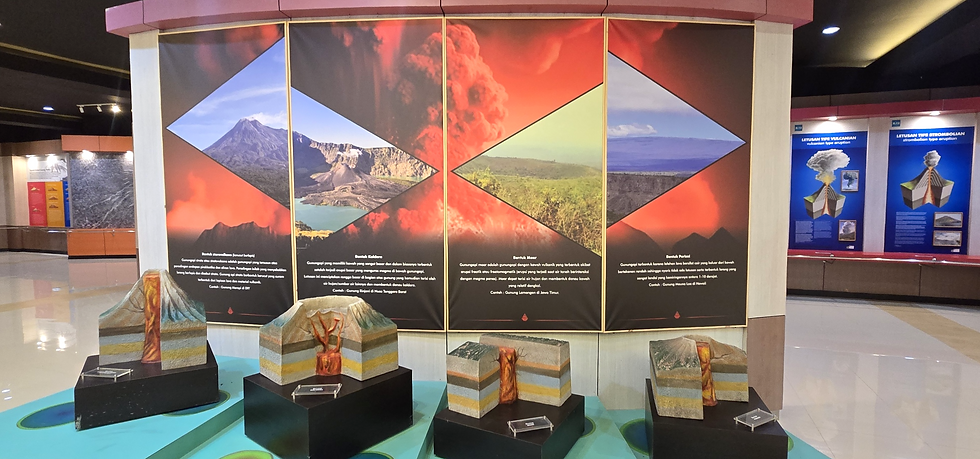
Finally, the museum functions as a living centre of preparedness and reflection. Beyond history and science, it teaches evacuation strategies, emergency response and hazard recognition, yet it does so with a constant awareness of the mountain’s lurking menace. Simulations of lahars, ash clouds and pyroclastic flows are startlingly immersive, leaving no doubt that Merapi’s memory is active and vigilant. Visitors leave with more than knowledge, they carry a sense of awe, fear and respect for a mountain whose ancient, recurring wrath has shaped centuries of life, death and survival in ways that science and human effort can only hope to anticipate.

🗺️ Location
Jalan Banteng No 22, Pakem Village, Sleman Regency, Special Region of Yogyakarta, Java, Indonesia
🚆 How to get there
The museum is located on the lower slopes of Mount Merapi, about 30 km's north of central Yogyakarta. Visitors can reach it by car or motorbike along Jalan Kaliurang, a scenic route through villages and farmland. A private driver for the day typically costs around 750,000 IDR, which allows stops at nearby waterfalls and other attractions along the way, making for a flexible, immersive journey. The drive usually takes around 60 minutes, with ample parking available for cars, motorcycles and buses.
⭐ Attraction Info
The museum is open Tuesday to Sunday between 8am - 3pm and Friday's between 8am - 2pm, it is closed on Mondays. Entry fees are 5,000 IDR for local visitors and 10,000 IDR for international guests, with an additional small fee for the audio visual room. Visitors can make use of restrooms, a wide parking area for cars and buses, a souvenir shop, café and a mushola for prayer. Walking through the museum takes about 30 - 60 minutes. During my visit it was extremely quiet, with no other tourists in sight.


Thanks for reading about the Merapi Volcano Museum. Check out more awesome destinations here!


