
Thawan Duchanee
Baan Dam and the Art of Darkness
Born in Chiang Rai on 27 September 1939, Thawan Duchanee showed extraordinary artistic talent from childhood. While still young, he won a scholarship to study at Poh Chang Arts and Crafts College in Bangkok, only to discover that the school had no accommodation for him. Rather than tell his family and risk worrying them, he secretly slept inside the college building, turning its classrooms into a makeshift home. The boy from Thailand’s northern frontier would eventually become one of the country’s most celebrated artists, named a National Artist in Visual Arts in 2001. Yet long before the honours came, Thawan had already begun developing an artistic language that would disturb, provoke and eventually enrage the people who encountered it.

At Silpakorn University, Thawan came under the influence of Silpa Bhirasri, the Italian born sculptor who helped establish modern art education in Thailand. His teacher recognised Thawan’s technical ability but believed something essential was missing. His birds could not fly, his horses could not run and his fish had no smell. The criticism cut far deeper than an insult to his drawing. Bhirasri was demanding that Thawan stop imitating the appearance of life and learn to capture its raw velocity. Thawan responded by tearing into the instincts beneath the surface. Animals became muscular, volatile and almost supernatural. Tigers seemed ready to spring from the canvas, buffaloes carried the weight of ancient violence and horses became expressions of speed, fear and uncontrollable energy. He was no longer interested in making animals look alive. He wanted them to feel alive.

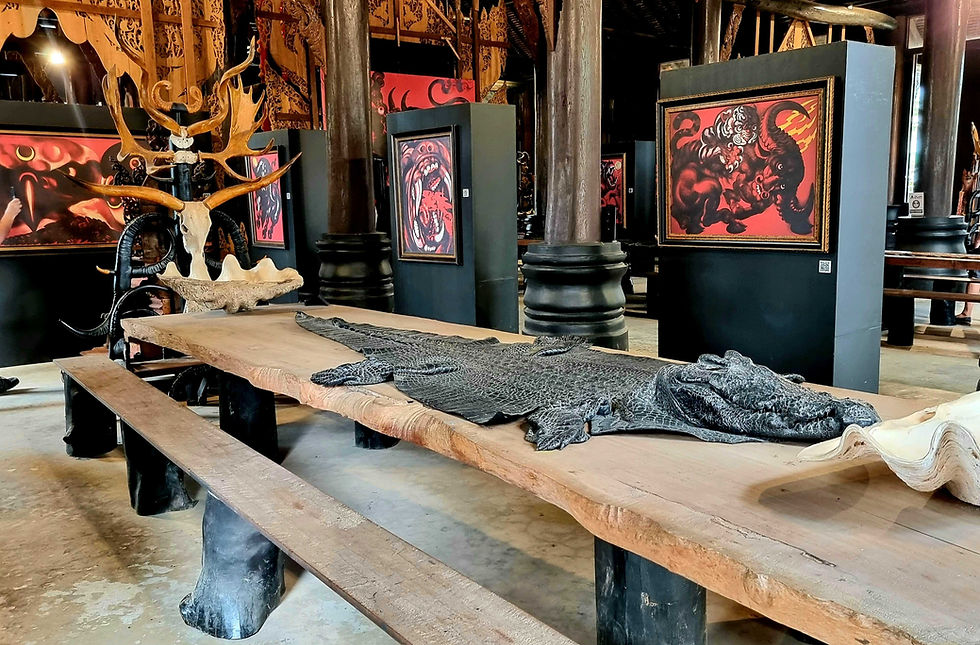
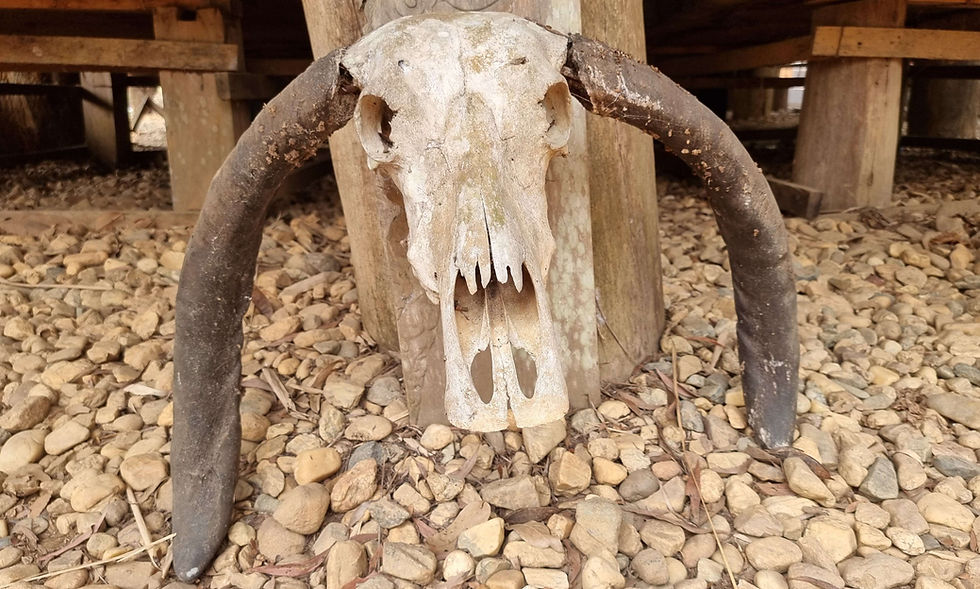
That obsession with physical life inevitably brought him face to face with death. Thawan collected horns, bones, skulls, hides and other animal remains, transforming them from discarded remnants into objects of contemplation. At Baan Dam, the Black House, death entered the domestic world with astonishing force. Horns curl from furniture, enormous animal skins cover surfaces and skulls occupy rooms like silent occupants who have no intention of leaving. A chair ceases to be ordinary furniture when its structure is built around the bones of a slaughtered buffalo. A dining table becomes something altogether stranger when the evidence of slaughter lies across it. Thawan did not hide death beneath the ground or behind the walls. He brought it into the room, surrounded himself with it and made the remains of once living creatures part of everyday existence.

His fascination with darkness was rooted in something deeper than horror. Buddhist philosophy, Hindu mythology, Thai spiritual traditions and the relentless cycle of samsara all fed into an imagination where gods, demons, animals and humans could embody the same struggles of desire, suffering and impermanence. Then, in 1971, that vision collided violently with religious convention. During an exhibition in Bangkok, several of Thawan’s works were condemned as blasphemous because of their religious imagery, nudity and violence. Conservative students attacked the paintings and ten works were destroyed, with some reportedly slashed or scratched with knives. For an artist whose work was built around spiritual inquiry, watching his paintings physically butchered was devastating. The attack became one of the darkest episodes of his career, revealing that the violence inside his paintings could provoke violence outside them. His demons were painted on canvas, but the outrage they awakened was painfully real.
Thawan also stripped away the polite boundaries surrounding the human body. Desire in his work could be sensual but it was rarely gentle. Flesh merged with animal forms, bodies became exaggerated and predatory and sexuality seemed inseparable from power, hunger and mortality. He rejected the comforting idea that civilisation had completely tamed the instincts buried beneath the skin. His figures suggest something older lurking underneath, something capable of desire without restraint and violence without apology. Beauty could become threatening in an instant. The human body could appear magnificent one moment and almost bestial the next. For Thawan, sexuality was not simply about attraction. It was another doorway into the primitive forces that connect humanity with the animal world.

Baan Dam became the physical expression of that entire philosophy. Developed over decades on the outskirts of Chiang Rai, the estate grew into a sprawling collection of dark buildings inspired partly by traditional Lanna architecture and partly by forms that seem to belong to another world. Thawan lived and worked there, filling the complex with paintings, sculptures, animal remains and objects created from horns, skins, bones and timber. The buildings do not behave like conventional galleries. They feel more like chambers within a vast psychological landscape, each structure revealing another fragment of the artist who created it. Black wood rises from the tropical surroundings while enormous horns, skulls and hides transform interiors into something between a sanctuary, a studio and a mausoleum. Baan Dam was not merely a place where Thawan displayed his art. It was the environment through which he gave his imagination physical form.
Thawan died in Bangkok on 3 September 2014 at the age of 74 but his final work returned to the animal that had followed him throughout his artistic life. From his hospital bed, he completed a painting of a horse, an extraordinary final echo of the lesson that had once changed everything: horses must run. The young artist who had been told his animals lacked life ultimately spent decades trying to capture the force that exists beyond appearance, until paintings, sculptures and buildings became extensions of the same restless vision. At Baan Dam, that vision still surrounds the visitor. Horns rise from the darkness, skulls watch from the shadows and the remains of dead animals occupy the spaces where people once lived. Thawan Duchanee spent his life confronting the boundary between beauty and brutality. In the Black House, he erased it.

Wooden carving of a buddha through an ornate doorway, purple and white flowers at its feet
🗺️ Location
333 Moo 13 Nang Lae, Muang, Chiang Rai, Thailand
🚆 How to get there
The Black House Museum is one of Chiang Rai’s most distinctive art sites, located about 12 km's north, or roughly a 20 minute drive, from the city centre. A tuk-tuk or song taew typically costs around 500 THB return, while Grab or InDrive rides usually range between 200 and 250 THB per trip. Public buses are available but slower, with a short walk required from the drop off point. Many travellers choose to visit the Black House as part of a temple circuit tour, which also includes the White Temple (Wat Rong Khun) and the Blue Temple (Wat Rong Suea Ten). These shared tours tend to be the most economical option, bundling entrance fees and round-trip transport into one convenient and time efficient experience.
⭐ Attraction Info
Baan Dam is open everyday between 9am - 5pm, though it closes briefly for lunch between 12pm - 1pm. Entrance fees are 100 THB for adults and 50 THB for children, with free admission for those under six. Spanning a serene landscape of over 40 darkly elegant structures, the complex is filled with artworks, animal bones, taxidermy, sculptures, and intricate furniture created by the late Thawan Duchanee. Visitors should allow one to two hours to explore the grounds and absorb the haunting beauty of his vision. Small cafés and souvenir stalls near the entrance provide refreshments and locally inspired art for those wishing to linger a little longer.
🔗Official Website
Thanks for reading about Thawan Duchanee. Check out more awesome destinations here!


