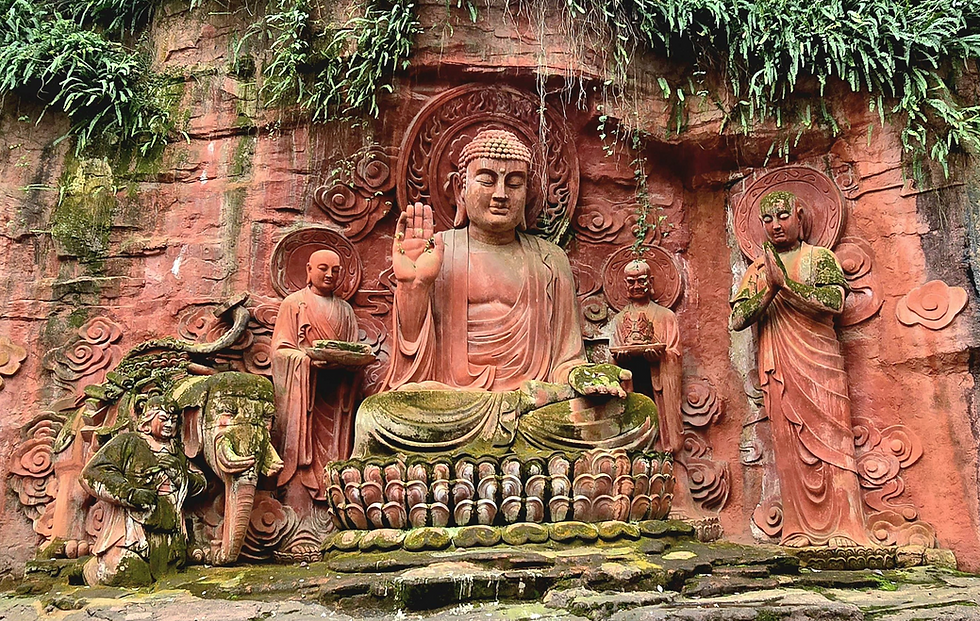
Yeh Pulu Temple
Water of the Stone Jar
Yeh Pulu is a 700 year old rock carved monument concealed within a secluded ravine between the Petanu and Pakerisan Rivers near Bedulu. Created during the 14th century, its monumental relief stretches for almost 25 metres across a natural cliff face, making it one of the most important surviving works of ancient Balinese art. After lying buried beneath volcanic deposits and dense vegetation for centuries, the monument was excavated by Dutch archaeologists in 1925. Conservation work carried out in 1949 diverted rainwater away from the carvings, preserving details that would otherwise have slowly disappeared beneath erosion and encroaching jungle.

The name Yeh Pulu, meaning “water of the stone jar,” is generally understood to reference a nearby spring or ritual water source connected to the site. It may also allude to the way water was once collected, stored or offered in stone containers as part of sacred practice, suggesting the monument was never only visual but also tied to living ritual activity. Often regarded as the defining sculptural achievement of Bali's Middle Period, Yeh Pulu occupies a category entirely its own. Its artistic style bears little resemblance to the formal religious reliefs found elsewhere in either Bali or Java, leading many scholars to conclude it was conceived by a single master sculptor rather than a workshop of craftsmen. The figures possess an unusual vitality and individuality, suggesting an artist who was less concerned with convention than with capturing movement, expression and narrative. Even today its distinctive style remains difficult to place within the broader history of Indonesian art, as if it developed from a visual language that has no surviving parallel.

The carvings reward slow observation rather than distant viewing. What first appears as rough stone gradually resolves into a dense sequence of human movement and symbolic detail, where overlapping figures, natural proportions and finely observed gestures unfold across the cliff face. Read from north to south, the frieze moves as a continuous narrative in which scenes of village life merge with mythology without clear separation. Hunters move through forested terrain, labourers carry provisions and noble figures pass through the same space as supernatural forms, suggesting a worldview in which the everyday and the divine occupied the same landscape.

One figure dominates the composition. Widely identified as Bhima, one of the legendary Pandava heroes from the ancient Hindu epic, the Mahabharata, he strides across the relief carrying hi00s heavy club, the emblem of immense strength and uncompromising will. His presence is unmistakable, yet the narrative around him resists closure. Some scholars interpret the sequence as an episode from the epic cycle, while others suggest it preserves local stories that once carried meaning but were never recorded in written form, leaving the scene open to interpretation rather than certainty.

At the southern end of the monument the imagery gives way to a rock cut chamber believed to have served as the dwelling of a hermit. This austere space would have housed an ascetic who deliberately renounced worldly ties in pursuit of spiritual discipline and enlightenment. From this secluded shelter the resident likely tended the site, received pilgrims and maintained rituals dedicated to gods, ancestors and unseen forces believed to inhabit the surrounding valley. The presence of water implied in the name continues to echo through this setting, hinting that purification rites or offerings connected to a spring may once have formed part of the site’s spiritual function.

Yeh Pulu Temple sits within a broader landscape often described as the land between the rivers, a corridor dense with some of Bali’s most significant archaeological sites. Within a short distance lie the royal funerary complex of Gunung Kawi, the cave sanctuary of Goa Gajah and the monumental Moon of Pejeng bronze drum. The repetition of similar sacred imagery across these sites, including depictions of Ganesha, has led to speculation that they were linked through shared religious networks or overlapping traditions that are no longer fully understood. This concentration of monuments suggests a landscape that was once far more interconnected spiritually than its quiet forested valleys now reveal.

Centuries after its creation, Yeh Pulu continues to resist definitive explanation. Archaeology can establish its age, technique and partial narrative, yet much of its original meaning remains unresolved. Balinese folklore attributes the monument to the giant Kebo Iwa, a figure said to possess immense strength and supernatural abilities, capable of shaping stone with ease and reshaping landscapes in moments. Whether approached as historical record or mythic memory, Yeh Pulu remains suspended between explanation and ambiguity, its carved figures holding a presence that feels deliberate yet never fully decoded.

🗺️ Location
Jalan Yeh Pulu Blahbatuh, Bedulu Village, Blahbatuh District, Gianyar Regency, Bali, Indonesia
🚆 How to get there
This unique archaelogical site is open daily between 7am - 6pm. The entry fee is 30,000 IDR per person There is also a small 3,000 IDR parking fee. The carved wall is an easy, shaded 300 metre walk from the gate and a Pemangku (a Hindu priest) may ask for a small donation in exchange for a blessing with holy water.
⭐ Attraction Info
This unique site is located about half an hour southwest of Ubud, hidden on the edge of a small farming village called Bedulu. You will definitely need a local guide to find this place. A visit here can be bundled into a half day trip to see other temples and waterfalls in the surrounding areas. You can negotiate a Go-Gek rider for about 250,000 IDR for 4 - 5 hours. Thankfully Yeh Pulu remains off the radar of most tourists for now, so you'll probably have the place to yourself.

Thanks for reading about Yeh Pulu Temple. Check out more awesome destinations here!