
Lumbung Temple
Where Ancient Faith Meets the Earth
For more than 1100 years, Lumbung Temple has stood quietly in the lowlands of Central Java, a historically significant Buddhist sanctuary often overshadowed by the soaring Hindu towers of nearby Prambanan Temple. Built in the 9th century during the Medang Kingdom period, it belongs to a wider religious world where Buddhist and Hindu monuments rose across the same volcanic terrain, shaped by shared rivers, shifting power and the slow layering of ritual landscapes rather than isolated construction. The name Lumbung, meaning rice barn in Javanese, is a later local reading of its form, inspired by the clustered arrangement of its smaller shrines that sit low against the earth, more like scattered granaries in the fields than a monument that tries to rise above them.

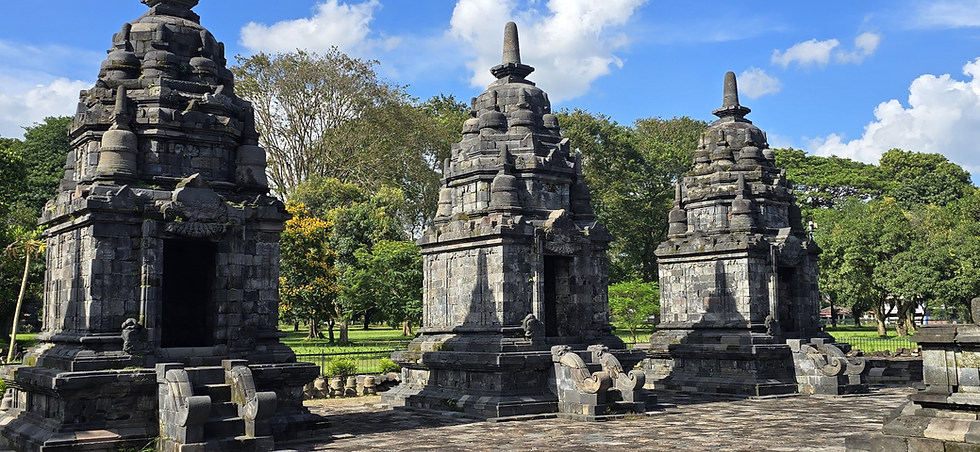
The structure itself is organised around a central sanctuary encircled by sixteen smaller perwara shrines arranged in a precise rectangular formation, a geometry that feels less like decoration than an attempt to impose order onto space itself. In Central Javanese Buddhist construction, such arrangements were not simply architectural choices but expressions of proportion and orientation, where built form echoed ideas of balance and containment rather than spectacle. The temple’s volcanic andesite blocks, drawn from the surrounding land and carried into place centuries ago, have been steadily reshaped by rain, seismic tremors and the persistent ash of Mount Merapi, until the sharpness of carving has softened into something closer to erosion than edge, as if the structure is slowly returning to the landscape that produced it.

What remains of its decoration carries that same sense of partial visibility. Instead of long narrative reliefs, there are fragments of Buddhist iconography scattered across stone surfaces, celestial figures, guardian forms, floral traces and recessed niches that once held seated Buddha statues, now mostly absent. At certain thresholds, figures associated with Kubera and Hariti appear, suggesting protective and beneficent functions woven into the temple’s ritual logic, yet even these are no longer fully legible, their features reduced to softened contours that shift with changing light. The effect is not emptiness but fluctuation, as though the imagery is still present but only briefly willing to reveal itself.

Across the site lie broken statues, collapsed architectural components and incomplete decorative panels that reflect a long history of abandonment followed by selective archaeological intervention. Rather than the result of a single destructive event, the temple’s current condition is the outcome of gradual decay combined with partial reconstruction, where restoration has stabilised what remains but cannot recover what has been lost. These gaps are not incidental to the structure but central to how it is understood today, since interpretation must account for both surviving material and missing architectural sections that once completed the design.

One of the most important historical references connected to this wider region is the Kelurak Inscription, discovered nearby and dated to 782 CE, written in Sanskrit using Pranagari script and describing the dedication of a Buddhist sanctuary to Manjusri, the Bodhisattva of wisdom. Although most closely associated with nearby Sewu Temple, it confirms that this entire volcanic plain once supported a dense and interconnected Buddhist ritual environment during the 8th and 9th centuries. Unlike Prambanan Temple, which became bound to the legend of Rara Jonggrang, Lumbung survives without narrative framing, its meaning carried not through myth but through stone, fragment and the slow accumulation of time.

What distinguishes Lumbung is not scale or ornamentation but a disciplined architectural restraint, where proportion, enclosure and spatial clarity carry meaning more deeply than decoration ever could. The temple does not assert itself so much as hold its position, part of a wider Medang period network in which sacred sites structured both spiritual practice and the organisation of settlement across the region. Even in its reduced and weathered state, there is a sense of continuity here, as though use and reverence once extended further than what remains can now show, leaving only a faint trace of that former density of ritual life.
By night the temple changes again, not through transformation but through withdrawal, as detail recedes and the structure becomes a darker presence against the surrounding fields. Without strong light the geometry softens, edges dissolve and what remains feels less like an object and more like something embedded within the land itself, shaped equally by construction and by centuries of weathering. There is no spectacle in this condition, only persistence, a form that has stayed in place long enough for time to become visible through it and in that quiet persistence, Lumbung feels less described than encountered, as if it has been holding this position far longer than the act of looking can easily account for.

🗺️ Location
Jalan Jogja Solo, Bokoharjo, Prambanan Archaeological Park, Klaten Regency, Central Java, Indonesia
🚆 How to get there
The Prambanan Temple complex lies about 17 km's northeast of Yogyakarta’s city centre, roughly a 25 - 30 minute drive depending on traffic, making it an easy addition to a day exploring the eastern plains of Sleman. Visitors can reach the site by taxi or rideshare, with fares from central Yogyakarta generally ranging between 100,000 - 150,000 IDR one way or by renting a scooter for about 70,000 - 100,000 IDR per day if you’re comfortable navigating local roads. Many travellers prefer hiring a private car with driver for the day at roughly 600,000 IDR, which offers the flexibility to combine the visit with nearby temples such as Ratu Boku or Plaosan Lor and other scenic spots in the region. Once you are at the entry, Lumbung is a 1.3km.
⭐ Attraction Info
The temple grounds are open daily between 6:30am - 5:30pm, with international visitor entrance fees at (a steep!) 400,000 IDR. On Mondays, the main temple courtyards may be restricted for maintenance and preservation, though visitors can still explore the outer grounds and satellite temples, including Lumbung. The wider complex offers a range of facilities, including restrooms, cafés and restaurants, shaded seating, souvenir stalls, a dedicated on site museum and options to hire guides. Shuttles and bicycles are also available for rent, making it easier to explore the huge, 40 hectare temple complex. Visitors should allow at least two to three hours to fully experience the main temples and surrounding perwara shrines. On Tuesday, Thursday and Saturday evenings, the Ramayana Ballet is performed against the illuminated temple backdrop, usually starting around 7:30pm, with tickets ranging from 150,000 to 450,000 IDR depending on seating. The temple is particularly striking in the late afternoon, when the sun casts a warm glow over the spires and reliefs, creating ideal conditions for photography.
Thanks for reading about Lumbung Temple. Check out more awesome destinations here!


